

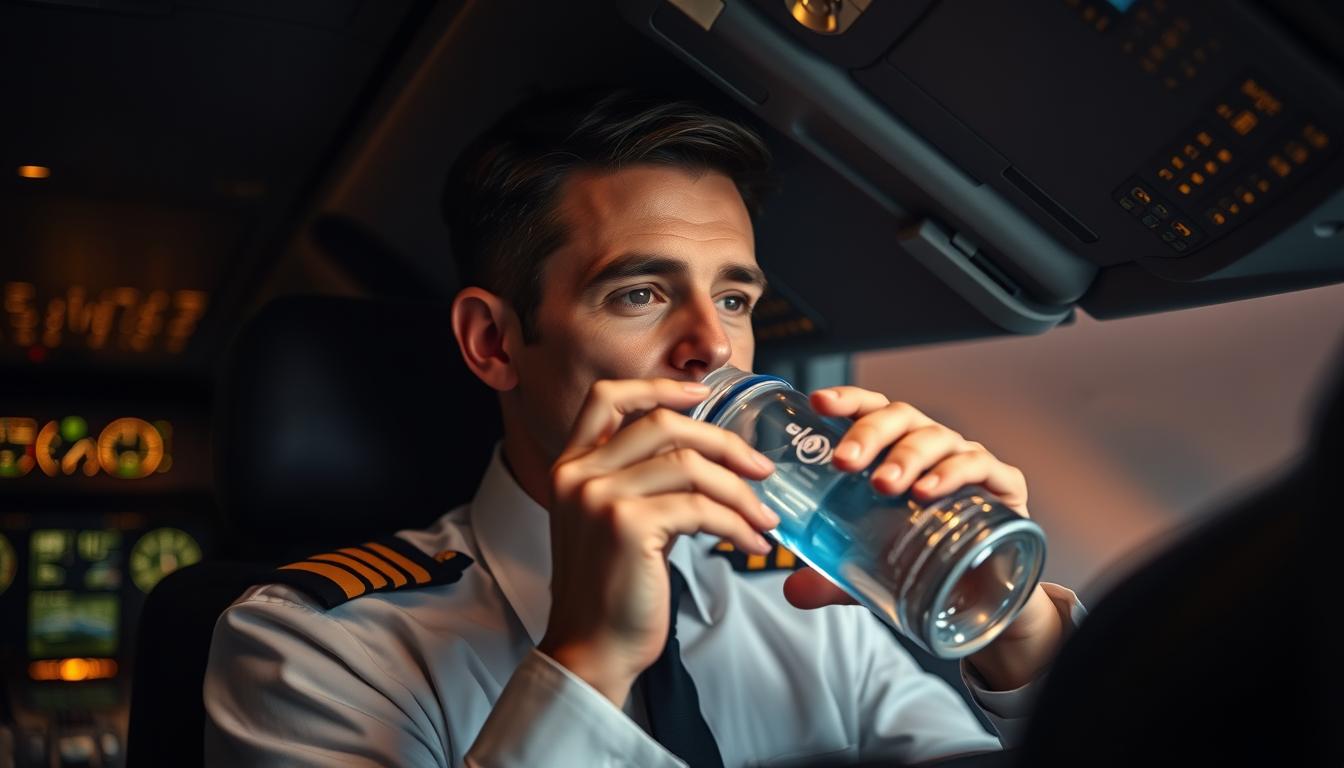
In 1965, a Pan Am captain enjoyed whiskey mid-flight, thanks to autopilot. Now, pilots use electrolyte tablets and breathalyzers. Progress? The FAA’s 0.04% alcohol limit fights against jet lag.
Aviators today face a challenge. Boeing’s Dreamliners have dry cabins, but pilots need to stay sharp. Your body doesn’t care about duty schedules. Crossing six time zones is like navigating blindfolded.
Dehydration isn’t just about drinking water. It’s a battle against artificial light and pressurized cabins. Ever notice how tomato juice tastes better at 35,000 feet? It’s your body asking for electrolytes, not Bloody Mary mix.
Today’s hydration needs more than just drinking water. We’re up against our body’s internal clock. Crack this code, and you’ll beat jet lag’s dehydration tricks.
Why Dehydration Is a Risk in the Cockpit
Ever wondered why cockpit seats don’t have camel humps? Let’s explore desert survival in the sky. Modern aircraft cabins are very dry, with humidity levels at 10-20%. The Boeing 787 Dreamliner has an “advanced” air system that NASA says is as dry as drinking through a coffee stirrer at high altitudes. Your kidneys work hard, like a Tesla Cybertruck’s cooling system in Death Valley, all the time.
Every hour in the air, you lose 8 ounces of water just by breathing. And then there’s the TSA’s liquid terrorism – their 3.4-ounce rule makes staying hydrated a challenge. Pilots face a silent battle against electrolyte balance loss. Treating your body like a Cybertruck with tap water won’t work well.
New pilot wellness technology shows the hidden cost: Dehydrated crews lose cognitive function 30% faster. This matches NASA’s findings on brain fog at high altitudes. Electrolytes are like your immune system’s bouncers, keeping inflammation and jet lag away.
The real kicker? Dry cabin air doesn’t just dehydrate you – it also makes your mucous membranes a virus checkpoint. Frequent flyers’ immunity weakens faster than a stale pretzel at 35,000 feet. Next-gen cockpits might need IV drip ports alongside cup holders.
Signs of Dehydration and Cognitive Fatigue
Ever tried solving a Rubik’s Cube while wearing oven mitts? That’s how dehydration makes your brain feel at 35,000 feet. The FAA’s 20/40 vision standard seems cruel when your eyes feel like sandpaper. Suddenly, the VOR navigation panel looks like your kid’s Xbox controller.
Here’s the sobering math: 2% dehydration – about the point where your throat starts whispering “emergency descent” – impairs cognition like a 0.08% blood alcohol level. NASA proved it with cockpit studies showing a 14% spike in pilot errors. That’s the aviation equivalent of texting “BRB” to ATC while accidentally diverting to Cleveland.
Watch for these red flags mid-flight:
- Mistaking altitude readings for your CrossFit PR numbers
- Radio calls that sound like a sleep-deprived TikTok voiceover
- Decision-making slower than airport Wi-Fi
Your mental health as an aviation professional isn’t just about meditation apps. When neurons start shriveling like raisins, even Maverick from Top Gun would struggle to differentiate between a stall warning and his ringtone. The brain’s prefrontal cortex – your biological autopilot – starts operating on dial-up internet speeds.
Stress management for pilots begins with recognizing these biochemical mutinies. That metallic taste? That’s not in-flight coffee – it’s your amygdala hijacking your instrument scan. Hydration isn’t about avoiding discomfort; it’s about preventing cockpit decisions that belong in a Jackass movie sequel.
Tricks for In-Flight Hydration
Ever mixed a cocktail at cruising altitude? Time to become a hydration mixologist. The beverage cart isn’t just for Bloody Marys – it’s your mobile electrolyte lab. I once watched a captain transform tomato juice into a sodium-packed recovery drink using LMNT electrolyte protocols. Pro tip: Carry single-serve salt packets (TSA-approved) to turn any drink into a hydration booster.

Here’s the golden rule: Hydrate like you’re evading airport security. Aisle seat warriors know the secret – strategic sips beat marathon bathroom sprints. The FAA’s 8-hour alcohol rule? More like a free pass to hydrate smarter. Swap that pre-flight beer for coconut water spiked with magnesium powder.
Let’s shame some Sky Mall gadget fails:
- $120 “smart water bottles” that beep when you’re thirsty (your bladder works fine)
- UV water purifiers for airline coffee (overkill meets overpriced)
- Collapsible foot baths disguised as hydration systems (just…why?)
The real MVP? A $3 silicone flask that slips into your epaulet pocket. Fill it with electrolyte concentrate before boarding – mix with water during beverage service. You’ll stay hydrated without looking like you’re smuggling contraband.
For pilots doing travel-proof workouts between flights: Chug 16oz of mineral water post-exercise, then follow with a potassium-rich snack. My go-to? Banana slices dipped in almond butter, sprinkled with Himalayan salt. Tastes like victory over flight dehydration.
Best Fluids (Water, Electrolytes)
I once saw two pilots turn into human glue sticks after drinking Gatorade. It turns out, sugar-laden drinks are not for pilots. The real hero is electrolyte balance, which keeps pilots sharp and focused.
- IV drips (emergency use only – save the drama for turbulence)
- Bone broth (grandma’s wisdom meets NASA-grade nutrition)
- Electrolyte mixes (more nuanced than your last relationship)
- Champagne (celebratory, not functional – don’t kid yourself)
The NUUN vs LMNT showdown is more than a TikTok feud. Let’s dive in:
| NUUN | LMNT | |
|---|---|---|
| Sodium Content | Light jazz | Heavy metal |
| Sweeteners | Stevia whisper | Zero-calorie roar |
| Portability | Pocket-sized zen | Glove compartment warrior |
Pro tip: Himalayan salt packets are like power ties. Add one to your water and stay focused. Ayurvedic nariyal pani (coconut water + turmeric) boosts immunity without a chemical taste.
Hydration is about quality, not quantity. Your body at 35,000 feet needs careful fueling. Before drinking, ask if it would keep a cactus alive in Dubai. If not, keep looking.
Caffeine: Friend or Foe?
Caffeine is a tricky friend in the skies. It makes you feel good before flying but then crashes hard. The FAA bans alcohol close to flying, but caffeine gets a free pass.
One espresso shot stays in your system for 5-6 hours, close to the FAA’s alcohol rule. Drinking three shots messes with your body’s natural alertness times. Our bodies naturally feel most alert at 9 AM and 5 PM.
| Airline | Caffeine Policy | Pilot Fatigue Index* |
|---|---|---|
| Colombian Airlines | Unlimited café tinto | 72/100 |
| Norwegian Air | Herbal tea only post-UTC+3 | 41/100 |
| US Regional | 2 coffee cups/hour cap | 58/100 |
Smart anti-jet lag routines use caffeine wisely. It’s like nitro boosts, not constant fuel. Here’s a pilot-approved caffeine plan:
- 06:00: 1 black coffee (body clock acceleration)
- 11:30: Matcha latte (sustained alertness)
- 15:00: Cold brew sabotage (career suicide)
Healthy snacking for pilots is more than just nuts and greens. Mix caffeine with slow carbs like oat bars or chia pudding. It helps avoid energy crashes and keeps your memory sharp.
When flying across >3 time zones, adjust your caffeine intake. Drink it in the morning if flying east, and in the afternoon if flying west. Your body will appreciate it.
Dehydration and Jet Lag
Jet lag isn’t just about losing sleep. It’s like a hydration crime syndicate stealing water from you. Every time zone change is like Danny Ocean’s crew in Ocean’s Eleven, taking 8oz of water. Your suprachiasmatic nucleus is like the flight dispatcher in your brain, refusing to adjust schedules without the right paperwork.
Here’s the twist: The FAA bans melatonin, but your circadian rhythm pilot wellness plan needs smarter solutions. The Timeshifter App helps your biological clock, but only with the right hydration. Think of water as your circadian passport – it’s processed faster than any immigration check.
Three anti-jet lag routines that outsmart your inner timekeeper:
- Pre-load hydration 24hrs before crossing zones (your body’s version of pre-departure clearance)
- Electrolyte cocktails at destination breakfast time (even if your stomach thinks it’s midnight)
- Tech detox during critical hydration windows (because blue light dehydrates faster than cabin air)
Modern pilot wellness technology shows the harsh truth: For every hour of circadian mismatch, your kidneys lose enough water to fill a whiskey mini-bottle. That’s why eastbound redeyes make you feel like a raisin – your body’s trying to adjust to the new time.
The solution? Treat water intake like ATC handoffs. Drink consistently, matching your rhythm to the destination’s sunrise patterns. Remember: Hydration doesn’t prevent jet lag – it gives your biological clock the fuel it needs to catch up.
Balancing Fluid Intake without Disturbing Sleep
Want to drink water without waking up? The FAA says every midnight trip to the bathroom costs 22 minutes of REM sleep. This is more valuable than any upgrade. Here’s how pilots manage to stay hydrated without waking up.
Military pilots use a clever trick called the “Hydration Heist.” They drink water during their shifts and then drink 16oz of water with electrolytes when they sleep. The Airbus A350 has special humidity controls that help pilots stay hydrated without waking up.
Let’s look at two extremes:
- Bloated long-haulers: They drink a lot of water and then deal with the challenges of turbulence in the bathroom.
- Keto cargo pilots: They drink a special mix of water, Himalayan salt, and magnesium to stay lean.
The key is to match your urine color to the flight phase:
Takeoff: Pale Morning 11-0601
Cruise: Hazy Skies 14-4120
Descent: Lemon Zest 12-0721
FAA-approved sleep aids work best with strategic dehydration. Try drinking 8oz of coconut water 90 minutes before sleep. The potassium helps you sleep, and the electrolytes prevent dry mouth.
Managing body fat is important for pilots. Extra weight can make you retain water, leading to dehydration. Stay lean. Stay hydrated. Stay airborne.
Actionable Hydration Schedules
Your body is like a twin-engine turboprop flying through time zones. Without the right fuel, you’ll struggle with dehydration. It’s time to understand your Hydration METAR – to avoid dry-mouth turbulence.
The FAA recommends 7-8 hours of sleep for hydration. Short-haul pilots should drink in intervals, like a barista. Long-haul pilots need to drink slowly, like a marathon runner.
| Schedule Type | Hydration Focus | Fluid Types | Timing | Mobility Pairings |
|---|---|---|---|---|
| Short-Haul (2-4hrs) | Electrolyte bursts | Coconut water + green tea | Every 45min | Seat yoga stretches |
| Long-Haul (8+hrs) | Slow absorption | PH-balanced water + chia infusions | Hourly sips | Aisle lunges |
| Layovers | Recovery mode | Bone broth + magnesium spray | Pre/post sleep | Hotel room Pilates |
Our Bottle to Throttle Planner is like an app for your kidneys. It tracks your hydration, from ”green tea IVs” to emergency coconut water.
Match your drinking with layover workout routines that are easy on everyone:
- Terminal toe touches during connections
- Hotel room isometric exercises while rehydrating
- Pre-flight dynamic stretches with electrolyte chasers
Hydration is about sipping, not gulping. It keeps your bladder and brain sharp for early morning landings. Download our planner and make your water bottle a ”liquid copilot”.
Pilot Stories and Solutions
Imagine a cargo pilot rushing to what they thought was a restroom at 3 AM. But it was actually a row of jet fuel drums. This story from an Alaska Airlines veteran shows how dehydration can distort reality at high altitudes.
Regional jet crews often sneak in electrolyte packets like they’re smuggling candy. Emirates A380 pilots use personal humidifiers to fight dry cabin air. It’s like they’re in a sci-fi movie.
Japan Airlines changed their ways after studying crew fatigue. They now use smart bottles for hydration scans before flights. This is like a Fitbit for water intake.
INFINIFLY AVIATION found that pilots make fewer mistakes when they stay hydrated and wear blue-light blocking glasses. This is great for pilots’ eye health when they’re staring at screens for hours.
An Atlanta air traffic controller once said they can tell if a pilot is dehydrated by their radio voice. They even called it “frequency dehydration rage.” Now, there are apps to help pilots stay hydrated during layovers.
These stories show that healthy relationships in aviation start with water. When captains drink water, their crews do too. It turns survival into a shared ritual. Next time you’re on a flight, think: Is that headache from the plane or just thirst?




