


An instrument rating is a special skill you get by passing two tests by the FAA. It lets you fly by using instruments in the cockpit, important when weather surprises you. It’s not its own license but adds on to your pilot’s certificate as part of FAA rules.
Since 1929, starting with Lt. James H. Doolittle’s landmark “blind” flight, flying by instruments has been key. This shows that relying on instruments is smarter than trusting our own unreliable senses. Today’s instrument rating follows this idea, helping pilots fly safely when they can’t see clearly.
To start, you check if you’re ready, have your medical up-to-date, find a trainer, and hit the books. Then, you ace a written test, complete flight training, and pass the final checkride. It’s a step-by-step journey, focusing on precision, not just a gut feeling, as IFR flying demands.
But it’s about more than just feeling secure. This certification improves your decision-making and awareness, lets you use instrument landing systems, and reduces flight delays due to weather. You also get to fly in high-altitude airspace, where following IFR is mandatory, not a choice.
Choosing your training path—Part 61 or Part 141—depends on your preferred schedule and type of school. To keep your skills sharp, practice specific maneuvers and if needed, refresh with an IPC. For a broader view, check out Canada’s flight test guide. It helps to compare different standards, even if you’re not moving to Canada.
Who Should Pursue an Instrument Rating?
The AOPA says there are three main reasons for getting an instrument rating. Some see it as a useful skill, others as a step in their career, and some need it to make flights more reliable. Whatever the reason, the goal is the same: to fly safely when the weather is bad.
Firstly, for those who fly for fun, unexpected weather can change plans fast. An instrument rating allows you to fly through clouds legally and safely. It is better than trying to figure things out yourself up in the air.
Having an instrument rating means being ready. You learn to fly using only instruments from start to finish. This isn’t about guessing. It’s about following strict rules and procedures even when you can’t see much.
Next, the career-focused group needs an instrument rating early on. It’s a must for becoming an airline pilot. Plus, if you want to fly passengers for money, you need this rating to do it at night or over long distances, as stated in 14 CFR § 61.133.
Then, there are those who fly to save time. With an instrument rating, flights that were uncertain can now happen, regardless of bad weather. This isn’t about taking risks; it’s about smart planning and having backups.
| Motivation bucket | What you gain in practice | Where it shows up fast |
|---|---|---|
| “Good to have in your pocket” | More tools for surprise ceilings, reduced visibility, and route changes | Safer decision-making when a VFR day quietly stops being VFR |
| “Career step” | Meets common hiring baselines; supports ATP pathways | Commercial ops limits under 14 CFR § 61.133 for longer cross-country and night passenger-for-hire flying |
| “Increase productivity” | More reliable arrivals using clearances, approaches, and alternates | Business and personal trips where timing matters more than bragging rights |
Learning about instruments also shows you how the National Airspace System operates. You get to understand radar, airspace clearances, and air traffic control. This experience changes how you see flying. Being an instrument-rated pilot is more than a title—it’s a way of thinking about flying.
FAA Eligibility Checklist
I like checklists. They’re useful because the weather and rules don’t care about how hopeful you are. When going for an instrument rating, the FAA checks basic things first. You need the correct pilot certificate, aircraft category, and proper paperwork. Think of it as a strict music tune — easy to understand, but no room for error.
- Hold at least a current private pilot certificate, or apply for it at the same time
- Have the aircraft category/class rating that matches what you want (Airplane, Helicopter, or Powered-Lift)
- Be at least 17 years old when you receive the instrument rating
- Read, speak, write, and understand English
The “category” part often surprises people. You can only get an instrument rating for Airplane, Helicopter, or Powered-Lift. Your goals must fit one of these categories. If not, the FAA won’t approve, no matter your passion.
- Complete ground instruction that covers IFR rules, procedures, and chart work
- Complete flight training to sharpen your instrument skills and decision-making
- Get the needed logbook or training record endorsements from an authorized instructor
- Pass the knowledge test first, then the practical test
| Checklist Item | What the FAA is really verifying | Common snag | Quick self-check |
|---|---|---|---|
| Certificate level | You’re eligible to add the privilege, not skip the ladder | Assuming student pilot status is enough | Do I hold a private pilot certificate or am I applying concurrently? |
| Category eligibility | The instrument rating is tied to Airplane, Helicopter, or Powered-Lift | Training in one category, applying in another | Does my current rating match the category I want on my instrument rating? |
| Age and English | Minimum maturity and communication for IFR operations | Forgetting the 17-at-issuance rule | Will I be 17 when the rating is issued, and can I meet English proficiency? |
| Training + endorsements | Documented instruction and readiness | Missing a required endorsement before a test | Are my logbook entries specific, signed, and current? |
| Knowledge + practical tests | You can apply rules and fly the procedures, not just recite them | Great written score, messy IFR cockpit flow | Can I brief, fly, and debrief an approach without stumbling? |
| BasicMed nuance | Medical compliance that still supports IFR when requirements are met | Believing BasicMed bans IFR by default | Am I within BasicMed limits (U.S. ops, <12,500 lbs, no more than 7 occupants) and current on requirements? |
Here’s a final tip about BasicMed. It’s not the obstacle some think it is. Following FAA’s advice, like AC 68-1A, it doesn’t stop you from flying IFR. It also doesn’t block teaching or skill checks as long as you meet the BasicMed requirements and stick to its limits. So, getting your FAA instrument certification is doable. It just requires understanding the details before bad weather comes.
Minimum Flight Hours
I like minimums the way Congress likes budgets: they look neat at first glance. But, the details are where things get tricky. For getting an instrument rating in airplanes, the requirements are clear but need careful attention.
First, let’s talk about cross-country flight time. You need 50 hours of it as the Pilot in Command. This includes 10 hours in airplanes for the specific rating. It proves you can navigate, not just enjoy the view.
Next, we dive into the core: 40 hours of real or simulated instrument time. This covers specific operations listed in 61.65(c). Of these, 15 hours must be with an instructor, showing structured learning, not just logged hours.
Recency of experience is also vital. You must have 3 hours of training in the two months before your test. It’s the FAA’s way of ensuring you’re ready, not rusty.

Under Part 141, the required hours can be less. You only need 35 hours for an initial rating or 15 hours for an additional one. It’s more structured, perfect for those who prefer clear guidelines.
There’s also an option to combine private and instrument training. Some programs require 65 hours of ground training and 70 flight hours. Another path reduces the cross-country time to 45 hours while with an instructor. This way, you still learn essential skills, just with different hour counts.
| Training Path | Minimum Flight Hours | Cross-Country PIC Minimum | Instrument Time Minimum | Instructor-Led Instrument Flight Training | Checkride Prep Requirement |
|---|---|---|---|---|---|
| Part 61 (Instrument-Airplane) | Not a single “total” number; driven by experience buckets | 50 hours (includes 10 hours in airplanes) | 40 hours actual or simulated (per 61.65(c) areas) | 15 hours with an authorized instructor | 3 hours within 2 calendar months |
| Part 141 (Initial Instrument Rating) | 35 hours minimum | Program-specific; still must meet course completion standards | Included within the course minimums | Built into an approved syllabus and stage checks | Aligned to course completion and practical test readiness |
| Part 141 (Additional Instrument Rating) | 15 hours minimum | Program-specific; depends on prior ratings and course scope | Included within the course minimums | Structured instrument flight training focused on add-on tasks | Practical test prep tied to the course end stage |
| Combined Private + Instrument Program | 70 flight hours minimum | May be reduced to 45 hours while performing PIC duties with instructor onboard | Integrated across the combined sequence | Integrated, with instrument rating milestones inside one track | Instrument training timed to the practical test window |
Finally, remember that a minimum does not guarantee success. Your progress in getting an instrument rating depends on many factors. These include weather, how the aircraft is scheduled, and how quickly you can master skills. The goal is to make critical skills second nature.
Required Training and Endorsements
Instrument flight training is split into ground and flight work. This is key for an IFR rating. It teaches you to think and fly according to system standards. Both require documented practice in your logbook.
Ground training develops your foundational knowledge. You’ll learn about weather, IFR procedures, and rules that prevent chaos in the sky. The focus is also on instrument navigation and clear communication, which are essential for safety.
If you’re studying under Part 61, you can choose between instructor-led or home-based learning. For those preferring structured learning without travel, Pilot Institute offers an online course, “Instrument Rating Made Easy”.
Part 141 ground training has a formal structure. It includes an approved syllabus and feels more intense, like a college class but with more practical elements and fewer team projects.
| Training path | Ground training requirement | How it usually feels in real life |
|---|---|---|
| Part 61 | Instructor-led or home-study allowed, tailored to your pace | Flexible, suits busy schedules if you’re disciplined |
| Part 141 (initial instrument rating) | Approved course with a minimum of 30 hours of ground training | Structured, helps avoid procrastination |
| Part 141 (additional rating) | Approved course with a minimum of 20 hours of ground training | Efficient for those adding on ratings |
Endorsements are crucial paperwork in flight training. You’ll need one for the knowledge test and another for the practical test. Think of them as a trainer’s ok that you’re safe to fly.
In flight training, you apply what you’ve learned to real situations. You’ll master different flying techniques until you’re relaxed and in control. The aim is to form consistent, reliable flying habits for challenging conditions.
AOPA emphasizes the importance of your training goals. Whether you prefer structured programs, local instructors, or fast-tracked courses depends on your needs. Fast-track training can be completed in 10 to 12 days, with options for on-site or in-your-plane instruction.
After mastering basics, practice with a safety pilot and a view-limiting device refines your skills. The safety pilot can log flight time, making it beneficial for both. This focused practice improves your abilities and speeds up IFR certification.
Medical Certificate Needs
Want to fly with FAA instrument certification? The sky’s the limit, but not the paperwork. Before starting serious lessons, I check my medical status. It’s quick, boring, but crucial. You don’t want to find a missing document when it’s time for your checkride.
To start, you need a third-class FAA medical certificate or you can choose BasicMed. BasicMed fits for FAA instrument certification, but it has strict rules. It’s like a club bouncer: polite but strict, and your logbook won’t impress it.
BasicMed lets you fly IFR if you meet its rules. This includes flying only in the U.S., in planes under 12,500 lbs, with no more than 7 people. For most instrument pilots, this is enough. But not if you want to fly big jets for fun.
The FAA’s Advisory Circular AC 68-1A shares something important: BasicMed doesn’t stop you from flying IFR. It also doesn’t limit teaching or checkups. It’s a rare government statement that’s kind of reassuring. If you check off BasicMed, FAA instrument certification is still possible.
| Medical path | What it supports for an instrument pilot | Key boundaries to watch | Best time to verify |
|---|---|---|---|
| Third-class FAA medical certificate | IFR training, checkride prep, and ongoing IFR flying with fewer operational limits | Must stay current; any deferral or expiration can pause training momentum | Before scheduling intensive training blocks or a practical test date |
| BasicMed | IFR operations allowed; flight instruction and proficiency checks not restricted per AC 68-1A | U.S. only; aircraft under 12,500 lbs; no more than 7 occupants; must meet BasicMed compliance steps | Before committing deposits, instructor availability, and checkride timelines |
Here’s a simple rule: make sure your medical or BasicMed is up-to-date before training gets serious. One expired document can delay you more than bad weather. For FAA instrument certification, a clean medical record keeps your training on track.
Passing the Written and Practical Tests
The written and the checkride turn your instrument rating from a dream to a real date. Think of it as facing a strict examiner who only cares about results, not excuses. Is it fair? Maybe. Does it work? Definitely.
To take the FAA knowledge test for an IFR rating, you need to be at least 15. It’s one of those “you can get it but can’t use it yet” situations. Aviation sure loves its surprises.
You need something that shows you’re prepared. This could be a logbook sign-off, a statement, or a course completion certificate.
The test itself is straightforward but strict: 60 multiple-choice questions, each with three answers. You have 2.5 hours. Get 70% to pass. Your score is good for 24 months.
If you don’t pass, take another shot after you study what you missed and get a new endorsement. Keep your original score report safe. Losing it is a hassle and costly. It’s important, like concert tickets.
Many pilots study with Sheppard Air before the exam. It helps master the questions you’ll see. It might not be fun, but it’s better than missing questions you could have answered right.
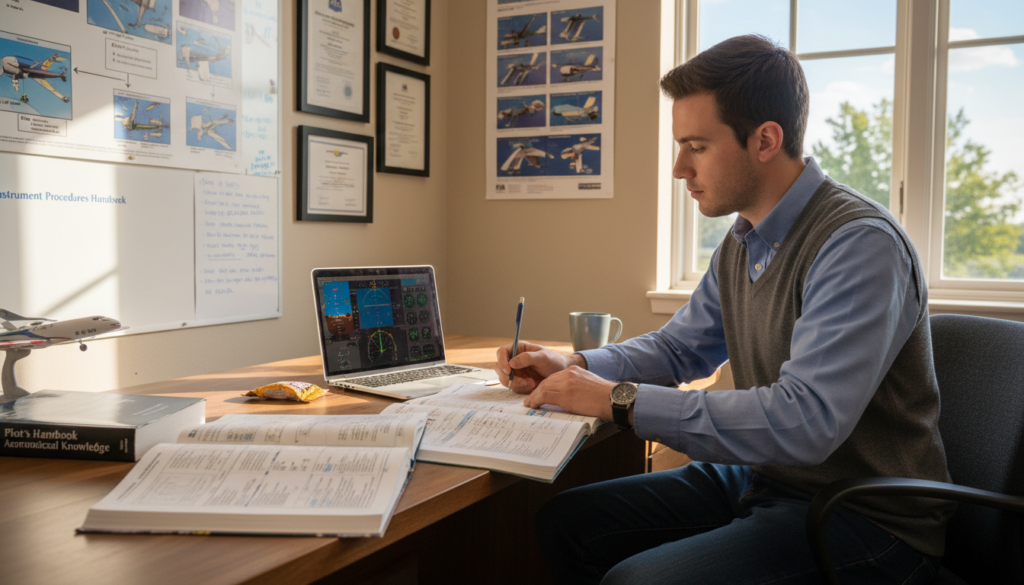
The practical test makes things serious fast. An FAA inspector or Designated Pilot Examiner will test you. It includes an oral exam and flying.
The oral part can last over 2 hours, and flying about 2 to 3 hours. You’re judged by FAA’s standards, so don’t guess. Know what’s important.
You need to show you can make good decisions and read instruments well. You’ll do tasks like flying in tough conditions, following specific flight paths, and using standby instruments.
Pass, and you get a temporary license right away. Your official instrument rating comes later, after the FAA does its thing. That process is slow but sure.
| Test | What You Need to Start | What It Looks Like | What Counts as Passing | Timing and Paperwork Reality |
|---|---|---|---|---|
| FAA Instrument Rating Knowledge Test | Authorization (logbook endorsement, written statement, or ground/home-study graduation certificate); minimum age 15 | 60 multiple-choice questions; 3 choices per question; 2.5 hours | 70% or higher | Results valid 24 months; retest after review and instructor re-endorsement; keep the original score report because replacement can be costly |
| Practical Test (Checkride) for an IFR rating | Eligibility met plus instructor endorsements; readiness aligned to the FAA ACS | Oral exam (commonly 2+ hours) and flight test (about 2–3 hours) with FAA inspector or DPE | Meets ACS standards across knowledge, risk management, and skills | Temporary certificate issued after passing; permanent certificate arrives after FAA processing |
Frequently Overlooked Details
Getting an instrument rating is tricky. It’s like signing up for a streaming service. You think you’ve read the fine print until a surprise charge appears. With instrument flight training, you’re not hit with a fee. The surprises come as weather challenges, a high workload, and realizing being current is crucial.
Becoming a pilot takes more than just earning a rating. You must stay current. In the last 6 months, you need six instrument approaches. This includes holding procedures and using electronic systems to track courses. You can practice in real conditions or a simulator, in a plane or a training device. This isn’t just for passing the FAA test. It’s what separates the ready from the unprepared.
If you let your skills lapse, getting back on track is straightforward. You need an instrument proficiency check (IPC). This can be done with a flight instructor, an FAA examiner, or an airline check pilot. Think of it as a tune-up for your flying skills, not a penalty.
| Detail people forget | What the rule expects | Practical effect on planning |
|---|---|---|
| IFR recency in the last 6 months | 6 instrument approaches, holding, and intercepting/tracking with electronic navigation | Without it, your flight plan is a non-starter, no matter how ready your plane is |
| Where you can do the work | Actual or simulated; aircraft or approved training device | Smart planning means using bad weather for more flight training time |
| What fixes an expired currency clock | IPC with an instructor, FAA examiner, or airline check pilot | It turns “I’ll do it later” into a scheduled skill check |
There are times when having that rating is vital. To fly in Class A airspace, you need it. The same goes for Special VFR flights at night. If you’re flying commercially, carrying passengers over 50 nautical miles or at night, having an instrument rating is mandatory.
Another complex point lies in 14 CFR 61.3(e). You can’t be the PIC on IFR flights without an instrument rating. However, during training, you might still log PIC time if you’re the one flying the plane. It sounds confusing. And no, the FAA doesn’t accept excuses.
One last important detail: IMC conditions are real risks. They’re not just for dramatic effect. Nearly half the weather-related flight accidents happen when pilots try flying VFR into IMC conditions. The key message? FAA instrument certification is about safe, clear plans for when weather turns bad.
Aeronautical Experience Breakdown
The FAA writes about aeronautical experience in a detailed way. It feels like both a class plan and a test of who you are. To get an IFR rating, you must meet specific goals, log them well, and fly skillfully. The top instrument pilot isn’t just about reaching minimum goals. It’s about seeing each requirement as a chance to improve a skill.
For the instrument-airplane part under Part 61, the main points start simple but get complex. You must have 50 hours of cross-country PIC flight time, with 10 of those hours in airplanes. You also need 40 hours of actual or simulated instrument time, with 15 hours spent with a certified instructor. Yes, getting the IFR rating involves a lot of math. However, the real challenge is keeping everything well-organized without getting overwhelmed.
The cross-country IFR flight under Part 61 is unforgettable due to its precise requirements. It must be with a teacher, cover at least 250 nautical miles following specific routes or as directed by ATC. You also need to perform an instrument approach at each stop, plus three different types of approaches with navigation systems. This might be using ILS, VOR, or GPS systems. For those training to be instrument pilots, this is your moment to shine in handling tasks calmly.
There’s a timing rule that often surprises people. You must have 3 hours of instrument training within the two months before your test. The FAA’s message here is clear: come prepared and up-to-date, not just relying on past achievements.
| Requirement | Part 61 (Instrument-Airplane) | Part 141 (Instrument-Airplane) | Why it matters in real life |
|---|---|---|---|
| Cross-country PIC time | 50 hours cross-country PIC; at least 10 hours in airplanes | Program-based minimums per approved syllabus; schools track it tightly | Builds real-world route planning and decision-making that an instrument pilot can’t fake |
| Total instrument time | 40 hours actual/simulated instrument; 15 hours with an authorized instructor | Structured course requirements under the school’s FAA-approved program | Moves you from “I can follow needles” to “I can manage the whole cockpit” for an IFR rating |
| Long IFR cross-country requirement | One IFR cross-country with instructor: 250 nm along airways/ATC routing; approach at each airport; three different approach types (e.g., ILS, VOR, GPS) | IFR cross-country: straight-line distance at least 100 nm between airports | Part 61 emphasizes a longer, ATC-style routing; Part 141 leans into standardized training flow |
| Checkride proximity | 3 hours instrument training within two calendar months of the practical test | Also managed through the course timeline and stage checks | Keeps skills sharp so the IFR rating is about competence, not cramming |
Simulators and other training tools can be useful, but their credits have limits. According to 14 CFR § 61.65, you’re allowed to log instrument time in FAA-approved devices. This includes up to 10 hours in a BATD, 20 hours in an AATD, FTD, or FFS. And if your training is at a Part 142 center, you can log up to 30 hours in an FFS or FTD. When used right, these devices make you a sharper pilot. If not, they just add to your logbook.
Part 141 sets different limits, focusing on percentages. No more than 50% of your time can be in a full flight simulator. Up to 40% can be in an FTD/AATD or a mix of both. You can also use up to 50% with a mix of full flight simulators, FTD, and AATD, and up to 25% in a BATD. Getting your IFR rating might be planned out in a classroom, but bad weather doesn’t stick to a schedule.
- Minimums are compliance; proficiency is the point.
- Log approaches and holds like you’ll have to defend them later—because you might.
- If the device time is doing the heavy lifting, make sure the airplane time still builds scan, radio work, and cockpit discipline.
Common Questions
The first question about instrument rating isn’t about the technical stuff. It’s about finding time in your busy schedule. Most pilots take about 10 weeks to land their rating. Part 141 schools can do it quicker because they’re very structured. If you fly a lot under Part 61, you might finish in two months. But if life keeps getting in the way, it could take four months.
Then, there’s the question of cost. Getting your FAA instrument rating usually costs between $6,000 and $10,000. This includes about $5,000 for 40 hours in the air, around $600 for an instructor, and $300 to $2,000 for ground school. Don’t forget the $150 test and $500 checkride fee. And you’ll need about $250 to rent a plane for the checkride. If you add extras like a logbook and headset, expect to spend $10,000 to $15,000. Exam fees for Part 61 are around $500 to $1,200, but Part 141 might cover them.
Using a simulator can cut costs. It’s cheaper, at about $40 per hour, and helps with the hard stuff like hold patterns and missed approaches. Plus, it saves money on fuel and prevents wear on the plane. It’s a smart way to practice without the extra costs.
Choosing a school is tough. You start by comparing options and end up worried. Check if they have enough planes and teachers, so delays don’t ruin your plans. I always visit the schools, look into their safety records, and chat with teachers and students. Taking a test flight is a good idea to feel the vibe. Don’t let pride dictate your choice; a nearby school is better than one that’s a long drive away. Tools like Pilot Pipeline Flight School Finder make it easier to pick a school. And if you’re looking for scholarships, Pilot Pipeline Scholarship Finder and AOPA have resources worth exploring. They even mention accelerated courses that can take as little as 10 to 12 days.




