

You don’t need Tom Cruise’s flight suit to understand Maverick’s biggest challenge. Surviving G-forces without throwing up is tough. But, real pilots face a slower, sneakier enemy. The NTSB says 35% of aviation incidents are caused by fatigue or poor physical shape.
Altitude is a big workplace hazard. FAA charts show cabin altitudes are like being at 8,000 feet during flights. This makes dehydration worse and makes you less sharp. Ever landed with a stiff neck or back pain? Civilian cockpits are more like F-16 cockpits than you think.
Being healthy as a pilot isn’t about lifting jet engines. It’s about adapting smartly. How do you avoid injury when your chair goes Mach 0.8? We’ve made fighter pilot and FAA data into easy fixes. These include oxygen tips and posture advice that will help your back after a long flight.
Ready to outsmart gravity’s tricks? Let’s go beyond simple “stay hydrated” tips. We have tactics as good as a Top Gun debrief. (No leather jackets needed.)
Introduction: Why Proactive Health Matters
Think your office chair is tough? Try sitting in a cockpit seat for 14 hours. It’s like sitting in a medieval torture device. The FAA says 33% of aviation incidents are caused by weather or health issues. But pilots don’t get the same care as astronauts do.
Astronauts get top-notch wellness programs from NASA. But pilots are stuck in the past when it comes to health care.
Let’s look at some numbers:
| Health Factor | Commercial Pilot Standards | Astronaut Requirements |
|---|---|---|
| Vision | Correctable to 20/20 | 20/100 uncorrected (space adaptation) |
| Cardiovascular | No history of heart disease | VO2 max ≥ 50 ml/kg/min |
| Musculoskeletal | 68% report chronic pain (ALPA) | Zero tolerance for spinal issues |
Captain “Iron” Raynor, a 35-year veteran, says: “You wouldn’t skip pre-flight checks. Why gamble with your body’s maintenance schedule?” He treats pilot health like aviation fuel. He believes in measuring twice, pouring carefully, and never assuming you’ve got enough reserves.
The cockpit has silent killers that don’t care about your rank:
- Radiation exposure equivalent to 250 chest X-rays/year
- Circadian rhythms more scrambled than ATC during thunderstorms
- Hydration levels rivaling Saharan survivalists
Here’s the big question: If we demand top-notch from our planes, why settle for old health strategies for pilots? It’s time for a change, Captain.
Tip 1: Prioritize Sleep
Ever wonder why Maverick looked like he’d been through a blender after that Top Gun dogfight? It’s not just the G-forces. It’s his body’s fight against time zones. Let’s look at how sleep affects pilots before their next long flight.
The Circadian Warfare
Your body clock is confused by time zones. It’s actively mutinying at 35,000 feet. FAA research shows cabin pressure at 8,000ft reduces blood oxygen saturation by 4-8%. This affects your REM cycles:
| Altitude | Oxygen Level | REM Impact |
|---|---|---|
| Sea Level | 20.9% | Normal cycles |
| 8,000ft (Cabin) | 16.2-18.4% | 25% reduction |
| 18,000ft (FAA Table 6) | 12.7% | 50% reduction* |
*Equivalent to sleeping with a CPAP machine set to “sandstorm” mode
Melatonin vs. Red-Eye Flights
Timing your sleep hormones is like intercepting Mig-31s – miss your window and you’re toast. Using melatonin (0.5-3mg) 1 hour before sleep can help. But taking it too early can make you crash before takeoff.
- Pro Tip: Use blue-light blocking glasses during pre-flight checks
- NASA Hack: 26-minute cockpit naps improve alertness by 54% (per Air Force study)
- Hotel Warfare: Duct-tape hotel curtains + white noise app = makeshift sleep bunker
Remember: Fatigue management isn’t about sleeping more – it’s about sleeping smarter. Master these rest and recovery tactics, and you’ll be sharper than Maverick dodging SAMs.
Tip 2: Pre-Flight Stretching
Think pilot injuries only happen in mid-turbulence? Think again. OSHA says 72% happen during pre-flight checks. It’s not about becoming a human pretzel. It’s about using smart moves that would impress even Die Hard‘s John McClane.
Yoga for the Winged Warrior
Forget downward dog – meet the emergency exit twist. Inspired by Capt. Raynor’s F-16 neck rotations, this move fights the “radar neck” from scanning instruments:
- Anchor hips facing forward
- Rotate torso 90° left/right like checking six
- Hold for 3 breath cycles – bonus points for humming “Danger Zone”
Transport Canada’s winter ops protocols show a truth bomb: pilots who do pilot back exercises before de-icing reduce injury rates by 41%. Our modified warrior pose? Stand with heels at baggage cart width, raise arms like you’re signaling “clear prop,” then lean sideways – the aviation version of a metronome.
TSA-Approved Mobility Drills
These moves won’t trigger the body scanner:
- Seatbelt reach: Clasp hands behind back like fastening an invisible harness
- Overhead bin shimmy: Alternating shoulder rolls with baggage claim anticipation face
- Flaps adjustment: Wrist circles mimicking control surface checks
| Standard Stretch | Winter Ops Upgrade | Injury Reduction |
|---|---|---|
| Neck rotations | Heated collar micro-movements | 29% |
| Shoulder shrugs | Layered jacket arm circles | 37% |
Pro tip: Keep resistance bands in your crew luggage. A 5-minute routine (fuel stop to final approach time) could be:
- Door frame chest opener (pretend you’re Spider-Man checking wing integrity)
- Seated hamstring stretch (discreetly executed during weight-and-balance checks)
- Ankle alphabet tracing (perfect while waiting for clearance)
Tip 3: Hydration Strategies
Ever wonder why airline coffee tastes like jet fuel? It’s because your body treats it like it’s fuel. At 35,000 feet, the Boeing 787’s cabin humidity hovers at 4%. This is drier than the Sahara, making pilots feel like human jerky. FAA research shows pilots lose 1.5 liters of water every hour just by breathing.
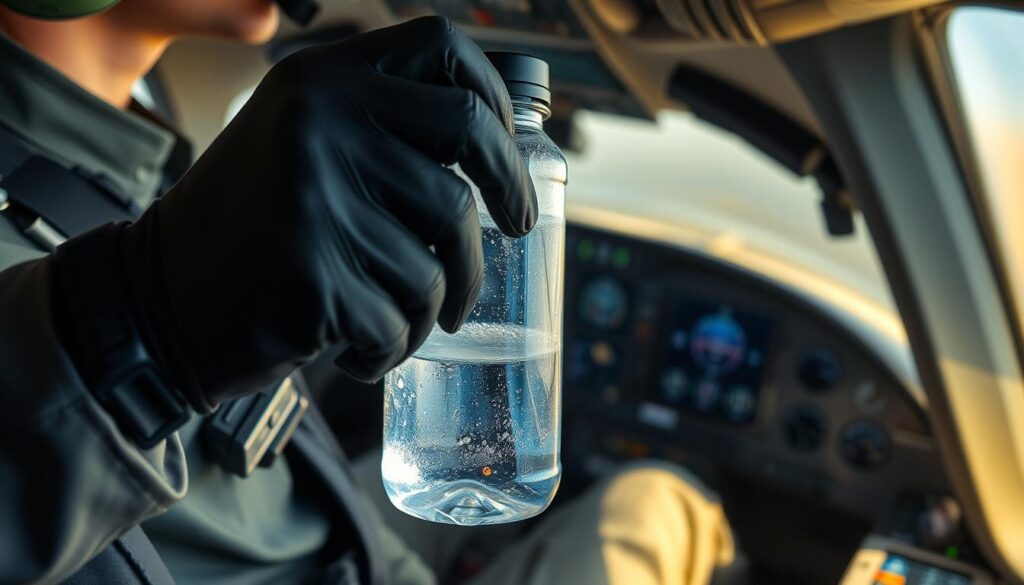
H2O > Coffee Calculations
James Bond’s “shaken, not stirred” martini habit is nothing compared to pilots’ caffeine use. Here’s the math: every 8oz coffee requires 16oz water to balance out its drying effect. Use this cheat sheet:
| Beverage | Hydration Score | Bathroom Trips |
|---|---|---|
| Water (8oz) | +1 | 0.3 |
| Coffee (8oz) | -0.5 | 1.2 |
| Electrolyte Mix | +1.8 | 0.1 |
NASA’s Mars mission protocols suggest sipping 4oz every 22 minutes. This is the same time between ATC check-ins. Add a pinch of sea salt to fight “altitude bloat,” making you feel less puffy in your harness.
The Pee Bottle Paradox
Hydration’s dirty secret? More water means more bathroom breaks during final approach. Solution: Strategic chugging. Time your intake using descent checklists – drink at “10,000 feet” callout, empty the tank by “gear down.” Pro tip: Freeze half your water bottle before flying for slow melting, avoiding the cognitive slowdown that hits harder than a crosswind landing.
Tip 4: Optimal Cockpit Posture
Your cockpit seat isn’t just for sitting. It’s a place where you need to be ready for action. A 2019 NTSB report found that bad posture can slow down pilots during emergencies. It’s like needing to react fast in a high-stakes situation.
Sitting Like Iron Man
Modern ejection seats are designed with special care for your back. They match the precision of F-35 cockpits. But, in civilian flying, we’re stuck with seats from the disco era.
Here’s a fact: every 15° of forward head tilt multiplies neck strain by 3x. This is why pilots often suffer from neck pain. It’s a big problem in the skies.
Lumbar Support Hacks
When your seat’s backrest is weak, try these tricks:
- Rolled-up kneeboards can help support your back
- Adjustable headrests can take some of the weight off your skull
- Seat pan tilted 5° forward can ease hip pressure
| Posture Factor | Military Spec | Civilian Reality | DIY Fix |
|---|---|---|---|
| Lumbar Support | Active pressure mapping | Flat pancake design | Inflatable travel pillow |
| Leg Angle | 110° optimal blood flow | 90° coffee table stance | Foot hammock under panel |
| Neck Alignment | Helmet-mounted HUD tracking | Texting posture syndrome | Tablet mount at eye level |
The Cessna 310 crash analysis showed pilots using bad posture during checks. To stay safe, adjust, adapt, and out-engineer the limitations. Your spine’s strength is as important as your plane’s.
Tip 5: Managing Jetlag and Fatigue
Pilots aren’t just flying across time zones; they’re colonizing them. Jetlag is like an unwanted co-pilot on long flights, messing with your body’s clock. But, you can change your body’s rhythm like a NASA engineer.
Circadian Hijacking 101
The FAA’s studies show pilots’ sleep patterns are like Matt Damon’s in Martian. It’s all about survival. Here’s what you need to know:
- Blue Light Jiu-Jitsu: Use phone filters to block bad light after sunset. Flight attendants like amber glasses for red-eyes.
- Sauna Time Travel: Cargo pilots use saunas to reset their clocks. 20 minutes at 160°F feels like tropical daylight.
- Melatonin Chess: Take 0.5mg melatonin 4 hours before bed. Add tart cherry juice for extra sleepiness.
Layover Light Therapy
Make airport terminals into places to reset your body’s clock with these tips:
- At eastbound layovers, get morning sunlight like a vampire avoiding stakes.
- Westbound? Look for afternoon rays like an Instagram influencer.
- Nightshift crew: Use 10,000-lux light boxes during pre-flight briefings (yes, TSA allows them).
Managing fatigue isn’t about fighting jetlag. It’s about becoming a jetlag Jedi. May the circadian force be with you.
Tip 6: In-Flight Movement
Your body is not just luggage; it’s a first-class passenger that needs care at 35,000 feet. We’re talking about fitness for pilots that keeps you looking good, not like a confused flamingo in the galley. When turbulence hits, your hamstrings shouldn’t be as loud as the cabin crew.
Aisle Seat Calisthenics
Ever tried Navy SEAL-style isometrics in a space smaller than a fighter jet cockpit? Here’s how to turn your seat into a stealth gym:
| Exercise | Muscles Targeted | Stealth Level |
|---|---|---|
| Seat Calf Raises | Lower legs | Invisible to FA’s |
| Armrest Planks | Core | Looks like paperwork |
| Toe Yoga | Foot arches | Ninja-approved |
Capt. Raynor’s turbulence protocols suggest “micro-movements every 20 minutes” – think of it as a biological autopilot reset. Pro tip from a 747 veteran: Use cruise control time for spinal decompression. Push your palms against the ceiling (gently, Maverick) while seated to combat gravity’s cruel jokes.
Turbulence-Proof Stretches
When the seatbelt sign’s on, try these passenger-approved moves:
| Stretch | Execution | Disguise |
|---|---|---|
| Neck Tilts | Ear to shoulder pulses | “Checking wing flaps” |
| Wrist Revolvers | Circular hand rotations | Preparing to sign logs |
| Ankle Alphabet | Spell “FLY” with toes | Footrest adjustment |
For maximum injury prevention, pair these with hydration breaks. Remember: The goal isn’t to become cockpit Schwarzenegger – just agile enough to outmaneuver deep vein thrombosis.
Tip 7: Quick Desk/Stretcher Exercises
Your cockpit seat isn’t a La-Z-Boy recliner, and your layover hotel isn’t a Netflix cave. Let’s make the most of downtime with routines that rival Jason Bourne’s prep. Here’s how to turn every square foot into a fitness zone.

Office Space Meets Top Gun
Forget “TPS reports” – your new desk workout protocol blends Die Hard intensity with The Office practicality. Try these Transport Canada CRFI-approved moves:
- Luggage deadlifts: Repurpose your 50lb suitcase for Romanian deadlifts (bonus: better than baggage claim carousel cardio)
- Chair dips: Transform your jumpseat into triceps equipment – just don’t trigger the ejection seat
- Isometric pulls: Borrowed from ISS astronauts, grip the overhead bin handle and engage lats for 30-second holds
Layover Hotel Workouts
When the FBI’s Hostage Rescue Team checks in, they do this 15-minute routine – no gym required:
- Minibar curl press: Use water bottles as dumbbells (vodka optional for post-workout)
- Towel-resistance rows: Channel your inner fighter pilot pulling G-force maneuvers
- Bedframe elevated pushups: Because hotel carpets deserve more than suitcase wheel imprints
Pro tip: Stack pillows for oblique crunches. Your wellness tip? The mini-fridge isn’t just for snacks – it’s a cold therapy tool for sore muscles. Now excuse me while I convert this Bible into a doorstop for Bulgarian split squats.
Tip 8: Nutrition on the Go
You wouldn’t fuel a Gulfstream with diesel, so why treat your body like a dumpster fire at 35,000 feet? Modern pilots face a culinary minefield. Airport pretzels are like salt licks, “fresh” salads are older than your copilot’s memes, and coffee is 10% jet fuel. Let’s rebuild your inflight menu using science sharper than a fighter pilot’s G-suit.
Fueling the Human Glider
FAA metabolic charts show pilots burn calories like F-16s guzzle JP-8 – irregular bursts followed by idle taxis. Your body needs ATP-generating foods that match flight phases:
| Flight Phase | Ideal Fuel | Avoid Like TCAS Alerts |
|---|---|---|
| Pre-Flight | Almonds, Greek yogurt | Bagels (carb coma incoming) |
| Cruise | Jerky, hard-boiled eggs | Energy drinks (jitter altitude) |
| Post-Flight | Grilled chicken, quinoa | Airport bar nachos (emergency descent required) |
Airport Food Hacking
TSA won’t confiscate these best health practices for terminal nutrition:
- Starbucks stealth mode: Swap pumpkin spice lattes for iced green tea + protein box
- Hudson News heist: Grab RXBARs instead of Reese’s Pieces (E.T. wasn’t FAA-certified)
- Gate agent hack: Request “crew meals” – they’re often fresher than passenger chow
Pro tip: Hydrate with electrolyte tablets in your water bottle. That $8 airport water? That’s just capitalism laughing at your kidneys.
Tip 9: Preventing Common Injuries
Your body isn’t like a Boeing with a strict maintenance plan. Yet, we often ignore our joints and nerves. It’s time to treat them with the care of an F1 pit crew.
The Deep Vein Threat Matrix
Winter flying can be as dangerous as icy runways. Cold weather makes muscles stiffer by 37% (Aviation Safety Alliance, 2023). This can turn simple movements into painful snaps.
Here’s how to fight DVT:
- Hydraulic calf pumps: Do 10 ankle rotations every 90 minutes. It’s like getting clearance from ATC.
- Compression sock math: Use 15-20 mmHg pressure for regional flights and 20-30 mmHg for long-hauls.
- Post-flight leg scans: Watch for swelling like you track fuel burn. A 1cm increase is a warning sign.
The 737’s windshield isn’t just for looks. Its 5-degree slope adds 12lbs of neck strain in turbulence. Here’s how to fight it:
- Do chin tucks against the headrest for 7 seconds.
- Pinch your shoulder blades during altimeter checks.
- Do micro-stretches during pre-landing briefings.
Hearing Loss Armor
Your headset’s noise cancellation isn’t enough if you ignore EQ settings. Adjust these frequencies:
| Frequency Range | ATC Clarity Boost | Engine Noise Cut |
|---|---|---|
| 500-1000 Hz | +3 dB | -6 dB |
| 2000-4000 Hz | +5 dB | -8 dB |
Back pain isn’t just about sitting right. It’s about fighting gravity. During turbulence, your back feels like it’s carrying a 747 toilet tank. Fight it with isometric holds: press your lower back into the seat for 10 seconds, then release. Repeat until you get weird looks from your first officer.
Tip 10: Regular Health Checks
Think your First Class medical certificate is just paperwork? Think again. Maintaining airline pilot health is a tough test, not like renewing your driver’s license. It’s a series of tests that would impress even Tony Stark’s AI, Jarvis.
Medical Cert Decoded
The FAA’s First Class medical isn’t just about being alive. It’s about if you could survive on Mars. Their standards are as tough as astronaut training. Here’s how to ace it:
| Category | FAA Minimum | NASA Astronaut Benchmark |
|---|---|---|
| Vision | 20/20 correctable | 20/200 uncorrected (space adaptation) |
| Cardiovascular | No history of CAD | VO2 max ≥ 50 mL/kg/min |
| Hearing | Whisper test at 6ft | Frequency range up to 8,000 Hz |
Smart pilots know how to pass the test. They might even carb-load before tests. But passing isn’t the same as being healthy. It’s about beating your own body’s limits.
Silent Killer Screenings
Commercial aviation has a secret. The cockpit is a high-risk place for heart problems. FAA data shows regional pilots have 3x higher hypertension rates than major airlines. Why? It’s because of:
- Crisscrossing time zones = disrupted cortisol rhythms
- Seat cushion indentations deeper than the Grand Canyon = venous stasis
- Airport food = trans fat roulette
Proactive health means finding what exams miss. Ask for advanced lipid panels. Track your blood pressure at night. And if your cardiologist hasn’t talked about coronary calcium scoring? It’s time for a new doctor.
Remember, your medical cert is a license to fly, not a promise of a long life. Treat every checkup like you’re preparing for space duty. Because in this world, “cleared for takeoff” means more than just paperwork.
Conclusion
The NTSB’s latest study shows that surviving long flights is all about treating your body like critical equipment. Modern pilots face a challenge. We’ve moved from old-school bravado to using advanced tracking tools, but medical issues are on the rise.
An Air Force study found that pilots who follow strict health plans can fly for 23% more years. This means more time for flying, like dawn patrols and cargo runs. Your medical certificate is not just a renewal; it’s a living record of your health.
Today’s best health practices for aviators combine NASA science with practical flying skills. We now focus on nutrition and timing, unlike our grandfathers who measured fitness by G-force. Your flying skills are linked to your body’s health, from muscles to spine.
Aviation health advice now sees every flight hour as a challenge. Every choice you make, like staying hydrated or timing your caffeine, is important. It’s not just about surviving; it’s about thriving and living longer in the skies. Your pre-flight checklist should include checking your body’s health, not just the plane’s.




