The Pennsylvania airport collision on August 19, 2026, offers a sober case study for private pilots who operate at non-towered fields, train near active runway areas, or fly shortly after maintenance. The National Transportation Safety Board had not issued a final cause as of September 4, 2026, so any practical lesson must stay inside the facts reported so far. Still, the preliminary record gives pilots several areas to review: aircraft spacing, visual scanning, CTAF discipline, and preflight caution after mechanical work.
What The Pennsylvania Airport Collision Shows
Pennsylvania Airport Collision Facts Under Review
On August 19, 2026, at about 6:50 p.m. EDT, a private Cessna 150 airplane collided with a Pennsylvania State Police Bell 407 helicopter near Carlisle Regional Airport in Pennsylvania. According to Vertical Mag’s report on the NTSB preliminary findings, the Cessna pilot was killed, and both troopers in the helicopter were seriously injured but survived; the helicopter had been hovering over a grassy area beside the runway as part of a training exercise, and both the fixed-wing pilot and the helicopter crew were flight instructors NTSB preliminary findings.
The preliminary account said the helicopter was hovering about 30 to 50 feet from the runway threshold. The Cessna, while attempting to land, veered sideways, increased its nose-up pitch, turned left, and struck the helicopter’s tail. Those details do not prove why the aircraft moved as it did. They do, however, describe a runway-adjacent environment where small changes in aircraft path had immediate consequences.
Why Instructor Experience Does Not Remove Risk
One of the strongest lifestyle lessons for private pilots is that experience reduces risk only when paired with active discipline. In this case, the research notes state that the pilots involved were flight instructors. That fact matters because it pushes the lesson beyond student-pilot basics. Even qualified aviators can face high-risk spacing problems when different aircraft types share a non-towered airport environment.
Private pilots often treat local airports as familiar territory. Familiarity can help with orientation, but it can also make a pilot accept situations that deserve a pause. A helicopter hovering near a runway threshold is not the same hazard profile as a parked aircraft, a taxiing aircraft, or traffic established on final. Rotorcraft can remain in one area, reposition quickly, and occupy space that a fixed-wing pilot may mentally classify as outside the landing path. The Pennsylvania airport collision shows why pilots should treat any aircraft operating near the runway environment as active traffic, not as background activity.
Non-Towered Field Habits That Matter
CTAF Calls Need Conservative Visual Assumptions
Carlisle Regional Airport is a non-towered airport where pilots use a common traffic advisory frequency. The research notes state that there was evidence the Cessna pilot was aware of the helicopter, but visual limitations or misjudgment may have contributed. That point should stand out to every private pilot: awareness is not the same as assured separation.
At a non-towered field, a radio call can build a shared mental picture, but it cannot guarantee that every aircraft is where another pilot expects it to be. A pilot may hear a call, identify traffic, and still misread distance, closure, or lateral clearance. This is especially true when one aircraft is hovering and another is transitioning through approach, flare, or go-around decision space. The Pennsylvania airport collision also reinforces the need to keep radio calls short, position-based, and tied to visible traffic whenever possible.
Mixed Helicopter And Fixed-Wing Operations
Mixed operations require more than routine pattern habit. A fixed-wing pilot thinking in terms of runway centerline and touchdown zone may not be fully accounting for helicopter training conducted over nearby grass. A helicopter crew focused on hover work may have a different sight picture, different motion cues, and different constraints. Neither operation is unusual by itself. The risk increases when they occur close together near a runway threshold.
For private pilots, the practical response is conservative spacing. If an aircraft is hovering near the approach end, the fixed-wing pilot should assess whether the landing can be completed with clear lateral and vertical separation. If any part of that assessment feels uncertain, a go-around, extended pattern, or radio clarification can be the safer choice. That is not a sign of poor skill. It is disciplined risk management. For broader decision-making habits in training environments, Pilot Pointer’s discussion of pilot decision-making connects human factors with scenario-based practice.
Maintenance Awareness Before Pattern Work
Same-Day Maintenance Calls For Extra Discipline
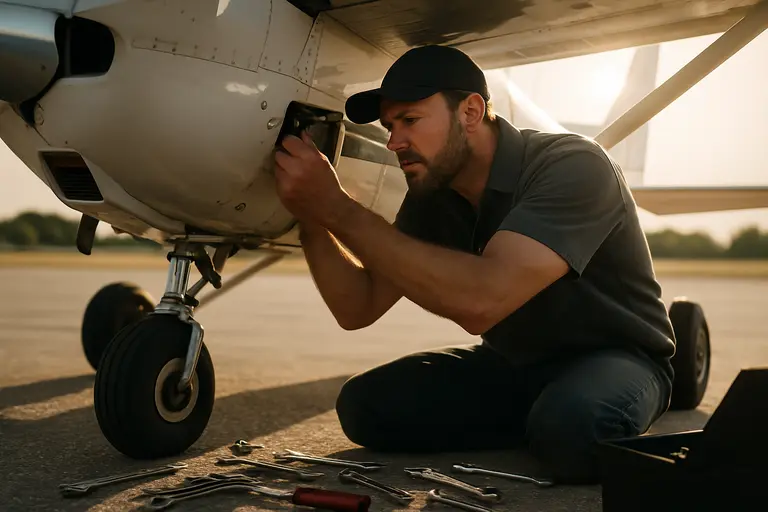
Investigators reported no pre-crash mechanical failure in either aircraft during post-accident examination, based on the research notes. The same notes also state that the Cessna pilot had performed maintenance earlier that day, and it was too early to know whether that work had any connection to the accident. Those two facts should be kept separate. No pilot should assume a mechanical cause, and no pilot should ignore the operational caution raised by same-day maintenance.
After maintenance, even routine work deserves a slower preflight mindset. Control surfaces, control travel, rigging cues, trim position, fasteners, cowling security, and general responsiveness all deserve direct attention before flight. If a pilot plans local pattern work after maintenance, the first takeoff and landing should be treated as a verification flight, not an ordinary lap in familiar airspace. The purpose is to give the pilot time and margin to detect any abnormal handling before operating close to other aircraft, obstacles, or runway-edge activity.
Data Cards And Post-Accident Learning
Investigators retrieved intact data cards from both aircraft even though black-box recorders were not required in those low-weight aircraft. The Associated Press reported that the recovered cards were being analyzed for content such as flight data and cockpit audio data cards recovered. For private pilots, that detail is a reminder that many modern cockpit devices can provide useful information after an event, even when the aircraft is not equipped like an airliner.
The safety value is not limited to investigations. Pilots who use avionics, portable devices, or training tools that record flight paths can review their own approaches, go-arounds, and spacing decisions after routine flights. That review should never replace instruction or regulation-based procedures, but it can help a pilot see patterns that were not obvious in real time. Readers who compare pilot resources across related publishing projects may also recognize the usefulness of SiteBob, a site that shares the same network dedicated to aviation insights and resources.
Pennsylvania Airport Collision Lessons For Pilots
Practical Safety Protocols From The Pennsylvania Airport Collision
The most useful response to this accident is not speculation. It is a disciplined review of safety habits that apply to every private pilot. Based on the reported facts, the highest-value protocols are simple, repeatable, and especially relevant at non-towered airports:
- Use CTAF calls to confirm position and intentions, but do not treat a radio exchange as proof of safe separation.
- Maintain conservative clearance from helicopters operating near runway thresholds, grass areas, or approach paths.
- Go around or extend the pattern when traffic spacing cannot be judged with confidence.
- After same-day maintenance, perform a slower preflight and treat the first flight as a higher-attention operation.
- Separate known facts from assumptions until the final accident report is released.
Private flying rewards preparation, but it also demands humility. A runway area can change quickly, especially when fixed-wing and rotorcraft training overlap. The Pennsylvania airport collision should prompt pilots to ask better questions before committing to land: Where is the other aircraft? Is it moving or hovering? Do I have a clear escape plan? Have I left enough margin if my aircraft does not behave exactly as expected?
Those questions fit the daily life of a careful pilot. They do not require new technology or unusual skill. They require patience, clear communication, and a willingness to abandon a landing attempt when the picture is not fully clear. Until investigators complete their work, the final cause remains unsettled. The safety message for private pilots is already practical: protect spacing, verify aircraft condition, and make conservative decisions before the runway environment leaves little room to correct an error.