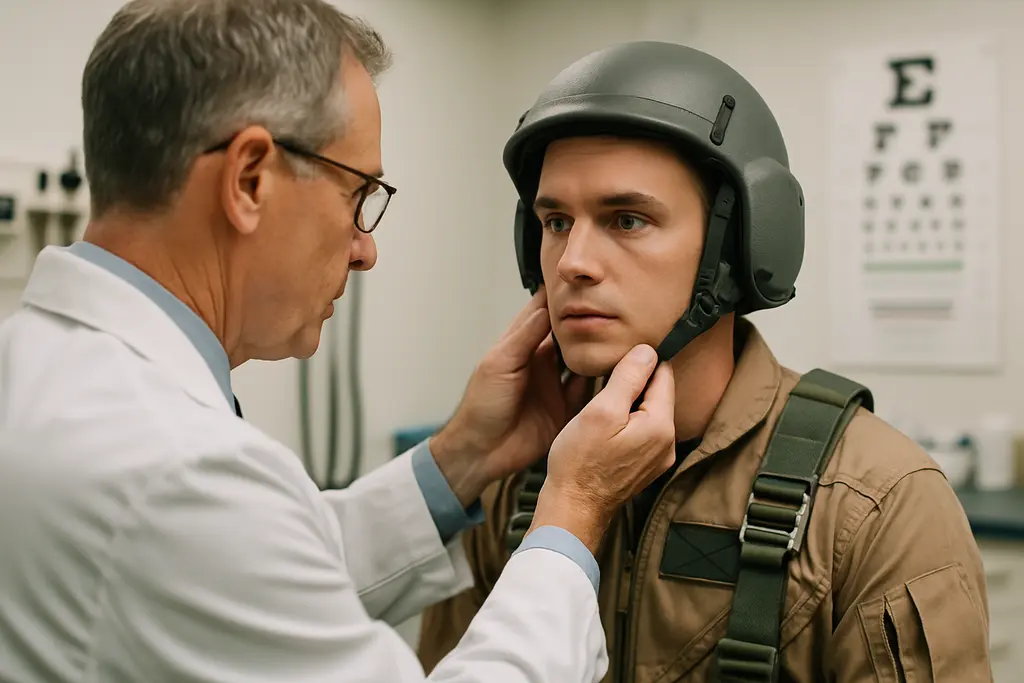
Aviation safety depends just as much on the health of the pilot as it does on the mechanical integrity of the aircraft. Before you invest thousands of dollars into flight training, you must prove you are physically capable of commanding an airplane. The Federal Aviation Administration (FAA) establishes strict aeromedical standards to guarantee no pilot suffers a sudden incapacitation when in the air. Fulfilling the FAA medical certificate requirements represents the very first administrative hurdle for every aspiring aviator. You apply for this physical exam by submitting your health history through the official FAA MedXPress portal, which generates a confirmation number you bring to an Aviation Medical Examiner (AME). Knowing the differences between a First, Second, and Third-Class certificate allows you to choose the correct physical exam for your exact career trajectory and avoid unnecessary training delays as you prepare for your first solo flight success.
Securing Your Third-Class Medical For Private Flying
The Third-Class medical certificate serves as the foundational health standard for student pilots and recreational aviators. It grants you the legal privilege to fly a single-engine or multi-engine aircraft for personal use. The physical examination focuses on baseline wellness, verifying you possess adequate vision, hearing, and cardiovascular health. You must demonstrate a distant visual acuity of 20/40 or better in each eye, with or without corrective lenses. If you require glasses to pass the vision test, the AME prints a restriction on your certificate stating you must wear corrective lenses when exercising the privileges of your license.
For pilots under the age of forty, a Third-Class medical remains valid for sixty calendar months. Once you cross your fortieth birthday, that validity period drops to twenty-four calendar months. This certificate easily accommodates the needs of individuals who fly purely for recreation and never plan to accept compensation for their time in the cockpit.

The Second-Class Certificate For Commercial Operations
Transitioning from a hobbyist to a professional aviator requires a Second-Class medical certificate. This tier applies directly to pilots holding a Commercial Pilot License who fly for compensation or hire. Crop dusters, banner towers, aerial surveyors, and Part 135 charter pilots all operate under this standard. The visual requirements increase at this level; you must demonstrate 20/20 distant vision in each eye, with or without correction.
The privileges of a Second-Class certificate expire twelve calendar months from the date of the examination, regardless of your age. If you let that twelve-month window lapse, the certificate automatically downgrades to Third-Class privileges. Students figuring out how to build flight hours efficiently as a student pilot often schedule a Second-Class exam right from the beginning of their training to confirm their bodies meet the commercial standard before they spend money on advanced ratings. You can review the exact physiological tolerances for this tier by consulting the FAA Guide for Aviation Medical Examiners to verify your baseline health.
The First-Class Standard For Airline Transport
Operating a multi-crew passenger jet under Part 121 scheduled airline operations demands the highest level of physical scrutiny. Captains and First Officers must hold a First-Class medical certificate. The standards match the Second-Class vision requirements but introduce much stricter cardiovascular monitoring. When a First-Class applicant turns thirty-five, they must complete an electrocardiogram (ECG) to establish a baseline heart reading. Once that pilot turns forty, the FAA mandates an annual ECG to screen for undetected cardiac anomalies.
| Certificate Class | Primary Pilot Privilege | Duration Under Age 40 | Duration Age 40 And Over |
| First-Class | Airline Transport Pilot (ATP) | 12 Calendar Months | 6 Calendar Months |
| Second-Class | Commercial Pilot (Hire/Compensation) | 12 Calendar Months | 12 Calendar Months |
| Third-Class | Private / Student Pilot | 60 Calendar Months | 24 Calendar Months |
Managing Disqualifying Conditions And BasicMed
The FAA maintains a list of explicitly disqualifying medical conditions, including severe personality disorders, psychosis, substance abuse history, and certain cardiovascular diseases. Having a history of these conditions does not mean an automatic lifetime ban from the cockpit, but it does require a complex Special Issuance waiver. The waiver process forces the pilot to provide extensive medical records and undergo specialized testing to prove their condition is stable and effectively managed.
For veteran aviators who want to maintain the lifestyle of general aviation pilots without the stress of renewing a Third-Class certificate, the government introduced the BasicMed alternative. BasicMed allows pilots who previously held an FAA medical certificate after July 2006 to fly under strict operational limitations using a physical exam conducted by their state-licensed primary care physician. You can study the operational limitations of this program through the Aircraft Owners and Pilots Association BasicMed resources to see if you qualify.
Final Thoughts
Your aviation medical certificate acts as the absolute gatekeeper to the national airspace system. Taking the time to study the differences between the certificate classes prevents you from paying for a First-Class exam when a Third-Class fits your mission perfectly. Schedule your physical exam before you log your first dual instruction flight. Confirming your medical eligibility early allows you to focus your entire mental bandwidth on controlling the airplane, fully confident that your body meets the federal standards required to fly safely.