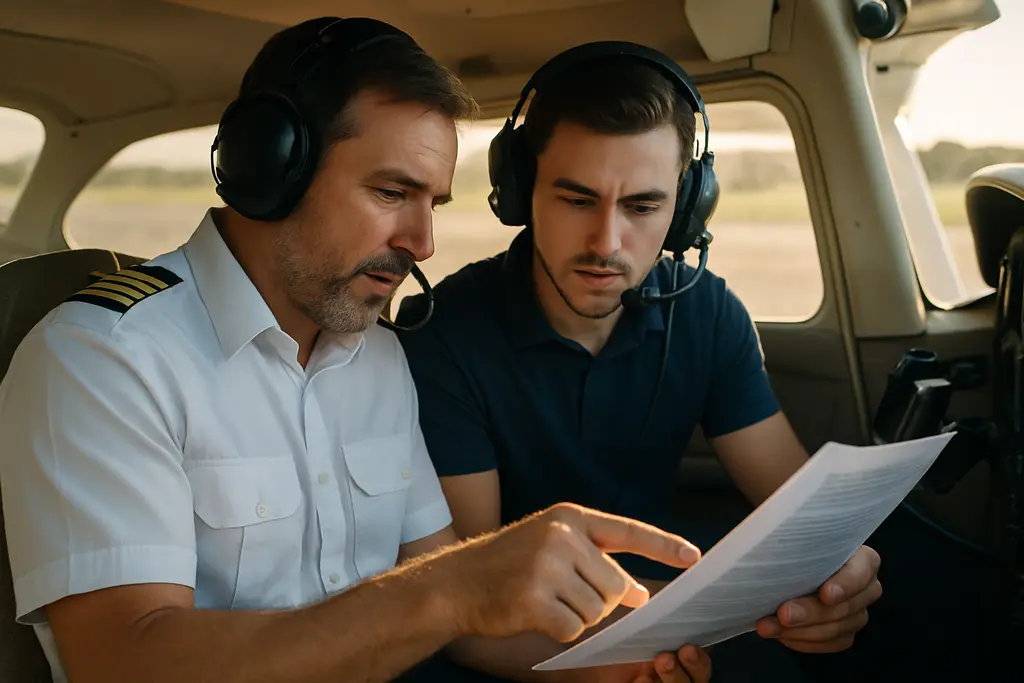
At first, I thought earning a pilot license was all about courage, a headset, and lovely sunsets. Then I discovered the FAA pilot license process. It’s freedom mixed with a lot of forms. Checklists become your best friend, ready or not.
The steps to become a pilot seem easy on the surface: you must meet FAA eligibility, train at a certified flight school, and pass two tests. But this path is more challenging than it sounds.
Before choosing a school, understand the different pilot certificates. The Private Pilot Certificate is just for fun, not for getting paid to fly. The Commercial Pilot Certificate allows you to earn money from flying under FAA rules. The Airline Transport Pilot (ATP) certificate is the highest level, required by airlines for their captains.
The usual path includes Private, Instrument, Commercial, Multi-Engine, and Flight Instructor certificates, ending with the ATP. Airlines might add ATP-CTP and a specific type rating later. The right school helps you move smoothly through each step.
But beware of early obstacles. No FAA medical certificate means no flying. Missing FAA requirements means you can’t even start. And if you don’t meet training or testing standards, expect delays.
Let’s talk about time and money. Fast-track programs can take 9-12 months, while part-time training takes longer. The total cost for becoming a professional pilot can reach over $100,000, depending on various factors.
Finally, what you fly also matters. The pilot license journey varies if you’re training on different aircraft like helicopters or balloons. And if you’re considering ultralights, remember, they don’t need a pilot certificate. This could be exciting or risky, depending on how you see it.
What Makes a Great Flight School?
A great flight school isn’t just about good looks. It’s about being organized and efficient. Like having FAA-aligned training, a clear plan, and teachers who really teach.
I look at how well a school sticks to the FAA’s standards. Because true quality doesn’t hinge on vibes. It means being ready for every lesson and every test. And moving through the pilot’s license steps with clear guidance.
Getting ready means real study for the FAA written test, and then the practical test. That includes talking with a DPE and actually flying. If a flight school can’t explain their training process, that’s a red flag.
Your schedule is really important too. Flying regularly means you learn more effectively. But if you can’t fly often because planes aren’t available, it could slow your progress a lot.
The best flight school also fits your goals. Whether it’s flying for fun or aiming for a career in aviation. They should be upfront about how long things will take and how life might affect your training.
Try a discovery flight before deciding. You’ll quickly get a feel for their teaching style. And you’ll see how they handle safety and every little detail.
Also, great schools are serious about following rules. They make sure you’re eligible and handle all the paperwork smoothly. That way, your training goes without a hitch.
| What to Evaluate | What a Great School Looks Like | What to Watch For |
|---|---|---|
| Training structure | FAA-aligned training with a written syllabus, stage checks, and clear lesson goals | “We just go fly” planning with no benchmarks or tracking |
| Test readiness | Systematic prep for the FAA knowledge test and practical test with DPE-style oral practice | Last-minute cramming and vague promises about “you’ll be fine” |
| Schedule and aircraft access | Reliable aircraft availability and an approach that supports consistent weekly flying | Frequent cancellations, long gaps, and hard-to-book airplanes |
| Instructor quality | A certified flight instructor who explains clearly, corrects early, and adapts to how you learn | Teaching by monologue, rushed debriefs, or a revolving door of instructors |
| Goal fit | Honest planning for PPL requirements and later pilot certification goals based on your mission | One-size-fits-all pacing that ignores your timeline and budget |
| Compliance support | Guidance on FAA paperwork steps and confirmation of English language requirements | Confusion, delays, or a “figure it out” attitude |
Types of Programs: Local, University, Accelerated
Choosing a training path is like picking a streaming service. All promise the “hit show,” but the details vary greatly. Think about the pilot licenses you want. This will guide you from a weekend hobby to a career in the cockpit.
Starting your pilot journey always begins with a Private Pilot license. Then, you add more ratings and certificates as your goals grow. The path might seem simple on paper, but real life can bring unexpected challenges.
Local flight schools and independent instructors offer flexibility, similar to a pay-as-you-go plan. You can train around your job or family schedule. However, if lessons are too spread out, it might take longer to progress.
University aviation programs combine academics and flight training into a semester system. Getting a college degree isn’t required for FAA certificates. But it might be preferred by some airlines. This option offers structure and a broader education.
Accelerated programs are like binge-watching a show. They have frequent flights and tight lesson schedules, usually taking 9–12 months for a professional track. This fast-paced training demands your full focus.
| Program style | Best fit | Typical pace feel | Tradeoffs to expect |
|---|---|---|---|
| Local flight school / independent instructor | Part-time learners balancing work and family | Flexible and student-driven | Completion time can stretch if lessons are inconsistent; progress depends on aircraft and instructor availability |
| University aviation program | Students who want a structured calendar and a degree environment | Steady, semester-based rhythm | More rigid scheduling; higher total cost is common; degree is optional for FAA certificates but may help some career paths |
| Accelerated flight training academy | Career-focused students who can train full-time | Fast, highly scheduled repetition | Less schedule flexibility; intense workload; momentum drops quickly if you pause training |
One important choice is what you’ll fly. Whether it’s airplanes, helicopters, gliders, or other types. This affects cost, available training, and how you log time.
Lastly, understand the rules behind the marketing. Schools might operate under Part 61 or Part 141. This impacts the program’s structure and training requirements. Choosing the right setup can make learning to fly clearer and more straightforward.
Accreditation and Reputation
When people praise a school’s reputation, I don’t think of nice lobbies. I look for actual results. I check if students graduate on time, pass FAA tests, and avoid endless extra flights.
The real mark of a school’s reputation is in guiding you clearly through the FAA pilot license process. It’s not just about buying flight time. It’s about step-by-step certification. If the staff can’t clearly explain the process, that’s a red flag.
The FAA system is where credibility is proven. You need to pass a computer exam and get an instructor’s endorsement for the FAA test. Then, you face a practical test, which includes both an oral exam and a flight with a Designated Pilot Examiner (DPE), where standards become a reality.
Quality schools simplify the paperwork. They help you with IACRA for your FAA Student Pilot Certificate. They make it clear: start training anytime, but get the certificate before your first solo flight. This clear information is a sign of a school’s good reputation.
| What to Check | What Strong Programs Do | What Weak Programs Do |
|---|---|---|
| Completion and pass rates | Track finishes, first-time checkride passes, and remediation trends tied to pilot certification | Rely on anecdotes, or shrug when asked about outcomes |
| Test readiness | Build a plan for FAA testing that matches the ACS and your schedule | Push “just take it” without structured prep or clear benchmarks |
| Checkride pipeline | Set expectations early about availability and prep for a Designated Pilot Examiner (DPE) | Blame delays on “the system” while students wait without a plan |
| Paperwork and troubleshooting | Help with IACRA steps and tell you when to call the FAA Flight Standards District Office (FSDO) | Act vague, or bounce you between desks when issues come up |
| Medical readiness | Encourage early AME visits, often starting career-track students with a First Class medical | Say “don’t worry about it yet,” right up until it becomes a training stop sign |
If you’re not getting clear answers, turn to the FAA. The FAA Flight Standards District Office (FSDO) can clarify your questions. A confident school won’t mind this. They see it as responsible planning, not betrayal.
Another sign of a good reputation is how a school handles medical eligibility. Respectful schools urge you to check your medical eligibility early, especially if you’re aiming for the airlines. It’s about ensuring your path toward certification before investing too much.
Instructor Experience Matters
Many smart adults try to save money by choosing the cheapest flight training option. Later, they end up paying more to learn the same lessons properly. A skilled flight instructor can quickly find and fix your mistakes. This helps you meet your Private Pilot License (PPL) requirements without wasting time.
Quality instruction guides you smoothly through learning to fly: from maneuvers and procedures to managing risks. It also includes understanding plane mechanics in simple terms. Great instructors plan each lesson carefully. This way, your improvement is clear in how you fly, not just in what you’re charged.
Handling the necessary paperwork is crucial because it’s what officially allows you to progress. You can’t just ‘feel ready’ for a test. Your logbook must have the correct instructor endorsements to move forward. The wrong choice of instructor can lead to unnecessary delays.
- Knowledge test: you need an instructor sign-off to be eligible, which means the ground knowledge has to be real, not vibes.
- Checkride: your checkride preparation ends with an endorsement stating you meet the standard, not merely that you showed up a lot.
If you aim for a career in flying, the quality of your instructor becomes even more important. Commercial flying requires precision. You must master maneuvers like lazy eights and chandelles with exact timing and control. A proficient instructor teaches these skills effectively, avoiding a “good enough” approach.
Beyond just learning, consider the teaching style of potential flight schools. Many pilots gain their required hours by teaching. This means you’ll likely become part of the teaching environment you’re learning in. So, think about what kind of instruction you want to both receive and potentially give in the future.
| Training milestone | What a strong instructor does | What a weak instructor tends to do |
|---|---|---|
| PPL requirements planning | Maps lessons to FAA standards, tracks gaps, and sets clear goals per flight | Teaches “whatever comes up,” then wonders why progress stalls |
| Logbook endorsements | Explains what each sign-off means and times it to real proficiency | Delays endorsements or treats them like routine stamps |
| Checkride preparation | Runs realistic mock orals and scenario flights, tightens weak maneuvers early | Over-focuses on trivia and hopes the DPE “doesn’t ask that” |
| Commercial maneuver coaching | Teaches lazy eights, chandelles, and power-off approaches with repeatable cues | Calls it good when it’s merely passable, then blames nerves later |
| Long-term steps to become a pilot | Discusses ratings, hour-building, and professionalism without sales pressure | Makes big promises, offers little structure, and dodges specifics |
Comparing Costs and Schedules
People often ask about the cost and time to get a pilot license. They expect a simple answer. But aviation doesn’t work that way. The cost of pilot certification varies by the program, pace, and training location. Finding something “cheap” and “fast” is rare.
Think of it like housing: costs vary by location, just like training costs. Training hours at a busy airport cost more than at a quiet one. Getting professional training can cost from a few thousand to over $100,000.
Schedules are like hidden economics. A regular training schedule means less relearning and surprise costs. Skip too many weeks, and it’ll cost you more in time and money.
| Training approach | Typical timeline | Cost pattern you’ll actually feel | Schedule risk |
|---|---|---|---|
| Accelerated, career-track | accelerated programs 9–12 months | Higher monthly cost, but efficient if you keep up | Disruptions can derail your plan quickly |
| Part-time, flexible | Often 18–36+ months | Payments are spread out, but may increase if skills fade | Delays can arise from weather, work, and breaks |
| University-style program | Usually 2–4 years | Combines tuition and flight costs with a fixed schedule, but it’s expensive | Course availability could slow progress |
When planning to become a pilot, notice how milestones match your schedule. Several steps like medical approval and tests have timing issues. A busy work schedule can extend expected timeframes significantly.
Commercial training introduces more costs. A typical course could be $5,000 to $10,000. Adding more ratings could push it to $30,000 or higher.
Then there are hidden costs, about $1,000–$2,000 for essentials like a headset and books. These may not be glamorous, but they’re necessary. If your budget doesn’t cover these, it’s not realistic.
When comparing programs, look at the entire journey, not just one part. See what happens if there are weather delays or if your instructor changes. A true comparison accounts for real-life scenarios, not just the ideal ones promised in brochures.
Ground School vs. Flight Lessons
Training has two main parts: ground school and flight lessons. Both are key for making smart choices and handling the plane well. If you ignore one, it will trip you up when it’s time for your checkride.
Ground training helps make sense of the rules and moves. It prepares you for the FAA knowledge test, which is on a computer and pretty strict. You also need a sign-off from an instructor to take it. So, it’s not something you can just do by yourself with coffee at midnight.
Flight lessons put what you’ve learned into practice. Checklists and scans become second nature. The goal is to do things the same way every time. That’s because the plane won’t wait for you to catch up.
After the basics, ground school for a commercial pilot dives deeper. You’ll learn about advanced weather, navigation, and communication. It’s about managing risks well, not just flying the plane.
| Training Piece | What It Builds | Where It Shows Up Fast |
|---|---|---|
| ground school | Aeronautical decision-making, regs, weather logic, airspace judgment | FAA knowledge test prep, endorsement readiness, smarter preflight planning |
| flight lessons | Maneuvers, procedures, radio flow, situational awareness under pressure | Landings, abnormal procedures, cross-country execution, confidence in the pattern |
| Both together | Transfer of learning from “I get it” to “I can do it” | Cleaner checkrides and steadier pilot certification progress |
How your school approaches ground training varies by rules. With Part 61, there’s no fixed ground hours. It can be done at home or with an instructor. Part 141 requires at least 35 hours of structured, FAA-approved ground training.
Then comes the timing. You can either finish ground school before starting flight lessons or do both together. Getting the FAA knowledge test done early can ease pressure later. Either way, keeping a steady pace helps avoid a drawn-out training process.
Questions to Ask on a School Visit
When visiting a flight school, I play the role of a curious reporter. I carry a notebook and watch out for unexpected costs. It’s all about gathering solid facts. This visit is crucial for anyone aiming for a FAA pilot license. It turns the dream of becoming a pilot into a concrete plan of action.
One key question is whether you can try a discovery flight first. This is a chance to see the instructor’s style, inspect the plane, and check the school’s organization. It’s a peek into the actual flying experience.
Then, I ask about medical requirements for becoming a professional pilot. It’s important to know how they guide students through FAA medical exams. Starting early with an Aviation Medical Examiner (AME) can prevent unwanted surprises. Ensuring your health meets flying standards is as crucial as a clean flying record.
Documentation is my next focus. I inquire if they help students with the IACRA student pilot certificate. Knowing this process is essential before solo flying. If they hesitate or seem unsure, that tells me a lot.
Looking at the big picture involves asking about their training pace. It’s key to find out how they balance flight practice and ground lessons. They should help you stay on track to avoid costly recaps of past lessons. We all know gaps in training can lead to setbacks.
Last, I ask about their preparation for the FAA knowledge test and the practical exam with a Designated Pilot Examiner (DPE). The right answer includes details about endorsements, study plans, and test prep. A vague “You’ll be fine” doesn’t cut it.
| Question to ask in person | What a clear answer includes | What it changes for your timeline and costs |
|---|---|---|
| Can I schedule a discovery flight soon, at a normal training time? | Preflight briefing, lesson objective, debrief notes, and a transparent hourly breakdown | Shows whether instruction is structured and whether the airplane is actually available |
| How do you plan medical steps with an Aviation Medical Examiner (AME)? | Guidance on class choice, timing, and what documents to bring before training ramps up | Reduces the risk of spending heavily before learning you can’t finish |
| Do you support the IACRA student pilot certificate process? | Who helps submit it, how identity verification works, and when they expect it completed | Prevents solo delays that can stretch training and add repeat-lesson time |
| How do you prepare students for the FAA knowledge test and DPE checkride? | Endorsement standards, test resources, mock orals, and a plan for scheduling the DPE | Avoids last-minute cram cycles and expensive “checkride prep” marathons |
| What’s aircraft and instructor availability like right now? | Dispatch process, maintenance downtime expectations, instructor caseload, and backup options | Directly affects how fast you can move through the steps to become a pilot |
When it comes to costs, I dive into what their quotes include and when charges begin. I’m keen on hidden fees like book costs, exam fees, fuel charges, and other extras. For more detailed cost insights, I use this flight training cost checklist. It helps translate costs into U.S. figures.
Last but not least, I inquire about who oversees training quality. It’s not about causing trouble. Rather, it’s about understanding how the school maintains quality, manages instructor changes, and measures progress. Your training is an investment, not just another subscription service.
Red Flags and Avoiding Scams
Scams and bad schools are like two sides of the same coin. One offers you dreams, the other just delays. In the end, both take your money while your skills don’t improve.
The best quick test is the FAA checklist. If a school is casual about the FAA medical certificate or says to think about it later, that’s bad news.

Be wary of vague talk about becoming a pilot. A good school explains the process clearly, like a set path. If they’re unclear about the FAA knowledge test or its purpose, you’ll likely face confusion and extra costs later.
The checkride is just as important. If their plan sounds unsure, like they’re making it up, be cautious. A checkride has strict standards; it’s not something you can just wing.
Beware of unrealistic timeline promises. If they say you’ll go “zero to hero by summer” without mentioning key details, doubt their claims. True skill comes from regular practice, not optimistic schedules.
Also, ask them a basic question: Part 61 or Part 141? If they can’t answer or explain the differences, it’s a red flag. The right answer shows they know their stuff.
| What you ask | Solid answer sounds like | Red-flag answer sounds like | Why it matters |
|---|---|---|---|
| When should I confirm my FAA medical certificate? | “Early—before you invest heavily. We’ll talk which class you need and how it affects scheduling.” | “Don’t bother yet. Let’s get you in the air first.” | Medical eligibility can stop training cold after you’ve spent real money. |
| How do I get a FAA knowledge test endorsement? | “We use a structured ground plan, track completion, then issue the endorsement when you meet the requirements.” | “We’ll figure it out when you feel ready.” | No endorsement, no test; no test, the pipeline to pilot certification slows down. |
| What’s your plan for the checkride DPE? | “We schedule ahead, maintain a short list of DPE options, and prep you for oral and flight standards.” | “DPEs are random. You’ll get one when you get one.” | Unplanned checkrides lead to long waits, skill fade, and repeat training. |
| Are you Part 61 or Part 141? | “Here’s our rule set, our syllabus, and how training records work under it.” | “It’s basically the same thing.” | Different rules change structure, oversight, and how progress is documented. |
| How fast can I finish? | “It depends on your training frequency. Three days a week is very different from once a month.” | “Everyone finishes in a set number of weeks.” | Realistic pacing protects your wallet and keeps learning from backsliding. |
If you want to avoid flight school scams, listen for details. Clear steps and records are crucial. In flying, paying attention to the details can save your life.
Making Your Final Choice
To pick the final option, I start from the goal and work backward. The phrase “follow your dreams” is too vague to guide anyone. First, I look into all steps required to become a pilot which are researching options, taking a discovery flight, getting medical clearance, and applying for a student pilot certificate via IACRA.
Next comes both flight and ground training, then the FAA knowledge test, and lastly the FAA practical test/checkride—both oral and flight—with a DPE. If a school is unclear about these steps, it’s not being flexible. It’s being unclear.
I then ensure the training program matches the specific pilot licenses I want. Each type of pilot license, like those for airplanes, helicopters, and gliders, has its own set of FAA rules. Ultralights are unique because they don’t need a certificate. That’s why generic promises from schools don’t work well.
After this, I evaluate the pilot training path against strict requirements. Being fluent in English is crucial, and there are set age minimums for different licenses: Private at 17, Commercial at 18, and ATP at 21. The minimum flight hours are also set: 40 for Private, 250 for Commercial (190 in some cases), and 1,500 for ATP. If a school’s plan sounds too good to be true, I look elsewhere.
Finally, I consider the cost and time needed. Becoming a professional pilot can cost a huge amount, from tens of thousands up to over $100,000, depending on many factors. Programs can last from 9–12 months for accelerated ones to much longer for part-time students. I pick a school based on how well its schedule, instructors, and reliability match what I can handle. After all, the best FAA pilot license is one you can actually get.