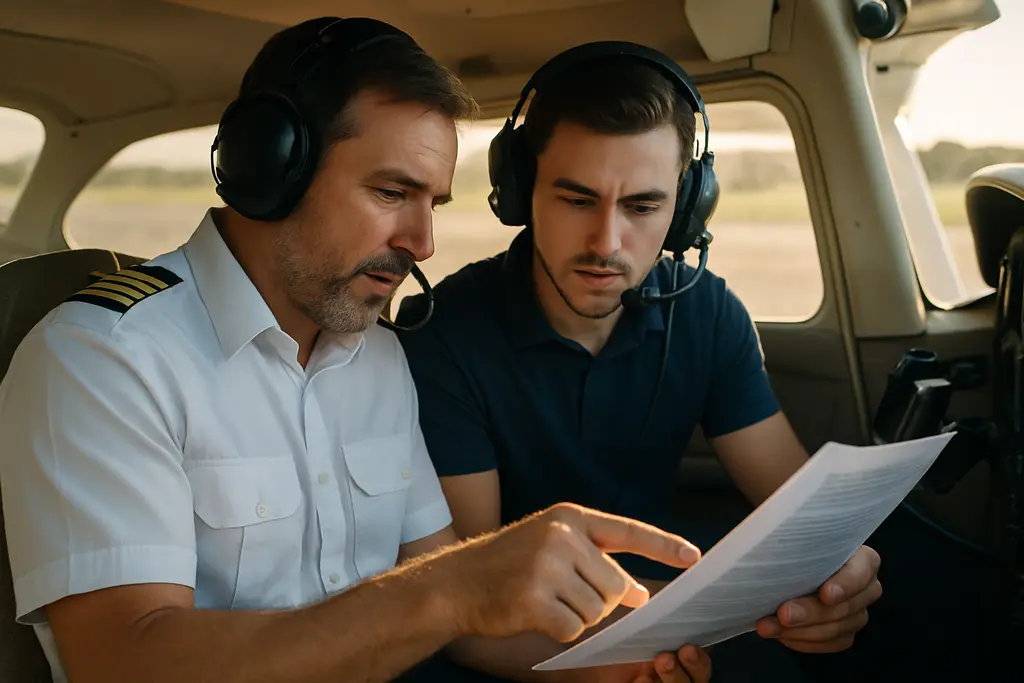
The student pilot checkride is a major step. It turns “student pilot with opinions” into a “certificated pilot with responsibilities.” It’s exciting, but it can also keep you up at night. Neil Glazer mentioned this in 2023.
The FAA checkride feels like a two-part drama: first the oral exam, then the flight test. Many fear the oral exam as if it’s a tough Senate hearing. The coffee’s bad, and there are too many weather charts.
Feeling nervous is common. You might lose sleep or worry about the examiner reading your thoughts. Maybe you fear one tricky question could ruin your test.
Here’s a key fact: the Airman Certification Standards (ACS) guides you. The examiner isn’t looking for perfection. They want to see that you make safe, smart decisions. That you think like a pilot, not just answer like you’re on a quiz show.
In this guide, I’ll show you what really matters. A smart study plan is crucial. Use the ASA Oral Exam Guide, have a marked-up FAR/AIM, practice mock checkrides, and work on real-life scenarios. We’ll address common challenges—like maneuvers, decision-making, checklists, and communication—without pretending you can cheat the system.
But let’s be real: pilots often look for shortcuts. The goal is to meet the standards in a mature way. Understand the rules, then follow them.
Introduction: Why Medical Clearance Matters
I always thought acing steep turns and keeping cool was the key on checkride day. Then, I learned the hard way with a clipboard in hand. Failing because of missing paperwork, not a failed maneuver, is surprisingly common and embarrassing.
Medical clearance is a must on your flying to-do list. You can’t ignore a missing certificate any more than you can ignore official legal papers. Before setting a date for your practical test, make sure everything is in order. This includes being current and not getting caught out by an expired medical certificate.
The pilot oral exam begins with more than just airspace questions. A good examiner checks your ID, certificates, endorsements, and documents first. This isn’t about creating drama. It’s just the system working as intended.
| Item the examiner will ask for | Why it matters before the practical test | Easy way to avoid a bad surprise |
|---|---|---|
| Photo ID | Confirms you’re the applicant listed on the paperwork | Use a current driver’s license or passport and double-check the expiration date |
| Medical certificate | Shows you’re medically qualified for the privileges you’re seeking | Verify class, dates, and any limits; bring the original, not a “somewhere in my bag” plan |
| Student pilot certificate | Proves you can act as pilot in training under the rules | Confirm it’s the plastic certificate and that your personal info matches your ID |
| Logbook totals and signatures | Documents aeronautical experience requirements and training history | Total hours the night before and flag key entries with tabs |
| CFI endorsements | Shows you’re authorized to take the test and meet prerequisites | Review the endorsement list with your instructor and make sure none are missing |
| Knowledge test report | Links your written results to the test you’re taking | Pack it with your logbook; don’t assume it’s “in the email somewhere” |
| FAA IACRA 8710 submission/printout | Connects your application to the examiner’s process | Submit early, confirm status, and bring a copy in case the internet has opinions |
Your health affects your flying in subtle ways. Issues like poor eating, not drinking enough water, and fatigue can lead to airsickness. This type of sickness can turn small errors into big problems. Remember, during the exam and flight, taking care of your body is crucial.
To check your readiness, think PAVE: Pilot, Aircraft, enVironment, External pressures. The “Pilot” part includes your health. If something doesn’t feel right, rescheduling your test might be wise. After all, good decision-making is what the test is really about.
FAA Medical Certificate Classes Explained
I used to think medical certificate classes were like the boring fine print on a streaming contract: boring, unattractive, yet somehow crucial. Then reality hit me hard. It’s not just small detail—it’s a rule you must follow. On the day you take your student pilot checkride, not having the right paperwork can stop you before you start, just like a dead iPad would.
The deal is this: your certificate class and its validity decide which flying rights you can use. This becomes key after passing your flight skills test and wanting to use those new rights without trouble. It means knowing you’ve met the standards and can legally use them today.
In simpler terms, heed Glazer’s warning as if it’s written on your flight gear: update your medical certificate before test day. Not later, not after the weekend, but before. If not, you’re just wasting money and time on a pointless airport visit.
Here’s something else: being current doesn’t mean you’re skilled. “Current” relates to paperwork and recent flight time. Being “proficient” is about handling tasks, making decisions, and keeping pace with the plane. The FAA won’t measure your vibe, but your physical presence still counts on flight day.
So, think of your medical status as part of your flight plan. It’s something to figure out early, not something that surprises you the day of the test. This mindset also sharpens your prep for the checkride by making you act like a true pilot in command, rather than a procrastinator.
| Medical Class (What it signals) | Typical Fit for Training Goals | What Can Trip You Up at the Paperwork Review | Practical “Current vs Proficient” Takeaway |
|---|---|---|---|
| First Class (highest medical standard) | Often chosen when long-term goals include airline-style privileges and early planning | Certificate expiration timing, missing documentation, or an outdated status that wasn’t renewed before the test date | Being “current” won’t help if fatigue or dehydration makes you slow on radio calls and decision-making |
| Second Class (mid-level medical standard) | Common for pilots aiming toward commercial privileges later, even while training | Assuming the class level doesn’t matter yet, then realizing it affects what you can legally do after you pass | Proficiency shows up in workload management: clear explanations, stable airspeed control, and smart risk calls |
| Third Class (baseline medical standard for many private pilots) | Most common path for early training and the first practical test | Letting the certificate lapse and discovering it during the check-in, when it’s too late to fix | Sleep, nutrition, and hydration support cognitive sharpness—the part that makes FAA checkride tips actually usable |
For FAA checkride tips that go beyond just “be confident,” here’s the key: check your medical status and its validity well in advance. Also, arrive ready both mentally and physically. Good sleep and stable hydration might not sound very impressive, but they’re essential for clear thinking. This means you’ll be better at explaining maneuvers, watching for other planes, and making decisions under pressure.
Steps to Schedule Your Exam
Scheduling your exam feels similar to chasing concert tickets back in 2009: everyone’s eager, and the best slots disappear quickly. You often have to choose between an FAA official without a fee but longer wait times, or a Designated Pilot Examiner (DPE), whose fees vary. This choice mainly affects wait times and travel distances.
Interestingly, whether you pay or not doesn’t change the FAA checkride. Both FAA and DPE offer similar testing experiences. The difference lies in how accessible and costly they are, not in the content of the exam.
| Scheduling Path | Typical Cost | Availability | What Usually Changes |
|---|---|---|---|
| FAA official | Examiner fee: $0 (you still cover aircraft, instructor, and training costs) | Often limited; longer waits and fewer local dates | More travel planning; the practical test still follows the same standards |
| Designated Pilot Examiner (DPE) | Fee required; varies by examiner, location, and any travel involved | Often more flexible; dates can open up faster | More scheduling control; the FAA checkride format remains consistent |
Before booking, always double-check your paperwork to avoid scheduling errors. Glazer emphasizes checking endorsements and qualifications first. Skipping this could lead to learning about the importance of paperwork the hard way.
Then, revisit aeronautical experience requirements. Glazer references 14 CFR 61.103 and 61.109 for private pilot qualifications. This step is your defense against unforeseen checkride issues.
- 40 hours total flight time: 20 dual + 10 solo.
- Dual flight must have: 3 hours cross-country, 3 hours night (with extra rules), 3 hours on instruments, and 3 hours of prep for the test in the last 2 months.
- Solo flight must have: 5 hours cross-country, one 150 NM trip solo (with more details), and 3 takeoffs + 3 landings at an airport with a control tower.
Try scheduling a practice exam with High Tide Aviation, a tip I find quite clever. It’s an effective way to identify weaknesses early on. Use a different CFI for new perspectives. This practice makes the real exam feel more familiar and less intimidating.
To keep exam preparation stress-free, view your calendar as a tool. Good planning involves careful timing, correct documentation, and precise calculation of flight hours. Realizing too late that you’ve scheduled prematurely can spoil your big day.
Typical Questions and Procedures
The pilot oral exam is more about testing your ability to make safe decisions than testing your knowledge of trivia. DPE Jason Glazer considers it a practice session before you fly to ensure you can apply what you’ve learned. It’s all about turning what you’ve read in books into smart choices in the cockpit, especially when time is limited.
Be ready for questions that involve calculations and scenarios from the real world, not just textbook definitions. One moment, you’re going over familiar acronyms and procedures from your training. The next, you’re facing unexpected situations and explaining your decisions. This is similar to a practical test: your knowledge must stand up to real-life challenges.
The questions don’t end once you’re airborne. According to Glazer, the checkride is your chance to show off your decision-making skills in real-time, with the DPE continuing to ask questions mid-flight. Can you navigate the skies while maintaining clear communication? If it’s tough, it’s seen as an area for improvement, not a personal failure.
Yes, during the pilot oral exam, you can use books and other resources. But you can’t just search for all the answers as you go. You should know crucial information like V-speeds, weight limits, and basic aircraft specs by heart. Then, you should use your references wisely, not as a crutch.
- ASA Private Pilot Oral Exam Guide to prepare for the questions and then look into the details when needed
- FAR/AIM with marked tabs so you can quickly find the information without panicking
- FAA Pilot’s Handbook of Aeronautical Knowledge (PHAK) to understand the reasons behind the rules
- Your aircraft POH for its limitations, performance data, and normal/emergency operations
- 14 CFR Parts 61 and 91, plus having a good grasp of weather reports and airspace/navigation charts
The actual questions asked are often very practical. Glazer points out how they might ask about sharing expenses under 14 CFR 61.113: passengers can pitch in for fuel, oil, airport fees, or plane rental but not the fixed costs like yearly inspections. This rule reflects the essential checkride focus: what is legal, safe, and wise.
The discussion often goes into what it means to be “current” versus “proficient,” based on FAA guidelines. Being current means you meet the basic legal requirements. Being proficient means you can fly safely under challenging conditions. This distinction becomes clear quickly during a checkride.
High Tide suggests a simple but effective study method: explain concepts aloud. If you can teach it, you truly understand it. Then, make the situation more complicated and discuss this new scenario. This approach helps make the oral exam feel less like an interrogation and more like a professional discussion.
| Checkride moment | What the DPE is testing | Example prompt | Best reference to back you up |
|---|---|---|---|
| Before engine start | Depth, breadth, and how you choose safe options | “Walk me through a cross-country plan, including fuel reserves and alternates.” | PHAK, FAR/AIM, weather products, sectional chart |
| Regulations talk-through | Rule accuracy and real-life application | “Explain expense sharing and pro rata share limits under 14 CFR 61.113.” | 14 CFR Part 61, FAR/AIM tabs |
| Aircraft knowledge | Memory plus smart reference use | “What are your V-speeds and max gross weight, and where do you find them?” | POH, quick recall from flashcards |
| In-flight questioning | Workload management: aviate, navigate, communicate, explain | “What airspace are we entering, and what equipment and weather minimums apply?” | Sectional chart, FAR Part 91, PHAK airspace chapter |
| Judgment check | Understanding “current” vs “proficient” in risk decisions | “You’re legal to fly. Are you proficient for these winds and ceilings?” | FAA-H-8083-2, FAA-P-8740-36, personal minimums notes |
Common Conditions and FAA Guidelines
When people think of “FAA guidelines,” they picture medical rules and lots of paperwork. But on checkride day, the real challenge is your mindset and skills: rushing, unclear memory, and flying too stiffly. This is when your weaknesses are most noticeable.
The truth is, the Airman Certification Standards expect pilots to adapt because flying involves constant risk assessment. It’s not about being perfect. If something goes off plan, correct it smoothly. The examiner wants to see that you can identify and fix errors, not that you’re flawless.
Oftentimes, failures begin with basic maneuvers going wrong. Things like steep turns or stalls might not go as planned if you’re too focused on numbers. When your attention slips, so do your altitude and direction, making the rest feel like a difficult quiz in the air.
Decision-making skills are crucial, too. Understanding weather, planning your route, and knowing airspace rules are key. Poor decisions about weather, overlooking a NOTAM, or sloppy communication can quickly escalate from a good flight to a problematic one.
Lacking knowledge shows when you least expect it. For instance, if you can’t explain regulations or weather forecasts when asked. It means your study was incomplete if you can’t use what you’ve learned to make safe choices.
Preflight checks are also critical. Missing a detail about the aircraft’s condition, skipping steps, or ignoring fuel quality can cause concerns. The best advice for FAA checkrides? Be thorough, consistent, and verify everything you inspect.
| Common “Condition” | What It Looks Like on the Ride | What the DPE Usually Wants to See |
|---|---|---|
| Inadequate maneuver execution | Overbanking in steep turns, mushy stall entry, chasing airspeed in slow flight | Stable setup, smooth corrections, clear recovery steps without rushing |
| Weak aeronautical decision-making | Thin weather plan, sloppy airspace awareness, late reroutes, missed risk cues | Sound alternatives, timely choices, and a clear risk story you can defend |
| Checklist and flow breakdowns | Skipped items on takeoff/landing, improvised emergency steps, “I usually just…” | Correct checklist use at critical phases, with a calm, repeatable cockpit rhythm |
| Situational awareness drift | Altitude/heading creep, navigation errors, late traffic calls, surprise airspace | Active scan, planned checkpoints, early corrections, and hazard anticipation |
| Performance chart misuse | Wrong inputs for weight and balance, bad density altitude assumptions, misread charts | Accurate data, correct method, and an explanation that matches real conditions |
| Communication gaps | Stepped-on calls, vague position reports, missed instructions, slow readbacks | Clear, timely phrasing, correct readbacks, and prioritizing aviate-navigate-communicate |
Another important tip is about talking while flying; it’s tougher than it seems. You might be tempted to demonstrate like a teacher. But it’s essential to simply explain what you’re doing and planning. This approach helps during both the oral exam and unexpected situations.
So keep practicing how to describe your actions and decisions. This not only helps you during the exam but also prepares you for surprises mid-flight. This tip might seem straightforward, but it’s often overlooked until it’s needed.
What If You Get Deferred?
A “deferred” moment can feel like a surprise twist in a movie. One moment, you’re smoothly going through the FAA checkride. But then, the examiner suddenly stops the test. It’s usually for clear reasons like not knowing the rules well, making unsafe decisions, failing a maneuver, or a safety mistake.
The good news is, examiners aren’t trying to trick you. They act more like careful planners than bad guys. They look for safe choices and solid skills, even when things get tough. So, if the test stops, it’s more about being safe than about failing you.
When this happens, I see it as useful info, not a disaster. First, figure out what went wrong right away. Don’t just say, “I didn’t do steep turns well.” Be specific about what, why, and the result.
- Maneuver execution: altitude drifting off, speed not right, or not meeting standards
- ADM and risk management: heading into questionable weather, hasty decisions, or not planning detours well
- Knowledge gaps: not knowing airspace rules, what you need to fly, or other regulations
- Checklist discipline: forgetting steps, missing something important, or putting it off
- Situational awareness: missing the overall situation, wind effects, or misjudging your plane’s capabilities
- Comms: talking over others, wrong responses, or not speaking when needed
Next, test your improvements with a practice test and a new instructor. A new teacher can see mistakes your regular one might miss. It’s also a safe space to get used to the pressure, which can mess with your weak spots.
Then, redo your study plan with the FAA checkride’s grading in mind. Focus on the ACS and use the ASA Oral Exam Guide for better answers. Put tabs in your FAR/AIM for quick reference. Also, go over any written test questions you got wrong before, as examiners often check these areas.
| What triggered the stop | What to rebuild | How to verify you’re ready |
|---|---|---|
| Repeated maneuver errors or unstable approaches | Basic flying skills, stable approach criteria, clearer communication | Practice test with no help; meet ACS standards three flights in a row |
| Bad decisions or poor judgment under stress | Using a risk checklist, setting personal limits, thinking before acting | Practice emergency scenarios; talk through your decisions |
| Not knowing the rules during the oral test | Study with ACS, practice with ASA Oral Exam Guide, quick FAR/AIM searches | Teach a flight plan and cite regulations accurately |
| Skipping checklist steps and getting overwhelmed | Using checklists properly, organizing the cockpit, taking your time | Run through procedures consistently without missing anything |
Lastly, don’t overlook the effects of a long day. Tiredness, thirst, and hunger can ruin your performance quickly. If that was a factor, take care of yourself before trying again: get enough rest, eat well, drink water, and plan your day. We should be more open about this because our brains are as important as any part of the plane.
Dealing with a deferral this way turns it into a positive step back. You go back to the FAA checkride better prepared, with a stronger grasp of the material, and ready for less surprises. It’s not about the drama; it’s about being ready and safe.
Healthy Habits to Maintain Your Certificate
The funny thing about “pilot fitness” is it’s pretty simple. You won’t lose your student pilot checkride because of a dramatic emergency. It’s more likely due to a long day, poor food choices, and mild airsickness that clouds your thinking.
Small mistakes can have a big impact. Lack of sleep affects your focus. Not drinking enough water can make headaches worse. Neglecting your body’s needs will show in your performance.
I adopt a straightforward routine to reduce stress: get enough sleep, eat well, stay hydrated, arrive early, and breathe deeply for a minute. This shouldn’t just be for test day but a habit that becomes second nature. Boring is beneficial; it helps keep your mind clear.
Regularly checking in with yourself is crucial. I use the PAVE checklist. This isn’t just about a gut feeling; it’s about knowing your physical and mental state. The pilot’s well-being comes first before considering the aircraft, environment, or external pressures.
Practicing professional habits matters, especially the physical ones. I say what I am doing out loud during flight. This makes my thoughts clearer and shows the examiner I’m focused on safety. Repeating instructions as if talking to ATC helps avoid misunderstandings.
| Habit | What I do | What it protects | How it shows up on the student pilot test |
|---|---|---|---|
| Sleep rhythm | Same bedtime window for several nights before a flight | Attention, memory, steady scan | Cleaner maneuvers and fewer “uhh” moments under questions |
| Food + hydration | Light protein, slow carbs, water early; avoid greasy surprises | Nausea control, energy, mood stability | Less passive airsickness during steep turns and stalls |
| PAVE self-audit | Quick check of fatigue, illness, stress load before I go | Decision-making and risk awareness | Better aeronautical decision-making talk-throughs |
| Verbalize + read back | Say actions out loud; repeat examiner prompts clearly | Miscommunication and missed safety steps | Examiner hears intent and sees discipline, not guessing |
| Chair flying | Rehearse flows, calls, and “what if” decisions step-by-step | Cognitive load and startle response | More bandwidth for the unexpected during the student pilot checkride |
Chair flying is a smart way to prepare. I imagine every step of the flight, from taxi to the first diversion, in detail. Rehearsing makes FAA checkride tips second nature, like a special trick to stay calm under pressure.
Yes, even paperwork is a part of staying well-prepared. I make sure my certificates and important documents are ready. Then, I go through these FAA regs to review beforehand. Being ready keeps you from panicking over something you should already know.
Renewal and Updates
Renewal is like the boring paperwork you put off until you can’t ignore it anymore. Think of it like flossing. You might skip it until you have a toothache. Suddenly, when the FAA checkride is near, you’re searching for your medical certificate. That’s definitely not the situation you want to find yourself in.
Your practical test actually starts before you even turn on the engine. The examiner first checks your documents to decide if you’ll be flying or just doing paperwork. If your medical certification isn’t up to date, you could end up feeling like you’re stuck in a slow-moving line at the DMV.

Here’s my routine before every checkride:
- Logbook totals and signatures are double-checked. I ensure everything adds up, and there are no unexplained gaps.
- CFI endorsements are all there, current, and matched to the specific checkride I’m taking.
- Knowledge test report is ready, without wrinkles, and easy to find.
- FAA IACRA 8710 form is filled out and submitted, and I bring the printout, treating it like a VIP pass.
I also pack what I call the “don’t make this weird” trio: a photo ID, my medical certificate, and my student pilot certificate. You don’t want to find out your wallet is a mess when you’re about to take the practical test.
Having the right reference materials is key. I keep an up-to-date FAR/AIM with tabs for quick access. Nothing screams “I’m not prepared” like frantically flipping through pages during your pilot oral exam. Being quick shows you’re professional and respect yourself.
For my flight planning, I organize everything in a binder with tabs. It includes printouts, planning sheets, and aircraft info. This isn’t about showing off. It’s about avoiding paper chaos that makes you look like you’re questioning yourself. You don’t need that kind of stress during your FAA checkride.
Last step? I go through the aircraft logbooks the day before. They can be cryptic, so I take my time. This helps me understand important inspections and ask a mechanic about anything unclear. That way, I can keep my focus on flying during the test, not figuring out logbook entries.
| Update Item | What I Verify | Why It Matters to the DPE |
|---|---|---|
| Medical certificate status | Correct class, valid dates, no unresolved deferrals | Keeps the FAA checkride from becoming an admin stop |
| Logbook totals and signatures | Accurate hours, required experience, instructor signatures | Supports eligibility for the practical test on the spot |
| CFI endorsements | Proper wording, current dates, checkride-specific sign-offs | Sets the stage for a clean pilot oral exam start |
| Knowledge test report | Passing score, testing ID details, legible copy | Links written results to oral questioning areas |
| FAA IACRA 8710 | Submission complete, confirmation/printout ready | Prevents delays that can derail the practical test timeline |
| FAR/AIM currency and tabs | Latest edition, key regs and procedures marked | Speeds up references during the pilot oral exam |
| Aircraft logbook review | Annual/100-hour, AD compliance, inspections, open squawks | Avoids surprises when airworthiness comes up |
FAQs: Approved Medications, Vision, and More
As your FAA checkride approaches, those “small” questions start to feel big. “Can I fly if I’m on certain medications? Will my glasses be a problem?” The answer is straightforward and reassuring: Safety is key, not extraordinary abilities. The Airman Certification Standards (ACS) guide you. The examiner checks if you can manage risks well, make smart choices, and stay capable when plans shift.
For medicals, most student pilots need just a Third Class one from an FAA-certified doctor. Prices range from $100 to $160, depending on where you’re at. Vision requirements are simple: 20/20 for First Class and 20/40 for the others. Your near vision must be 20/40 at 16 inches. Color vision must be good enough for your tasks. And hearing? You just need to hear a normal voice from six feet away. For more info on medical certificates and common concerns, checking common questions about the FAA medical is helpful.
Now, let’s talk about the student pilot checkride—often the main worry. The oral part deals with scenarios and numbers, like weather, performance, and rules. Then, you take these discussions into the air. The flight test covers everything: managing the plane on the ground and in the air, navigating, taking off and landing in various conditions, and handling emergencies. The goal is to understand the “why” behind actions so you can stay adaptable.
To prepare for the FAA checkride, get comfortable multitasking in the cockpit. Dive into the ACS, use the ASA Private Pilot Oral Exam Guide, and know your regulations and flight data. Create flashcards for critical speeds and weight balance. Review any knowledge test questions you got wrong. Practice mock checkrides and use simulators, focusing on emergencies and radio skills. Your aim? To be solid in your skills, but also ready to think on your feet.