Loss of control in flight remains the leading cause of fatal accidents in general aviation. The federal government removed mandatory spin training from the private pilot curriculum decades ago, replacing it with a focus on stall awareness and prevention. Avoiding a stall entirely acts as the best defense, but this regulatory shift leaves modern aviators totally unprepared for the physiological shock of an unintended extreme attitude. When a sudden wake turbulence encounter or a botched traffic pattern turn flips an aircraft upside down, standard textbook theory falls apart. Investing your time and money into professional upset recovery training provides the actual physical experience required to survive these severe aerodynamic emergencies. Building this advanced muscle memory represents a natural progression for pilots who already achieved their first solo flight success and want to push their handling skills to a professional standard.
The Aerodynamics Of An Aircraft Spin
Many student pilots mistakenly believe an aircraft simply falls out of the sky during a spin. A spin operates as an aggravated stall resulting in autorotation. The aircraft enters a corkscrew path downward as one wing stalls more deeply than the other. This asymmetrical lift creates a continuous rolling and yawing motion. To enter a spin, the pilot must apply rudder pressure at the exact moment the wings stall, a combination that frequently happens during a poorly coordinated base-to-final turn.
To recover, the pilot must immediately break the stall and stop the rotation. The standard PARE acronym (Power to idle, Ailerons neutral, Rudder opposite the spin, Elevator forward) dictates the exact physical sequence. You can review the exact aerodynamic forces acting on an airframe during autorotation by studying the official FAA Airplane Flying Handbook chapter on spins. Reading the procedure on the ground differs wildly from executing it as you stare straight down at the spinning earth.
Why Standard Flight Training Falls Short
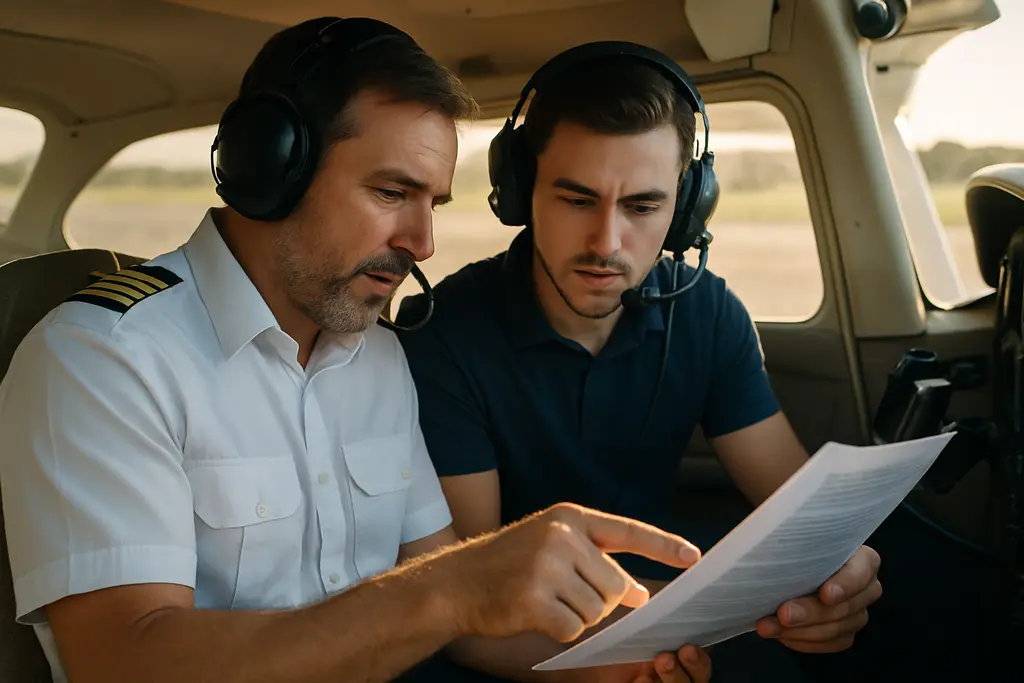
Standard primary training intentionally keeps the aircraft inside a very narrow flight envelope. Instructors teach students to recover from simple stalls with the nose barely dropping below the horizon. They introduce unusual attitude recoveries using a view-limiting device, rarely pushing the aircraft past thirty degrees of pitch or sixty degrees of bank. This sterile environment fails to trigger the human startle response.
When an actual upset occurs, the sudden G-forces and visual disorientation cause unexposed pilots to freeze or pull back aggressively on the yoke. Pulling back tightens a spin and guarantees a crash. Upset recovery training places you in an aerobatic aircraft with a specialized instructor who intentionally flips the airplane inverted. You learn to fight through the panic, identify the aircraft’s energy state, and execute the correct control inputs under extreme physical stress.
Comparing Training Environments
| Training Parameter | Standard Private Pilot Curriculum | Aerobatic Upset Recovery Course |
| Pitch Limits | Max 30 degrees nose up/down. | Full vertical up and down lines. |
| Bank Limits | Max 60 degrees of bank. | Fully inverted flight and aileron rolls. |
| Spin Exposure | Verbal discussion and stall avoidance. | Intentional multi-turn spin entry and recovery. |
The Physiological Impact Of Extreme Attitudes
Your inner ear relies on gravity to determine spatial orientation. During an upset, sustained G-forces trick your vestibular system into sending false signals to your brain. You might feel the aircraft climbing in a right turn when it actually descends rapidly in a left bank. Upset recovery training teaches you how to compartmentalize these overwhelming physical sensations and trust the instrument panel or the visible horizon over your own inner ear.
Safety organizations heavily advocate for this type of advanced maneuvering practice. You can review accident case studies and safety alerts regarding spatial disorientation through the National Transportation Safety Board (NTSB) aviation reports to see exactly how quickly loss of control develops. Experiencing these forces in a controlled, supervised environment drastically reduces the chance of spatial disorientation claiming your life during a real emergency.
Final Thoughts
Operating an aircraft safely requires more than holding altitude and talking on the radio. It demands the absolute ability to force the machine back into normal flight when the environment throws it out of balance. Taking a dedicated upset recovery course acts as the cheapest life insurance policy an aviator can buy. It strips away the fear of the unknown, replacing panic with trained, mechanical precision.