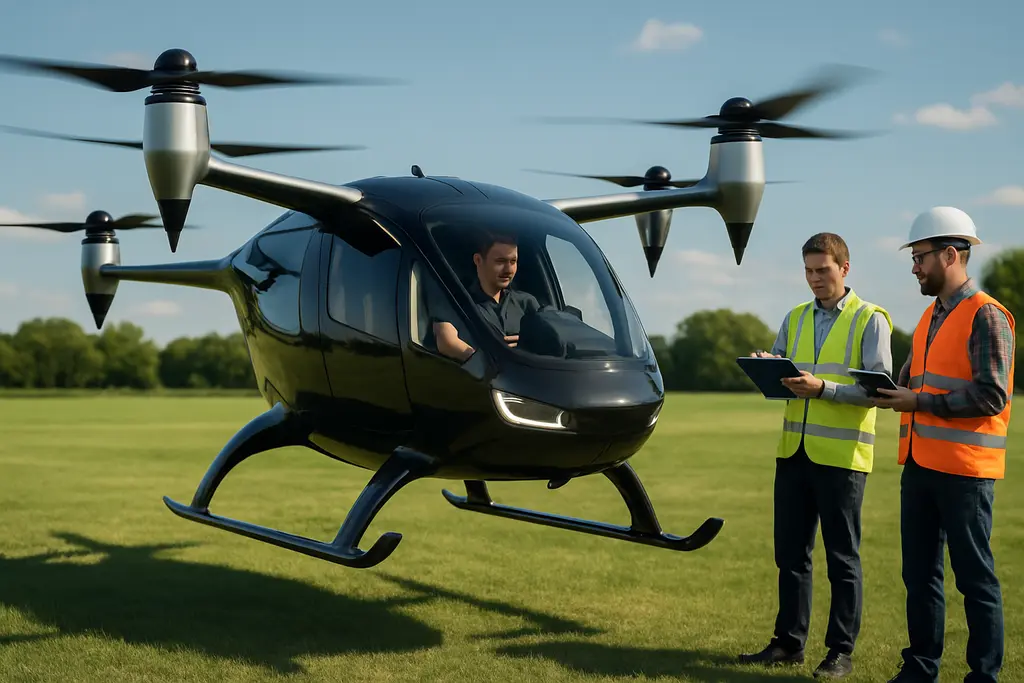
Flying taxis have moved into a more concrete U.S. test phase, with regulators, aircraft developers, airports, and training organizations now proving how advanced air mobility can fit into controlled airspace. On July 14, 2026, the FAA conducted an eVTOL Integration Pilot Program flight-test in which BETA Technologies’ ALIA electric aircraft transported an animal organ from Virginia Tech Montgomery Executive Airport to Charlottesville Albemarle Airport, then to Frederick, and finally to Martin State Airport in Maryland, validating the use of eVTOL aircraft for critical medical missions FAA milestone. That confirmed event matters because it shifted the discussion from aircraft promise to operational proof.
Flying Taxis Move From Concepts To Test Routes
The FAA’s eVTOL Integration Pilot Program, known as eIPP, became the main near-term proving ground for advanced air mobility in the United States. The eight projects selected in March 2026 span 26 U.S. states and include urban air taxi service, regional passenger flights with short-takeoff-and-landing elements, cargo logistics, emergency medical operations, and autonomous flight technologies. Operations were planned to begin by summer 2026. As of September 17, 2026, that planning window had already passed, but the supplied research confirms the selections and planned timing rather than the operational status of every individual project.
Why Flying Taxis Medical Missions Matter
The July 14, 2026 organ-transport test stands out because medical logistics create a demanding but clear use case. Speed has value, routing must be predictable, and safety margins must satisfy public agencies as well as aviation regulators. In flight training terms, this is the kind of mission profile that exposes the real questions: how crews brief vertical and cruise segments, how dispatchers coordinate with hospitals and airports, and how air traffic control manages an aircraft that does not fit neatly into fixed-wing or helicopter habits. Confirmed medical demonstrations do not prove broad public passenger service is ready, but they do provide a disciplined setting for evaluating aircraft handling, route coordination, and ground transfer timing.
Powered-Lift Rules Define Pilot Training
The regulatory foundation changed before the 2026 test phase began. On October 22, 2024, the FAA issued a final rule establishing a new powered-lift aircraft category. The rule addressed pilot and instructor certification, performance-based operational requirements, visibility rules, and minimum safe altitudes for aircraft that share characteristics with airplanes and rotorcraft. The powered-lift Special Federal Aviation Regulation, SFAR 120, took effect on January 21, 2025, with certain training center provisions becoming effective on July 21, 2025.
For aspiring pilots, the key takeaway is that these aircraft are not being treated as informal extensions of drone operations or helicopter flying. The pilot-in-command flight time requirement for a commercial pilot certificate with a powered-lift rating remains 50 hours of pilot-in-command time in a powered-lift aircraft. The SFAR also allows approved alternatives using simulators and certain supervised experience to help build the first generation of qualified powered-lift pilots. That balance reflects a practical training challenge: regulators must protect safety standards while recognizing that early aircraft availability will be limited.
Training Paths For Early Powered-Lift Pilots
From a certification standpoint, the simulator provisions are especially significant. Early powered-lift pilots will need to understand conventional cockpit discipline, energy management, automation monitoring, vertical-lift transition behavior, and airspace procedures. Simulators can help standardize those skills before enough operational aircraft exist to support large numbers of trainees. Flight schools, training centers, and airline-style programs should treat powered-lift as a separate professional track rather than a quick add-on. A candidate who already holds fixed-wing or rotorcraft experience may have transferable judgment, but the aircraft category requires dedicated procedures and documented proficiency.
Airspace Integration Is Now A Systems Test
The FAA’s human-in-the-loop simulations add another layer to the integration process. According to the supplied research, simulations have been completed for airports including Los Angeles International Airport and Orlando International Airport, with Orlando’s simulation held in September 2025. These exercises tested eVTOL operations in airspace shared with conventional aircraft. That matters because the hardest issue is not only whether an eVTOL can fly safely, but whether it can operate predictably around airline arrivals, departures, general aviation traffic, helicopters, weather deviations, and airport surface constraints.
Controllers, Airports, And Mixed Traffic
Controllers need repeatable flight profiles, phraseology, conflict-detection assumptions, and missed-approach expectations. Airports need practical gate, pad, charging, passenger-transfer, and emergency response procedures. Conventional aircraft operators need confidence that new routes will not erode runway throughput or add unclear right-of-way situations. Market-analysis: early deployment is more likely to favor structured routes, medical corridors, cargo patterns, and airport links before dense point-to-point urban networks. Those use cases are easier to brief, supervise, and evaluate through safety management systems.
Industry Demonstrations And Market Signals

Joby Aviation provided one of the clearer industry signals during 2026. The company reported demonstration flights earlier in 2026 connecting Manhattan and JFK, as well as flights in the San Francisco Bay Area. In an August 5, 2026 filing, Joby said it was preparing to conduct its first flights under eIPP in September 2026 in the U.S. states where it had been selected Joby filing. Because the supplied research does not confirm the outcome after that filing, the September eIPP flight status should be treated as not confirmed here.
| Area | Confirmed Status In Research | Training And Operations Meaning |
|---|---|---|
| Medical eVTOL test | Completed on July 14, 2026 | Shows how a time-sensitive mission can test route coordination and aircraft reliability. |
| eIPP projects | Eight projects selected across 26 states in March 2026 | Creates varied operating cases for regulators, airports, and operators. |
| Powered-lift certification | FAA rule issued in 2024 and effective in 2025 | Gives pilots and instructors a defined category for training standards. |
What The Joby Filing Confirms
For flying taxis, public demonstrations serve two purposes. They show passengers and local agencies what the aircraft may look and sound like in real operating areas, and they give regulators more data on procedures outside a laboratory setting. Still, demonstrations should not be confused with unrestricted commercial service. Certification, airspace procedures, maintenance programs, charging or energy management, dispatch rules, and pilot qualification all have to work together. Readers interested in broader aviation industry trends might find further information available on related network sites like SiteBob.
Infrastructure And Modernization Pressure Points
The supplied research points to infrastructure as a central limiting factor. In September 2022, the FAA issued vertiport design standards, and in May 2023 it released a blueprint for advanced air mobility operations in and around urban areas. In December 2025, the FAA’s AAM Comprehensive Plan of 2025 set out phased actions over the next decade to support wider deployment, standardize technology, develop vertiports, and connect AAM with other transport and aviation systems. The FAA also launched its Modern Skies air traffic control modernization effort with a $12.5 billion investment aimed at replacing outdated radar, communications, and control tower systems by 2028.
Vertiports And Local Operating Limits
Vertiports will not be simple landing pads placed wherever demand appears. They need obstacle clearance, emergency access, passenger flow, firefighting plans, charging or energy infrastructure, weather reporting, and coordination with nearby airports or heliports. Local acceptance will also depend on noise data, route discipline, and visible safety practices. For flight students, this means future AAM careers may involve airport-style standard operating procedures even on shorter routes. For instructors, the training emphasis should include decision-making around alternates, battery or energy reserves, abnormal procedures, and coordination with air traffic control.
Flying Taxis In The U.S. Airspace System
The turning point is not a single aircraft or one demonstration. It is the combination of confirmed flight tests, a powered-lift rule, simulator-supported certification paths, airport simulations, early route demonstrations, and infrastructure planning. Flying taxis still face practical barriers before broad passenger service can scale, and the supplied research does not confirm that every planned 2026 eIPP operation has been completed. The realistic signal is more grounded: advanced air mobility has entered a formal proving period inside the U.S. aviation system. For pilots, instructors, airports, and safety managers, this is the phase where disciplined procedures will matter more than promotional claims.