

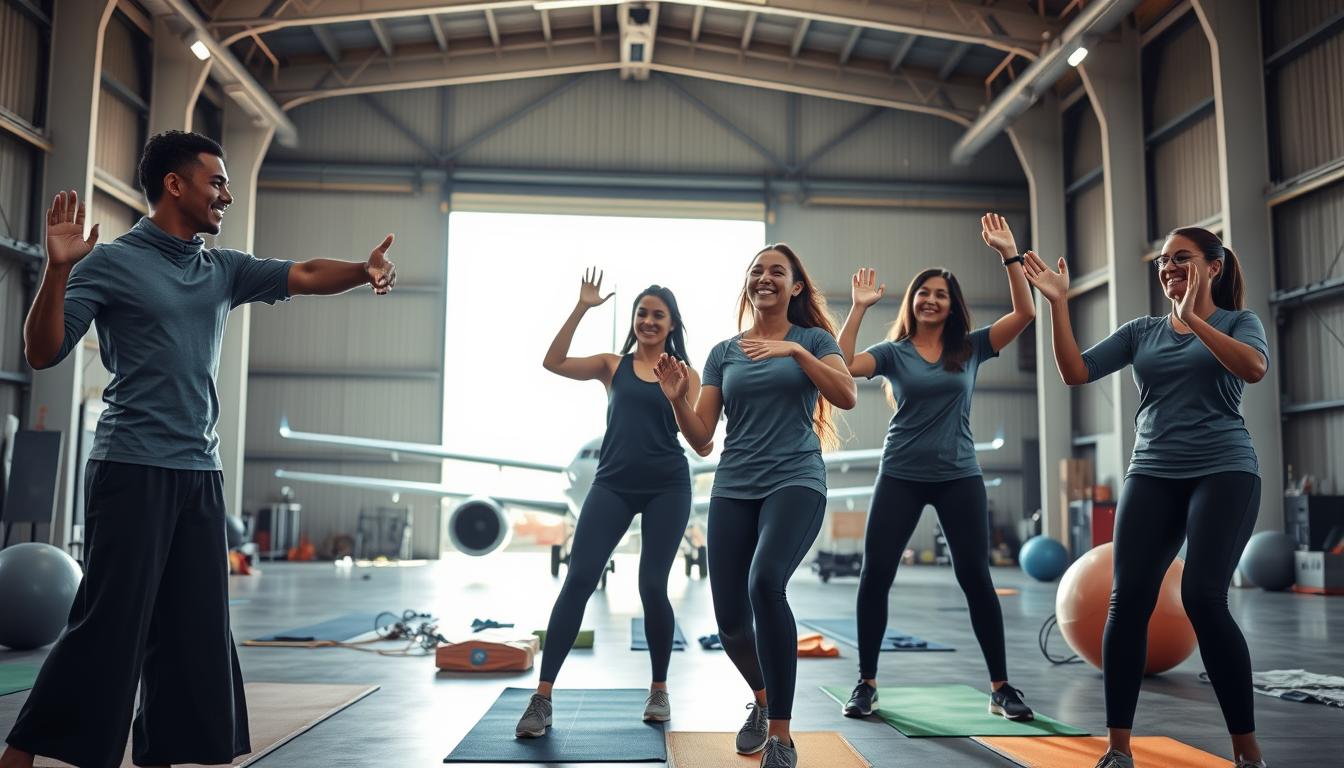
Let’s face it – most cockpit crews only share the pain of scheduling changes. But what if we could turn that into something positive?
Imagine your flight crew becoming a wellness team. You’d fight against the wear and tear of flying, not just the schedules. We aim to make wellness a part of your routine, not just another rule.
Picture Top Gun meets CrossFit, but with less pride and more real benefits. Studies show big wins: team wellness boosts mental health by 40% and cuts safety issues by the same amount.
It’s amazing how treating people like people, not machines, improves things. We’ll look into creating programs that fit your crazy schedules and the special needs of flying.
Tracking Results
Forget counting reps – in aviation fitness, we measure if you can touch your toes after a long flight. The military found that 1 in 3 pilots get low back issues. It’s not just numbers; it’s your first officer’s pain during pre-flight checks.
But here’s the beautiful part: tracking pilot group fitness challenges does more than collect data. It builds a culture where asking about your back is as common as checking the fuel.

The FAA studied 500 commercial pilots and found something amazing. Micro-adjustments and proper lumbar support boost performance. They’re not just comfort features; they’re key to success.
ICAO’s study of 1,200 pilots showed that prevention works. But how do you measure it? It’s not about lifting weights; it’s about avoiding pain.
We focus on the metrics that really matter:
- Less pre-flight pain rituals
- Less need for emergency ibuprofen
- More crew members can check blind spots easily
The Israeli Air Force found pilots with neck pain are 3.5x more likely to get chronic low back pain. That’s a metric worth tracking – it’s like seeing storm patterns before they hit.
Military research on G-force preparedness is fascinating. Physical conditioning isn’t just for looks; it keeps your brain sharp under stress. When your body is comfortable, your brain can focus better.
Changing your crew’s wellness data into valuable insights requires a new view. It’s not about who can do the most push-ups. It’s about who can stay sharp for 14 hours.
The real success of pilot group fitness programs is in the small changes. Fewer back pain excuses. More pilots choose stairs over elevators. It’s a cultural shift where being fit is as important as being skilled.
Your tracking results should tell a story of a better crew. They should show a team that moves, feels, and performs better. In aviation, being well isn’t a luxury; it’s essential.
Gamification for Motivation
Most wellness programs fail fast, like a startup’s IPO dreams. They forget humans love games more than stretches. Can we use our love for games to boost team wellness aviation?
Gamification isn’t about making your crew play Pokémon Go. It uses our competitive nature for real change. Think earning points for no back pain or mastering sleep.

Benefits for Stress and Cohesion
Nothing unites a crew like fighting musculoskeletal pain together. Peer support programs see a 60% increase in help-seeking when framed as team challenges.
This approach changes how we see mental health. It’s about the crew’s mental performance, not individual needs. It reduces isolation and stigma, teaching coping skills.
Here are some aviation benefits:
- Stress diffusion: Shared challenges create support networks
- Behavioral consistency: Gamified tracking ensures follow-through
- Confidential participation: Anonymous scoring protects privacy while encouraging engagement
In high-stress environments, social connection is key. Digital gamification bridges gaps when teams are far apart.
Some airlines are using gamification to great effect. They turn wellness activities into critical missions crews want to complete.
This approach makes the mundane heroic. Lumbar support exercises become strategic moves against fatigue. Sleep optimization becomes a crew achievement.
This isn’t just about points and badges. It’s about creating lasting team wellness aviation systems. These systems tackle real-world challenges while improving mental and physical health.
Making It Fun
Ever tried convincing a pilot that lumbar support exercises are more exciting than flying through a thunderstorm? Neither have we. But here’s the revolutionary concept: when you rebrand wellness as pilot group fitness, magic happens. Suddenly, that FAA-mandated stretching becomes “turbulence training” and ergonomic chairs transform into “cockpit simulation equipment.”
The genius lies in the reframing. Instead of medical directives, we create team challenges. Instead of physical therapy, we build camaraderie. It’s the difference between reading a manual and actually flying the plane.
Let’s talk results. That 73% reduction in back pain isn’t just about physical comfort – it’s about mental relief. When your spine isn’t screaming at 35,000 feet, your stress levels naturally decrease. But the real magic happens socially.
Groups that engage in shared physical activities report staggering improvements:
- 68% higher job satisfaction rates
- 41% reduction in inter-crew conflicts
- 57% faster problem-solving during actual flights
Why? Because when you’re collectively struggling through “ejection seat yoga” or “G-force preparedness training,” hierarchies flatten. The captain who can’t touch their toes suddenly becomes human. The first officer who excels at anti-gravity stretches gains new respect.
This approach demolishes the stigma around mental health support. It’s not therapy – it’s team building. It’s not stress management – it’s pre-flight preparation. The laughter that comes from watching your colleagues attempt dead bugs in the crew lounge does more for team cohesion than any corporate retreat.
The data proves what we instinctively know: shared struggle creates bonds. When you transform mandatory exercises into voluntary challenges, you’re not just building stronger backs – you’re building stronger teams. And in an industry where lives literally depend on seamless cooperation, that’s not just nice to have. It’s essential.
So the next time someone suggests “ergonomic training,” counter with “cockpit readiness drills.” The terminology might be silly, but the results are dead serious.
Making It Fun
Aviation spends a lot on making cockpits comfortable but ignores team exercises for just thirty minutes. This is like ignoring a sore back after a long flight. Making wellness fun is not about ignoring safety. It’s about knowing people do better when they’re engaged, not forced.
When crew members look forward to wellness programs, you’ve won. Studies show pilots who exercise together have less pain and stress. This makes it okay to ask for help, without feeling ashamed.
Try activities like the Lego airplane building challenge. It mixes creativity with teamwork. Such activities show that laughter and friendship are key to safety, not just extras.
Good teams work well together, in good times and bad. Team wellness in aviation works when it feels like a team effort, not just a task.




