I thought the private pilot written exam was just red tape. Then my instructor, Jamie Pittman (EAA 439727), suggested I take the FAA written test early. He was serious. This taught me an aviation lesson: feelings don’t matter to gravity or instructors.
Soon, I scored 98% on the test. It was not about memorizing answers. Rather, it was about understanding the logic behind them, making the pilot test useful for flying.
This approach is vital for finances too. Studying with intent means you don’t waste flight hours re-learning. View this as your strategic guide, not an excuse to buy every book out there. Overzealous adults can quickly overload on reading material.
The FAA written test uses a computer and multiple-choice format, held at an approved center. It covers various topics like weather and FAA rules over 2.5 hours. Hard topics like density altitude are essential for pilots to understand.
This guide views the pilot knowledge test as a crucial plan. We’ll discuss effective study methods and realistic practice exams. We’ll also explore how to finance your training smartly, including ways to afford it without loans. In aviation, the best hours are those you learn from efficiently.
Why It’s Expensive & How Much to Expect
Flight training isn’t just about spending money. It’s about investing time, concentrating hard, and missing out on hanging out with friends for seven weeks. I thought I knew what “busy” was until I had to learn weather codes like movie stars’ names.
The real deal hits when you start to pay. The cost of the private pilot written exam can be shocking. And it’s not just about the money. You have to dive into a wide range of topics and master them, all while watching out for tricky questions.
Taking the test is simple in theory. You go to an FAA-approved place and answer 60 multiple-choice questions on a computer in 2.5 hours. The questions cover everything from how planes fly to how to navigate them, so you need to be ready for anything.
But that written exam is just the beginning. It’s your first step before the practical test, which is more intense. You’ll have a face-to-face talk and a flying test with an examiner. And everyone will see how you do. This is why knowing how to study right is crucial.
| Cost Driver | What You’re Paying For | Why It Adds Up | How to Keep It in Check |
|---|---|---|---|
| Knowledge test fee | Scheduling and sitting the exam at an FAA-approved testing center | The private pilot written exam cost is a fixed hit, and rescheduling can create extra friction | Pick a date early, then study backward from it with weekly targets |
| Prep materials | Ground school, books, question banks, and practice exams | The pilot knowledge test format covers a wide syllabus, so gaps get expensive fast | Use one primary course, then one question bank; avoid collecting five “perfect” resources |
| Time and attention | Hours spent on weather, charts, regulations, and performance math | Opportunity cost: fewer work hours, fewer evenings free, more mental fatigue | Block short daily sessions; 30–45 minutes beats one weekend cram |
| Practical test readiness | Oral prep plus flight proficiency tied to your written knowledge | Missed concepts show up later in the oral, where “kind of” is not a passing grade | Turn weak quiz topics into briefing notes you can explain out loud |
- Match the clock. Practice with timed sets so the pilot knowledge test format feels normal, not dramatic.
- Study like a reporter. When you miss a question, write the “why” in one sentence, then move on.
- Don’t fight the calendar. The fastest savings often come from avoiding delays that drag training out.
Scholarships for Student Pilots
When flight training costs start acting like a luxury tax, I look for the parts of aviation that still behave like a community. Scholarships are the cleanest example. They don’t just lower the bill; they also add structure, deadlines, and a little social pressure. In other words, the stuff motivation posters can’t deliver.
One pipeline worth tracking is Sporty’s EAA partnership, which connects real training support to real aviation participation. If you’ve been involved with Young Eagles, you already know how the program turns curiosity into cockpit time. Eagle Flights can do the same for adults who want a first serious step without the “good luck out there” vibe.
Scholarships don’t always pay for every hour in the air, but they can still shrink your total spend. Covering study tools and ground prep matters because your FAA written score isn’t a vibe check; it’s a gate. Strong ground school programs can cut retest risk, tighten your timeline, and help you show up to the oral with something better than random tabs and half-remembered acronyms.
I also like local structure when the internet starts feeling like a buffet with no exits. High Tide Aviation offers ground school programs in-person and online, which means you can trade solo scrolling for a plan, peer pacing, and accountability. Yes, accountability—the only force in aviation stronger than caffeine and fear of embarrassment.
| Path | Who it fits | Typical cost relief | Best use during training | What to prepare |
|---|---|---|---|---|
| Sporty’s EAA partnership | Students who want an organized pipeline and clear next steps | Can offset training support and learning resources tied to EAA efforts | Early momentum: start strong, stay consistent, reduce false starts | Participation history, a simple training plan, and proof you’ll follow through |
| Young Eagles | Teens exploring aviation with a community push | Often leads to scholarship-aware networks and structured opportunities | Discovery to commitment: build experience and credibility before you spend big | Local involvement, school schedule awareness, and parental support if needed |
| Eagle Flights | Adults who want a first step that feels concrete, not theoretical | Can connect you to programs that reduce upfront friction and learning costs | Confidence building: validate interest before locking in a full budget | Availability, realistic timeline, and a short statement of goals |
| High Tide Aviation ground school programs | Students who need a coherent plan and fewer “DIY study spirals” | Can lower overall costs by reducing retest risk and wasted study materials | Written-to-oral transition: build knowledge you can explain under pressure | Consistent weekly time blocks and willingness to ask questions out loud |
If you’re weighing options, I treat scholarships like a strategy, not a lottery ticket. I map deadlines, match them to my training phases, and focus on programs that improve execution. Between Sporty’s EAA partnership, Young Eagles, Eagle Flights, and strong ground school programs, the theme is simple: the best help comes with a plan attached.
Private Loans and Grants
Private loans and grants can help pay for flying. But they’re often wasted on things we don’t need. I made the mistake of buying too many books. They mostly just ended up sitting on my shelf.
The better approach is less exciting, but it’s effective. Find out what your instructor uses in class and get the same materials. If you have a loan or grant, choose textbooks that are useful for both training and tests.
The Student Pilot’s Flight Manual by William Kershner was a great choice for me. It offers practical guidance and stays useful beyond the written exam. Your study materials should continue to be helpful, even after your initial enthusiasm wears off.
I regularly use ASA Test Prep for studying. ASA Test Prep: Private Pilot with Prepware covers every topic for the FAA Private Pilot test. It includes many updated questions and a software for endless practice tests. You can study in different ways and track your progress to improve.
Many pilots prefer Gleim Aviation for systematic study and lots of practice questions. If you like video lessons, try King Schools. Spend your money on resources that are up to date, track your learning, and use FAA terms. The FAA’s style is unique and important to understand.
| Resource | Best for | What you get | Why it’s a smart use of loan/grant funds |
|---|---|---|---|
| ASA Test Prep | Written exam readiness with feedback | Updated questions, explanations, Prepware practice tests, performance tracking | High-utility studying that mirrors FAA question style and shows weak areas fast |
| Gleim Aviation | Disciplined study plans and repetition | Structured outlines, strong test bank approach, clear learning path | Reduces “random studying” so paid training time doesn’t get wasted re-learning basics |
| King Schools | Video-based learning and concept clarity | Engaging lessons, scenario-style teaching, review tools that support retention | Helps prevent costly confusion in ground lessons and checkride prep |
| best pilot textbooks | Long-term reference during training | Core aviation knowledge, flight maneuvers, decision-making basics | Books that stay useful past the test beat impulse buys that turn into dead weight |
If a purchase won’t directly help you fly, pass tests, or perform better, it’s just shopping for fun. And fun shopping has a high cost in the end.
Working and Training at the Same Time
When trying to balance a job with flight training, it’s not about managing time. It’s like negotiating policy with my own stubborn calendar.
For a while, my life outside of work was all about studying. I had to say goodbye to my social life for seven weeks. It wasn’t fun, but it was like passing a major law, it really worked.
My rule was simple: study without breaks for one hour every day. Those daily study sessions helped me more than cramming at the last minute.
I thought coffee shops would be productive, but they were too distracting. So, my kitchen table turned into my control center. That’s when my study plans really took off.
Creating a structured study plan was key. It helped keep my mind on work during the day, just like HR wanted.
I started with essential FAA handbooks like the Pilot’s Handbook of Aeronautical Knowledge and the Airplane Flying Handbook. Next, I practiced FAA-style questions from ASA and Gleim. I did timed sets, then studied my mistakes until I got them right.
My study routine was purposely dull: review topics for 30-45 minutes most days and take a full practice test weekly. Then, I’d go over any questions I missed as if I was settling a score.
As the exam neared, I focused on oral preparation. I’d practice answers out loud or with my instructor. Designated Pilot Examiners (DPEs) expect you to know “why,” not just “what.”
| Phase | Goal | Workday-friendly actions | Proof you’re ready |
|---|---|---|---|
| Learning | Build the base knowledge without gaps | Read FAA core texts; make a short recap after each session; lock a repeatable study schedule | You can explain concepts in plain English without looking anything up |
| Practice | Turn knowledge into test performance | Use ASA or Gleim question banks; take timed quizzes; run a weekly full-length exam for pilot knowledge test prep | Your scores are consistently above 90%, and you rarely miss the same question twice |
| Scenario | Sound like a pilot, not a flashcard robot | Do mock orals; talk through weather and risk decisions; apply checklists to real scenarios as a daily study habit | You can confidently explain your decisions and the reasoning behind them |
The key to studying while working full-time is to stay consistent. Keep study times short but sacred, like an important meeting. Let momentum carry you forward.
Having a solid plan secretly powers your progress. It makes moving forward feel easy, even when work gets in the way.
Budgeting and Smart Spending
My best savings move wasn’t getting another book. Instead, it was investing in an online ground school. Trying to understand aviation laws was like hoping to learn French just by looking at a dictionary.
I chose Sporty’s Learn to Fly Course for its clear focus. The videos were straightforward, and the practice tests truly helped. Those online tests were key to my success, letting me measure my topic knowledge accurately.
Smart spending also includes buying tools that help with tricky questions. The ASA CX-3 flight computer saves time and avoids mistakes during tests. I started by borrowing one, but now I think it’s essential for solving aviation problems.
And certainly, get a plotter. It’s affordable, lightweight, and simplifies navigating through charts. While I got the hang of the E6-B, the CX-3 was best for test time and precision.
| Spend Category | What I Chose | Why It Paid Off | Budget Move |
|---|---|---|---|
| Study system | online ground school | Less overwhelm, more repetition, better recall under pressure | Pay once, use daily, track weak areas by section |
| Primary course | Sporty’s Learn to Fly Course | Videos + practice tests matched the way the written is actually asked | Use learning mode tests to avoid over-studying strong topics |
| Computations | ASA CX-3 flight computer | Fast, consistent answers on wind, time, fuel, and performance math | Borrow first if you can, then buy if training pace is steady |
| Chart work | plotter | Clean lines, quick measurements, fewer guess-and-check mistakes | Buy once, keep it with your sectionals and kneeboard |
For books, my rule is simple: borrow whenever possible, but make sure they’re updated. I often read Rod Machado’s Private Pilot Handbook, loaned by a colleague. It was informative without costing much.
When buying test prep, I went for the ASA 2019 Private Pilot Test Prep book. It covered 11 sections with over 989 questions. Such repetition might seem dull, but like push-ups, it’s effectively boring.
Hidden Costs to Plan For
Hidden costs in flight training are not always clear. They might appear as stress, lost time, or moments when everything seems new again. If you only prep once with old stuff, you’re likely to pay more.
Question banks often update, but silently. For instance, I saw Sporty’s update their FAA written test questions right before my exam. They added new questions that showed up on my test. If your study material is old, you’re not really learning useful aviation stuff.
Then there’s something we call format friction. It means some things are easier to study on paper than on a computer. Trying to zoom or scroll through exam materials online can be a pain. This isn’t just a small issue; it changes how we work.
Practicing too much can also be a problem. When I did too many practice questions in a row, I started making dumb mistakes. This wasn’t because I didn’t know the answers. It was because I wasn’t paying enough attention.
Mind games during tests are real, too. On January 7, the very first question tripped me up because I hadn’t seen it before. It was the only one I missed. My strategy was simple: skip hard questions, collect easy points, and then go back. I also double-checked my answers carefully.
We also need to be ready for wording changes. The FAA likes to rephrase things, so understanding concepts is key. Knowing the ‘why’ behind things helps you adapt to new questions.
| Hidden cost | How it shows up | What it impacts | Practical fix |
|---|---|---|---|
| Outdated prep content | New items appear after FAA written test updates, and your study set feels “off” | Confidence, accuracy, and review time | Use a course that refreshes often; re-check recent additions before you book the exam |
| Format friction with figures | Charts are harder to interpret on an exam platform than in a book | Speed, fatigue, and careless errors | Practice with the same style of charts you’ll use; keep a printed reference for study sessions |
| Overloading practice tests | Too many sample exam questions in one sitting leads to “silly misses” | Retention and error rate | Stop when focus drops; do shorter blocks with targeted review |
| First-question panic | An easy question you didn’t prep for spikes stress early | Decision-making for the next 10–15 questions | Stick to a test-day strategy: skip, answer what you know, and return with a cooler head |
| Paraphrased wording | Questions don’t match your notes even when the concept is familiar | Second-guessing and wasted minutes | Study concepts, not scripts; explain each topic in your own words before testing |
Budgeting for hidden costs means you expect things to change. You’re preparing for problems and distractions. The aim is not to know every question before the test. It’s to understand the material, even when it’s presented differently.
Success Stories: Pilots Who Made It Work
There’s nothing more convincing than a success story where you beat both time and difficulty. That was my journey. Just seven weeks after doubting if I could still take exams, I aced the private pilot exam with a 98%.
My strategy was not about romance but efficiency. I chose one main study path, stopped hoarding study guides, and got to work.
I relied on Sporty’s videos in my free moments. The ASA Private Pilot Test Prep became my unofficial second job, promising rewards in the form of runway lights.
I tackled the study book aggressively. Every mistake was marked, and every correct answer was highlighted. This strategy felt odd, remembering the FAA’s strict standards, but it worked.
After finishing a section, I took targeted practice tests using Sporty’s. My goal was simple: aim for 90% on each section. Dropping to 85% meant moving ahead but with regular reviews to strengthen weak points.
Indeed, I left the toughest subjects for the end. Normally, one would tackle these first. But gaining confidence and maintaining momentum proved to be effective study tools.
When I was two-thirds through and consistently scoring over 90%, I booked the exam date. Setting a deadline worked wonders.
With two weeks left, I started taking full, 60-question tests to build endurance and focus. Achieving scores above 90%, occasionally hitting 100%, gave me immense confidence.
The real benefit was more than a high score. Facing unexpected questions didn’t shake me. I was prepared, especially for tricky sections on cross-country flight planning, weather, and navigation.
My success wasn’t about shortcuts or special tricks. It was about a simple, effective cycle: learn, test, revise, and repeat. Following this, even the most challenging goals become attainable.
| Step | What I Did | Why It Worked | How It Connects to Test Day |
|---|---|---|---|
| 1 | Picked Sporty’s + ASA as my main stack and ignored the rest | Less switching, more depth; fewer “new shiny” distractions | Builds consistent recall patterns across question styles |
| 2 | Marked ASA answers hard: crossed out wrong, highlighted right | Faster review and cleaner mental cues | Reduces second-guessing under time pressure |
| 3 | Used section-level practice tests in learning mode after each chapter | Immediate feedback while the material was still fresh | Turns weak areas into predictable points, not surprises |
| 4 | Saved cross-country flight planning, weather and navigation for later | Momentum made harder topics feel manageable | Lets you enter “hard mode” with stronger base knowledge |
| 5 | Scheduled early once I was consistently scoring 90%+ | A real date created urgency and focus | Protects your best performance window from drift |
| 6 | Finished with full-length, randomized practice tests | Builds stamina and exposes gaps across all subjects | Mimics real pacing and keeps confidence steady |
Helpful Resources and Contacts
If you’re looking for top-notch pilot study materials, start with the FAA. The FAA handbooks, especially PHAK AFH, really delve into the reasons behind flight rules. Even when money is tight, these books remain some of the best resources on my desk.
The Pilot’s Handbook of Aeronautical Knowledge (PHAK) is essential for understanding airspace, weather, and more. I use it with the Airplane Flying Handbook (AFH) for learning about flying techniques and safety. The Instrument Flying Handbook comes in handy for more advanced topics without overwhelming me.
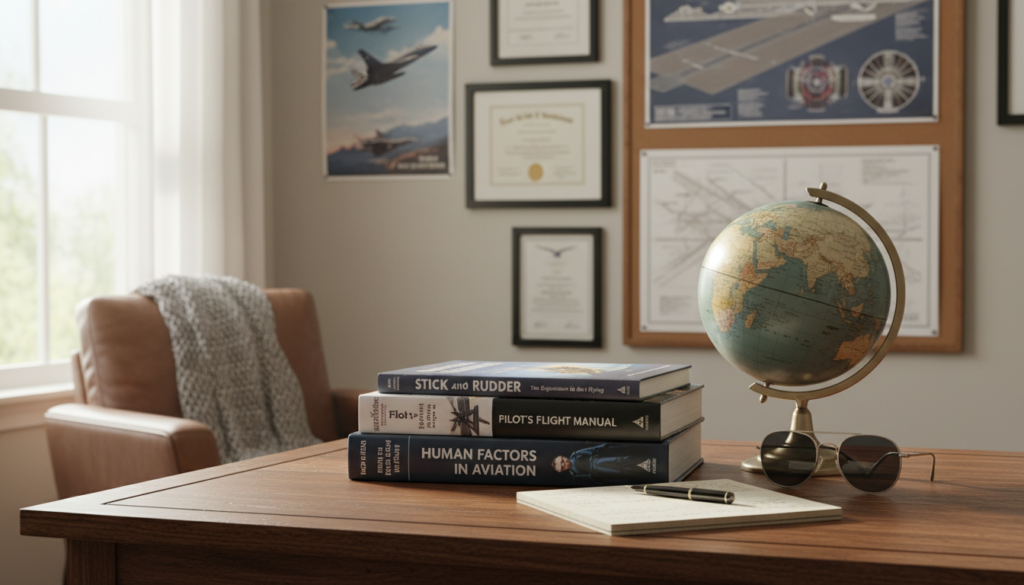
For written tests, tools that guide like a coach work best for me. ASA Test Prep: Private Pilot with Prepware offers practice exams and tracks progress. I also recommend Gleim Aviation, King Schools, and Sporty’s Online Learn to Fly Course for their videos and quizzes.
For oral exams, the ASA Oral Exam Guide is incredibly useful. It’s like practicing with an examiner without the cost. I use it to identify and improve my weak areas with the help of the Airman Certification Standards (ACS).
Jeppesen GFD Private Pilot Maneuvers manual is great for visualizing maneuvers and avoiding common mistakes. Simulators, like Redbird FMX, are useful for practice without spending too much. They help make complex topics easier to grasp.
Don’t forget about your logbook and endorsements. Keep them organized with tabs for important flights. It might not be the most exciting task, but it’s crucial for avoiding delays caused by paperwork issues.
| Resource | Best for | What I use it to do | When it pays off most |
|---|---|---|---|
| FAA handbooks PHAK AFH | Foundations and real understanding | Build mental models for weather, airspace, systems, and flight maneuvers | Early training and anytime a concept feels fuzzy |
| Airman Certification Standards (ACS) | Staying aligned with the checkride | Map each task to required knowledge, risk items, and skill standards | Mid-to-late prep, when you need structure and focus |
| ASA Oral Exam Guide | Oral exam readiness | Self-quiz in examiner style and practice crisp, accurate answers | Two to three weeks before the checkride |
| ASA Test Prep: Private Pilot with Prepware | Written exam confidence | Drill question banks, review explanations, and track weak areas | When you’re booking the knowledge test date |
| Jeppesen GFD Private Pilot Maneuvers | Visual learners and maneuver polish | Study step-by-step procedures and spot common errors before flying | Right before stage checks and maneuver-heavy lessons |
| Desktop simulators or Redbird FMX | Scenario practice without paying full aircraft costs | Rehearse navigation, radio flows, and flight planning under pressure | Bad weather weeks and pre-checkride confidence building |
| Logbook and endorsements | Proof and organization | Verify eligibility, required experience, and clean documentation | Checkride scheduling and the day of the practical test |
To build a useful collection of pilot textbooks, stick to the basics. Begin with FAA handbooks PHAK AFH. Add the Airman Certification Standards (ACS) for clear guidelines. Lastly, use the ASA Oral Exam Guide for speaking practice. This approach keeps your study time focused and effective.
Final Motivation to Get Started
Motivation is like a cute poster in a break room. But systems are what really make things happen. I made a choice that seemed a bit crazy: take the written test early, then treat studying like it’s brushing teeth—essential and effective. This decision boosted my confidence for the FAA written test more than any motivational talk.
My CFI, Nancy Bradshaw, emphasized finishing early because learning to fly isn’t easy. She said to separate the exam from flying lessons to ease our minds. And she was spot-on. If you’re aiming for true readiness for the pilot knowledge test, focus on understanding the concepts rather than cramming.
I learned some study strategies I now live by: study in timed sessions, use a computer, and keep practicing until you consistently score above 90%. Don’t rely solely on sample exam questions. The FAA might change the wording, and if you’re not solid on the basics, it’ll show.
Expect surprises on test day, like questions you’ve never seen. If that happens, skip it initially, secure the easy points, then tackle the tough one, even if it means recalculating. Passing is great, but the real win is how your flight training improves when you’ve laid a strong knowledge foundation. Remember, in aviation, as in politics, a solid foundation is key.