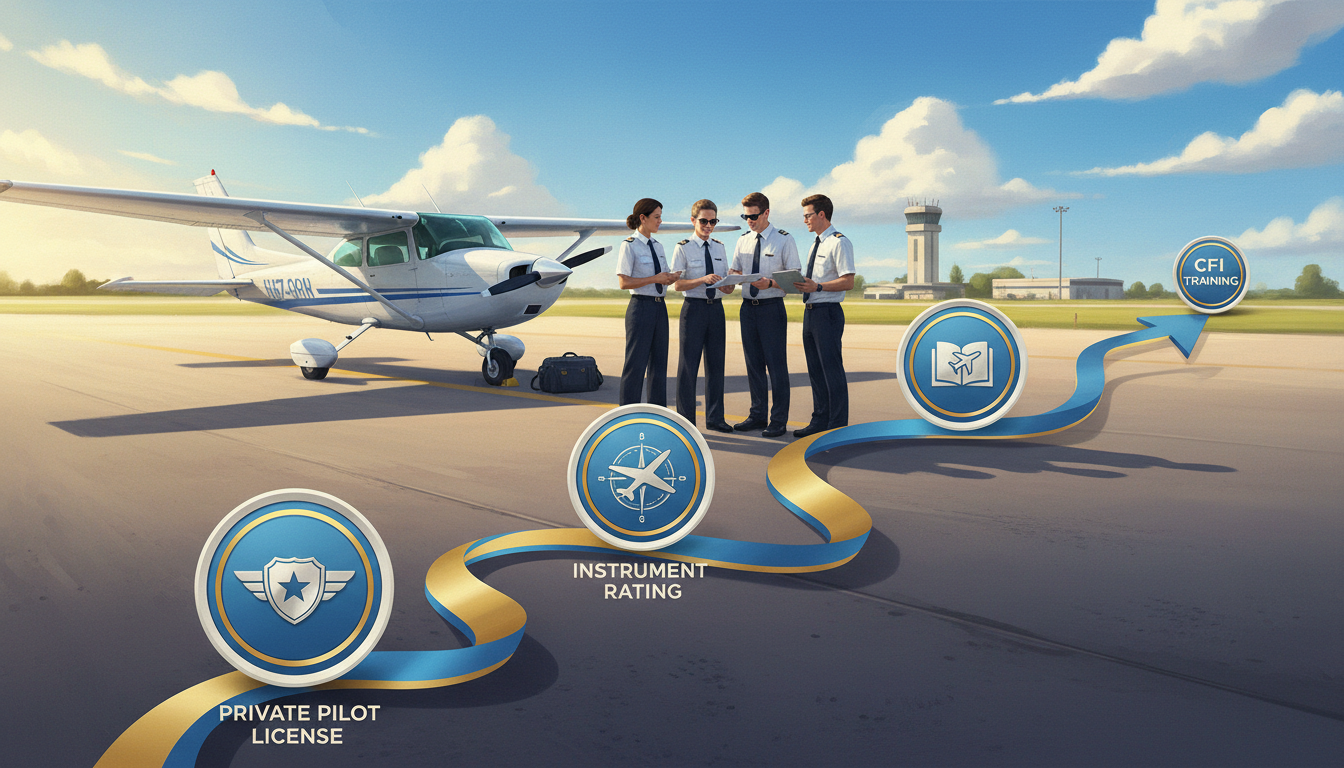
First impressions matter, not just in personal meetings but in search results too. If you’re looking to become a Certified Flight Instructor, your title needs to be clear and quick. Search engines are unforgiving in sorting information.
I approach this guide like it’s both practical and informative. Most folks only glance at the title before deciding to read on. So, being clear isn’t just nice, it’s necessary for catching attention and making Google notice.
When it comes to safety and credentials, being direct is key. A solid strategy focuses on what’s essential, ensuring nothing important is missed. Related Keywords are introduced early because people use simple search terms, not industry jargon.
This section is an overview of the entire guide. We’ll discuss what a CFI is, then go over the steps to become one. This includes training, tests, and finally, teaching your own students. We’ll also touch on finding a job and what happens next.
By the finish, you’ll know the exact steps to take, presented in a straightforward way. This roadmap aims to be easy to read, easy to follow and approved by search engines. And it’s written in plain language, so it’s easy for everyone to understand.
What is a Certified Flight Instructor (CFI)?
A Certified Flight Instructor, or CFI, is not just a title. It is a serious job with important responsibilities. A CFI is a pilot who is allowed to teach others how to fly. They can also evaluate students and sign documents that are crucial for the students’ progress.
In simpler terms, a CFI can teach for certificates and ratings, as well as help pilots stay sharp. This job is about teaching with clear standards and making big decisions that really count. It’s much more than just being a co-pilot who chats a lot.
Our goal here is to fully understand the CFI role before we explore why it’s appealing. The terms we’ll discuss—like endorsements and lesson plans—are key parts of a CFI’s job. They are essential for the teaching process, testing, and the final checkride.
What does being a CFI allow you to do? You can teach, assess, and endorse students. The real challenge is in deciding if a student is ready for FAA evaluation. When a CFI signs off on this, they are taking on a big responsibility.
| CFI permission in FAA terminology | What it means in plain English | How instructor responsibilities show up |
|---|---|---|
| Provide flight training | Teach maneuvers, procedures, and decision-making in the air and on the ground | Plan lessons, manage risk, and correct errors before they become habits |
| Give required endorsements | Sign training records so a student can solo, take a knowledge test, or attempt a practical test | Verify eligibility, track aeronautical experience, and document training accurately |
| Recommend for a practical test | State that the applicant meets standards and is ready for an examiner | Evaluate performance against published criteria, not vibes or optimism |
| Teach under defined privileges and limits | Instruct only within what your certificate allows | Know what you can teach, when to refer out, and how to stay compliant |
I’m focused on being clear and straightforward for a reason. Every detail must stand on its own; nothing should be just a teaser. The terms CFI, flight instructor role, and what they encompass—like training stages and exams—will remain clear as we progress. We aim to avoid surprises in aviation by being upfront about everything.
Why Become a Flight Instructor?
If the Main Keyword doesn’t grab you quickly, you might not keep reading. And that’s okay. Becoming a CFI might seem like paying to talk more at work. Yet, it sharpens your mind and skills, filling your logbook with experience.
Background: Teaching involves more than flying. You’ll deal with students, weather, maintenance, and busy skies. These challenges test you in front of others. This pressure makes you think seriously about your career, beyond just liking planes.
Objectives: Teaching isn’t just about logging hours. It’s about refining your judgment. You’ll explain complex ideas simply. This process builds professional discipline, as you follow standards daily.
Networking is a hidden benefit. You’ll meet many aviation professionals who notice your dedication. These connections are incredibly valuable, no matter your career goals in aviation.
- Likely outcomes: You’ll keep skills sharp, make better decisions, and fly more.
- Tradeoffs: You might start with lower pay and face tough schedules. Staying calm during stressful moments can also be challenging.
- Signals of fit: If you enjoy explaining things, can remain patient, and value the journey, teaching may be right for you.
Think carefully about becoming a flight instructor. It’s not all about feeling like a hero every day. Use this guide to check if this path fits your goals and commitment level.
| What you want | What instructing tends to give | What it asks of you | Who benefits from your networking |
|---|---|---|---|
| More flight time with purpose | Repetition under standards, plus real-world scenario teaching | Prep time, debriefs, and owning your student’s safety habits | Flight school leaders, fellow instructors, local operators |
| Better decision-making under stress | Constant practice with weather calls, go/no-go, and risk talk | Humility when plans change and lessons go sideways | Check airmen, designated pilot examiners, safety managers |
| A clearer aviation career strategy | A track record that shows discipline, consistency, and communication | Patience with slow progress and uneven schedules | Chief pilots and recruiters who value teaching credibility |
| Career momentum without guessing | Feedback loops that expose weak spots fast | Thick skin when you’re “on stage” every flight | Mentors who open doors when you’re ready |
If mastering your craft speaks to you, that’s a good sign you’re on the right path. But if you’re looking for an easy way, teaching won’t prevent burnout. A genuine career in aviation begins with an honest goal—before your first lesson on taxiing.
Prerequisites and Qualifications
Before dreaming of being a CFI, remember the prep work matters as much as style. If you’re sloppy upfront, no one will trust what comes after. It’s not just about looking cool or being confident. The real stuff, like eligibility, is what counts.

Picture a checklist for qualifications. If it’s too vague, you’ll skip important stuff. If it’s too long, you’ll hide the essentials. We aim for clear, specific, and useful—so you’re ready, without just hoping you’re good.
| Requirement area | What “meets the bar” in the U.S. | What to verify before spending money | Why it matters |
|---|---|---|---|
| Certificates | Commercial Pilot Certificate (Airplane category and class you plan to instruct in); instrument privileges strongly expected for most pipelines | Your certificate level, category/class, and whether your career goals fit with CFI or CFII paths | These are the basic must-haves. Without them, you’re not even in the running |
| Medical | Valid FAA medical for your flying needs; many instructors aim for at least Third-Class for more job options | Check your medical’s expiry, restrictions, and if it supports your training plans | If your medical isn’t up to date, your training plans hit a wall |
| Flight experience | Enough experience and skill for commercial flying and good instrument handling; recent flying to stay sharp for teaching | Make sure your logbook is current and you can show you know your stuff according to ACS standards | Students will notice if you’re unsure, just like TSA spots liquids in your bag |
| Knowledge tests | Passing scores on the FOI and FIA (plus others as needed) within the valid timeline | Understand what exams you need and if you’re eligible for shortcuts | This isn’t about cramming. It’s about matching your skills to FAA needs |
| Endorsements | The right instructor sign-offs for training and exams, from a qualified instructor | Check the details, dates, and match against your exam plans | A small mistake in wording can mess up your paperwork on test day |
| English proficiency | Meeting FAA English standards for pilots and instructors | Review any limits and ensure you can guide, teach, and correct safely | Clear talking is part of safety, not just being friendly |
| Identification & records | Proper ID and full records as needed | Ensure all your documents match across different forms and logs | Being ready paper-wise keeps things smooth when they look closely |
Here’s a quick checklist I use before contacting a flight school or examiner. It keeps things neither cryptic nor too long-winded. It balances what’s key with the practical bits we actually look at.
- Certificates: Commercial privileges for your teaching aircraft, and instrument skills if that’s what’s expected.
- Medical: Up-to-date and fitting for your weekly flying.
- Logbooks: Totals make sense, entries are clear, and you’ve been flying enough recently.
- Testing plan: Schedule FOI and FIA (as needed) with time to work on any weak spots.
- Endorsements: All endorsements correct, current, and in order.
- Paper trail: Make sure your ID and paperwork all match up exactly right.
List too short, and you miss key things. Too long, and you lose the main points among minor details. Make it precise, check against FAA advice, and get your documents ready like you mean business—not just feeling it out.
It’s tempting to trust a forum or a friend’s success story. But flying doesn’t work on tales. It’s about being thorough, checking your facts, and making sure you’re fully prepared before spending more on flying time.
CFI Training: Ground School & Flight
CFI training should feel more thoughtful. It needs to show deep understanding, not just flashy tricks. If the teaching methods are weak, even the examiner won’t be impressed. This is where Main Keyword and Related Keywords come into play. They ensure there’s real knowledge behind what’s taught.
Ground school sets the stage for understanding the big picture. It sharpens the why. Topics like regulations, aerodynamics, and weather are made clear and useful. If I can’t explain a concept simply, I haven’t mastered it yet.
The teaching methods are practical but not as glamorous as in films. Every lesson includes clear goals, detailed demonstrations, and straight feedback. Effective lesson planning is crucial. We must use time wisely, giving every moment a purpose.
Flight training is where teaching skills are really tested. It’s about doing and teaching simultaneously. I need to manage the plane and educate the student, especially during challenging tasks. This is the ultimate test of multitasking, far beyond any everyday task.
| Structured-Abstract Lens | What It Looks Like in ground school | What It Looks Like in flight training | How I Check It’s Working |
|---|---|---|---|
| Background | Define terms, rules, and risk triggers in simple language | Connect a maneuver to safety, airspace, and real-world decisions | Short teach-back: one-minute explanation with zero filler |
| Methods | Lesson planning with objectives, questions, and common errors | Demo–student try–debrief cycle, with clear callouts and pacing | Student can predict the next step before I say it |
| Results | Recall plus application: not trivia, but usable judgment | Stable performance under workload, with calm corrections | Fewer prompts needed each repetition |
| Word Discipline | Short explanations that hit the point and stop | Brief cockpit talk that doesn’t crowd the scan | Notes shrink over time without losing meaning |
Weak areas become obvious fast. A long briefing often means a gap in the basics. If a maneuver fails, it might be due to poor planning. Main Keyword and Related Keywords remind us to keep our training focused, clear, and useful.
CFI Written and Checkride Explained
I approach the CFI written exam like studying for research. I look beyond the surface and dive into the structure. This includes understanding what is tested, how it’s tested, and explaining your thoughts clearly under pressure. This is when Main Keyword and Related Keywords transform from buzzwords into a crucial study tool.
Understanding the practical test in parts helps. It sharpens your focus. Written tests gauge your memory and reasoning. Checkrides evaluate your teaching abilities and precision in silence.
Preparing for a checkride is like crafting a detailed outline. If your presentation seems confident but lacks depth, critics will notice. This is what a DPE looks for: not just confidence, but clear evidence of your skills.
Understanding evaluation standards is essential. They set the criteria for what is considered “good” before the grading starts. If you don’t know what’s being evaluated, you’re just taking wild guesses. And guessing is never a good plan.
| Structured Lens | CFI Written Exam Focus | Checkride (Oral + Flight) Focus | What You Prepare |
|---|---|---|---|
| Methodology | Regulations, aerodynamics, weather logic, endorsements, fundamentals of instruction | Teach-back, scenario decisions, risk management, lesson flow, in-flight coaching | Study blocks, lesson plans, and a detailed explanation from rule to application |
| Measures | Correct answers within a time frame | Consistency in teaching, judgment, and meeting standards | Concise briefings, focused drills, and straightforward explanations |
| Common Failure Mode | Learning facts without understanding connections | Appearing smooth but lacking depth or being too sure | Scenario practices that make you reference sources, limits, and follow-ups |
| Proof of Competence | A high score and review of areas to improve | A clear, teachable run-through during the practical test overview | Predictable routines: explain, show, fix, and do it again |
In preparing for the oral test, I take a page from academic journals. I make a list of terms I need to know well, including Main Keyword and Related Keywords. They’re as important as the concepts you’ll teach. If you can’t explain a term, you’re not ready to teach it.
- Accuracy first: share what you know, back it with evidence, and steer clear of guessing.
- Structure over showmanship: arrange your answers as a mini-lesson: beginning, middle, and end.
- Align with standards: focus on the required tasks, not just what you like.
- Realistic practice: Rehearse out loud and under time constraints for the best preparation.
The goal is straightforward, though challenging: prove your methodology is solid. The written CFI exam checks if you understand the material. The checkride demonstrates your ability to teach it clearly and accurately.
Building Teaching Skills
A major takeaway: teaching skills in CFI work really make a difference. It’s not just about logging hours. It’s about developing judgment, habits, and the ability to stay calm. This is crucial in high-pressure situations like a noisy cockpit.
Every lesson I give follows a specific outline: Goals → Techniques → Results. This isn’t because I love acting like an editor. It’s because it makes everything clear. If goals aren’t well-defined, then everything else just becomes guesswork.

First, I explain the goals using simple language. Then, I choose a teaching method that’s best for the situation. It could be showing how it’s done, practicing together, or using real-life scenarios. The key is to be consistent and focused on what really helps, ignoring fancy but empty phrases.
Then, I make sure my instructions can be understood on their own. An explanation should be clear without needing to say, “just trust me.” If a student can’t repeat what I’ve taught them, it means I wasn’t clear, no matter how confident I might have sounded.
Being precise is really important. In publishing, small mistakes can ruin your credibility. In flight training, unclear instructions or vague directives can have bigger, more costly consequences.
When giving feedback, I focus on one thing at a time. This approach highlights one behavior that needs to change, how it affects performance, and how to fix it. This keeps the focus on improvement, not personal feelings. And it helps keep the plane safely on the runway.
| Objectives → Methods → Findings Rhythm | What I Say and Do in the Lesson | What the Student Can Show Right Away | Quality Check I Use |
|---|---|---|---|
| Objectives | State learning objectives in one sentence, then ask for a quick read-back | Explains the goal and the standard (altitude, heading, airspeed) without prompting | If it can’t be repeated clearly, it isn’t clear |
| Methods | Choose one teaching technique and stick to it long enough to see patterns | Performs the steps in order, using a consistent scan and callouts | My instructional communication stays short, concrete, and timed to workload |
| Findings | Observe, then use feedback methods tied to one change at a time | Corrects the same error on the next try, not ten minutes later | I avoid vague words like “better” and replace them with measurable targets |
| Refine | Adjust the next rep: simpler task, tighter standard, or new cue | Holds performance longer with fewer reminders | Errors get tracked like edits: small, fast fixes before they become habits |
Here’s where the real work begins. I create a loop that repeats: set clear goals, pick a teaching method, check the outcomes, then refine my words. This structure is what truly helps students, not just motivational speeches.
Finding Your First Instructor Position
Finding a job at a flight school is like using a search engine, but more specific. They look for the right words in your résumé, just like keywords. If you don’t use the exact terms they do, you might be overlooked.
To stand out, use the job titles and certifications schools mention, like “Certified Flight Instructor” or “MEI.” This way, your application matches what they’re looking for. It’s important not to sound robotic, though. Keep it natural.
Your professional image should be clear and honest. Avoid confusing job titles that don’t mean much. Keep your résumé straightforward, focusing on what’s important. This makes it easier for employers to see your qualifications quickly.
Learn from the best by looking at job posts from well-known flight schools. This helps you understand what they want. You’re not copying someone else, just using the right language.
- Headline: Certified Flight Instructor (CFI) | CFII/MEI (if applicable) | FAA Certificates listed plainly
- Core hours: total time, PIC, dual given, night, instrument, cross-country (only what you can prove)
- Teaching proof: stage check pass rates, syllabus experience, ground lesson plans, scenario-based training
- Operations fit: Part 61/141 familiarity, safety culture, dispatch flow, logbook accuracy
| What hiring systems skim | What to write (clean and searchable) | What to avoid (sounds clever, means nothing) |
|---|---|---|
| Job title match | Certified Flight Instructor (CFI), CFII, MEI | “Flight Coach,” “Aviation Guru,” “Sky Mentor” |
| Certifications and currency | FAA CFI certificate, medical class, recent flight review date | Vague “current and qualified” with no dates |
| Time and experience buckets | Total time, dual given, instrument, multi (if relevant), endorsements issued | Only a total time number with no teaching detail |
| School-specific keywords | Part 141 stage checks, TSA procedures, safety reports, syllabus compliance | Buzzwords like “synergy” and “high performer” |
| Communication signals | Brief bullets, plain verbs, consistent tense, clean headings | Dense paragraphs and cute taglines |
Preparing for an interview means showing you’re human. Practice telling stories that highlight your teaching skills. Talk about times you turned a challenge into a success. These stories should be short, to the point, and genuine.
Use keywords smartly, as if guiding an airplane with runway lights. Combine this with a solid job search plan. Be truthful in your branding and interviews. This is how you stand out and get the job, based on merit, not chance.
Common Challenges and Tips
Life as a CFI can really humble you. One day, you’re on top; the next, you’re being tested. The details aren’t just extras—they make a good lesson great.
Most pitfalls aren’t big dramas. They are small errors like talking too much or not checking if a student really understands. I’ve learned to see a nod as intriguing but not final proof.
Checkride stress is a big deal, too. It affects both the student and your planning. To cope, I go for boring: set a clear goal, focus on one thing, short debriefs, then repeat.
Unexpected challenges come out of nowhere. Things like bad weather, delays, or a student falling behind. The solution? Find the issue, use one solution, track a small progress, then tweak as needed.
- Background: What standard is being missed, and when does it happen?
- Methods: Which one change will you try—briefing style, demo quality, or task breakdown?
- Results: What will you track—altitude control, timing, or error rate?
- Adjust: If the data stays flat, do you change cues, sequence, or tempo?
Effective tips aren’t about being clever. Instead of trying for a memorable saying, I focus on what works. “One correction at a time” is more useful than “be the airplane.”
| Challenge | What it looks like | Structured approach to try | What to measure next lesson |
|---|---|---|---|
| common pitfalls | Long briefings, unclear objectives, rushing the debrief | Start with one stated standard, end with one written takeaway | Student can restate the objective and the standard in one sentence |
| checkride stress | Over-prepping, second-guessing, “tight” flying | Use a fixed flow: teach, demonstrate, coach, then quiet repetition | Fewer instructor prompts needed on the second attempt |
| training setbacks | Plateaus after progress, regression on basics, schedule breaks | Return to fundamentals with a micro-goal and a short drill set | Trend line: errors per repetition drops across three tries |
| Main Keyword | Feeling behind on instructional polish and consistency | Plan each lesson with a single “teach point” and a single risk item | Time on task stays steady without skipping critical steps |
| Related Keywords | Weak cross-country planning, hazy regs recall, messy endorsements | Create a quick checklist and rehearse it the same way every time | Zero missing items on the checklist during a mock run |
| performance tips | Great demos one day, average the next | Standardize your demo script and your verbal cues | Student ratings: “clear” and “repeatable” improves over two lessons |
Keep it simple and focused, and everyone feels the difference. The secret? Less drama, more standards, and a routine that works even without your morning coffee.
Moving Beyond Initial CFI
After you get the Main Keyword, what’s your next chapter? Think of career steps like editing a story. You can add more, but the summary and details must align. Every new skill and job should form a unified story, not a mix of random moments.
Having a plan is crucial. In research, Related Keywords are about the content, not just trendy terms. So, your next steps should build on real experiences and skills. If aiming for higher instructor levels, choose ones that enhance your strengths.
Use simple words to describe your focus. Aviation already has too much complicated talk. Explain your specialty so anyone can understand it. Clear words last longer than fancy short forms.
People often dislike branding, but a memorable short title works. Create a brief statement about 40–50 characters to define your direction. It should guide your career path without making big promises. Think of it as a helpful sign, not a flashy ad.
| Next step | What it signals in career progression | Best fit if you enjoy | Plain-English positioning line (40–50 chars) |
|---|---|---|---|
| CFII (Instrument Instructor) | Stronger IFR teaching and decision-making | Procedures, weather logic, tidy briefings | IFR instructor: calm, clear, systematic |
| MEI (Multi-Engine Instructor) | Complex systems teaching and precision | Systems talk, higher workload, accuracy | Multi-engine instructor: sharp and steady |
| Advanced instructor credentials plan | Intentional sequencing of ratings and roles | Goal-setting, tracking outcomes, mentoring | Building instructors with repeatable habits |
| Specialization in stage checks or standards | Consistency, evaluation skill, risk awareness | Coaching, patterns, spotting weak links | Standards-focused: fair, firm, precise |
| Structured long-term pathway to airlines | Hours plus professionalism that scales | Ops discipline, SOPs, long-game planning | Airline-bound: disciplined, teachable, ready |
Make sure your choices connect well. The Main and Related Keywords should integrate smoothly into your story. Each step should enhance your narrative, showing a clear direction in your career. This approach makes your skills valuable in various settings and interviews.
Conclusion — Next Steps in Your Teaching Career
Becoming a CFI is akin to a “graduate seminar with a headset,” not quite “Top Gun” excitement. We’ve covered everything from the basics to finding your first job. The approach is straightforward but deliberate: stick to standards, document everything, and continue flying. After all, being consistent is more key than being charismatic.
What’s next? Create a plan that lines up with FAA rules and your schedule, then follow through as if every word counts. If anything’s unclear, review the prerequisites. Then, tighten up your ground school strategy, improve your lesson plans, and get ready for your checkride. View professional growth as a core part of the job.
Now, bring your skills into the real world. Keep a neat logbook, track how your students do, and note when you improve a skill or clear up confusion. Spruce up your resume and LinkedIn with the same attention to detail as a preflight check—make it clear and precise. This guide on updating your resume offers great tips applicable to aviation. Keywords help you stand out to those hiring, not just online.
If you hit a slow spot, think of this conclusion like the end of a great trailer: honest and ambitious. Focus on improving where you’re lacking, keeping up with testing standards, and bettering your teaching methods. Putting the Main Keyword into action is how you build true credibility, one flight and lesson at a time.