Your first solo flight feels like a big leap. It’s full of freedom and nerves. You start off bold, but then doubts creep in. But this mix is a good thing. Think of it as useful feedback, not just worry.
Flying solo doesn’t mean you’re on your own. It means you’re in charge now. Planning is key, and positive thinking alone won’t keep you safe.
We’ll focus on the practical stuff. Like what to prepare, what to avoid, and thinking like a risk manager, not just a hero. I’ll share tips from a Certified Flight Instructor (CFI) on the less exciting but crucial details, such as paperwork and making clear choices.
This journey isn’t just a happy story. It’s both empowering and challenging. But that struggle? It’s how you build confidence. Just like you gain altitude – with stability, patience, and knowing when it’s time to circle back.
What is the Checkride? An Overview
The checkride is a crucial moment. It tests if you’re ready to fly with fewer checks. Imagine moving from group travel planning to leading the trip solo. You hold the itinerary, map, and face the outcomes.
It’s like two tests combined: an oral exam and a flight test. You don’t need to be perfect, but you must make good decisions under stress. The FAA focuses on your ability to avoid risky situations, rather than your confidence.
Preparation reduces stress; lack of preparation manufactures drama. The efforts you put into your first solo flight matter here too. This test shows you can plan, brief, and act responsibly as a pilot.
Planning is essential for safety, not just a trait for the super organized. Doing your homework, picking a route, checking weather, and having backup plans save you from tough spots. Now, “stranded” can mean facing challenging terrain and tight schedules.
In flying, being connected means having a solid plan, staying in touch, and having backups. After you’re okayed for solo flights, it’s all on you to stay aware and prepared.
| Checkride Focus | What You Do | Why It Matters |
|---|---|---|
| Knowledge under pressure | Explain systems, weather decisions, airspace, and risk | Shows you can think like PIC instead of memorizing trivia |
| Planning logic | Build a route, set alternates, and brief contingencies | Turns “hope” into a workable plan when conditions change |
| Communication | Use clear radio calls, readbacks, and cockpit briefings | Reduces errors when workload spikes |
| Redundancy | Cross-check instruments, verify headings, confirm fuel and time | Prevents small misses from snowballing into big problems |
| Readiness for independence | Meet student pilot solo requirements and show consistent judgment | Signals you can operate safely with less supervision |
Treating solo pilot requirements as mere items to check off is a mistake. The checkride quickly reveals this. Seeing every requirement as a habit – consistent checks, clear decisions, steady corrections – is key. Approach it this way and your solo flight will feel deserved, not lucky.
Common Mistakes and How to Prevent Them
Every checkride meets a common foe: simple errors that pile up. Big mistakes often stem from acting too confident. This is like showing off in a strange place. It leads to carelessness, hurried choices, and a false sense of security.
Therefore, handling nervousness is crucial, but not like a slogan on a poster. Nerves tell us something important. When I feel anxious, I see it as a warning to slow down, not to hurry.
Another mistake is sharing too much. Like travelers avoid revealing their location online, pilots shouldn’t overcommunicate. They should keep their communications clear and share vital plans with only key people: their instructor, examiner, and their checklist.
Many errors when flying solo for the first time happen before starting the engine. The desire to take shortcuts isn’t helpful. It creates problems instead of solving them. Thus, I make sure there’s extra time, fuel, and capacity in my plans.
| Mistake Pattern | How It Shows Up on Checkride Day | Prevention Move | What to Monitor |
|---|---|---|---|
| Broadcasting overconfidence | Skipping a brief, “eyeballing” speeds, brushing off a gusty forecast | Slow is smooth: verbalize the plan, then fly the plan | Trim changes, unstable approaches, rushed callouts |
| Oversharing and external noise | Extra radio chatter, arguing with yourself mid-task, chasing others’ pace | Say what’s required, then get back to aviate-navigate-communicate | Missed readbacks, late turns, altitude drift |
| Improvised sequencing | Checklist bouncing, tasks done out of order, “I’ll fix it later” thinking | Use a flow, then verify with the checklist every time | Configuration errors, forgotten carb heat, mis-set altimeter |
| Situational awareness fade | Fixation on one instrument, ignoring traffic, late weather recognition | Scan wide, then narrow; reset the scan after every change | Cloud build-ups, pattern congestion, personal fatigue |
Being prepared is like a secret advantage. Plan your routes and schedule to save on costs, time, and risk. Then use this strategy when planning your flight: brief, prepare, do it, and verify. This advice might not seem exciting, but it prevents unexpected problems. And avoiding surprises is key for making good choices.
Situational awareness isn’t just a feeling; it’s a skill. I pay attention to things that seem off, like a new crosswind, odd traffic, or my own dwindling focus. These can reveal hidden mistakes, especially when flying solo for the first time.
If you start to feel anxious, don’t rush. To overcome nerves, give yourself a moment: stop, take a breath, and focus on the next step. And remember, following a checklist is always smart, even if it’s not popular on social media.
Understanding the Oral Exam
The oral exam is a chance to show your work. It’s not just about good vibes; it’s about solid evidence. The DPE wants to see if you think like a pilot.
That’s why understanding your first solo flight is crucial. You need to clearly explain your actions, the reasons behind them, and your backup plans. A vague answer will only lead to more questions.
Good solo flight planning is similar to planning a trip. You research everything from the weather to the small details that ensure safety. Things like weather patterns, runway conditions, NOTAMs, fuel choices, and alternative routes are all important.
Being conservative in aviation is seen as a good thing. It’s the heart of flying safely.
Being organized can help you stay calm under pressure. I recommend using a shared Google Sheet for flight details. It’s like organizing a trip where you keep track of everything in one spot. This beats relying on memory any day.
Having a plan with clear directions is crucial. Tools like Google My Maps and Google Maps can be lifesavers, especially with unreliable data. A smooth first solo briefing includes a clear plan, a backup plan, and defined limits.
| What the DPE asks for | What to bring to the table | How it sounds out loud |
|---|---|---|
| Route and destination choice | Runway length, winds, terrain, alternates, personal minimums | “I chose this airport because it lowers workload and gives me options if the wind shifts.” |
| Weather decision-making | Big-picture trends, ceilings/visibility, convective risk, timing | “If the trend tightens my margins, I delay or shorten the plan.” |
| Risk management | Fuel reserves, night currency, fatigue, passenger pressure | “My limit is set before I start the engine, not after I’m committed.” |
| Briefing quality | Simple sequence: goal, route, threats, mitigations, outs | “Here’s the plan, here are the risks, and here’s what makes me divert.” |
When you answer this way, solo flight planning becomes more than a checklist. It turns into a story. Your knowledge of your first solo flight becomes judgment you can clearly explain. And that’s the key to success.
Practical Test Maneuvers Explained
Checkride maneuvers can seem confusing until you view them as a test of decision-making. It’s like being in a new city by yourself with no one to follow. This way of thinking also makes solo flight skills better. It makes you fly based on what you can explain, not just feel.
Start small means beginning with something easy. If you’re alone, you might explore a town nearby first. You might grab coffee, have lunch, walk around, or see a movie. Then, you think about how you feel afterwards. When flying solo for the first time, doing this self-check helps you see your mistakes early.
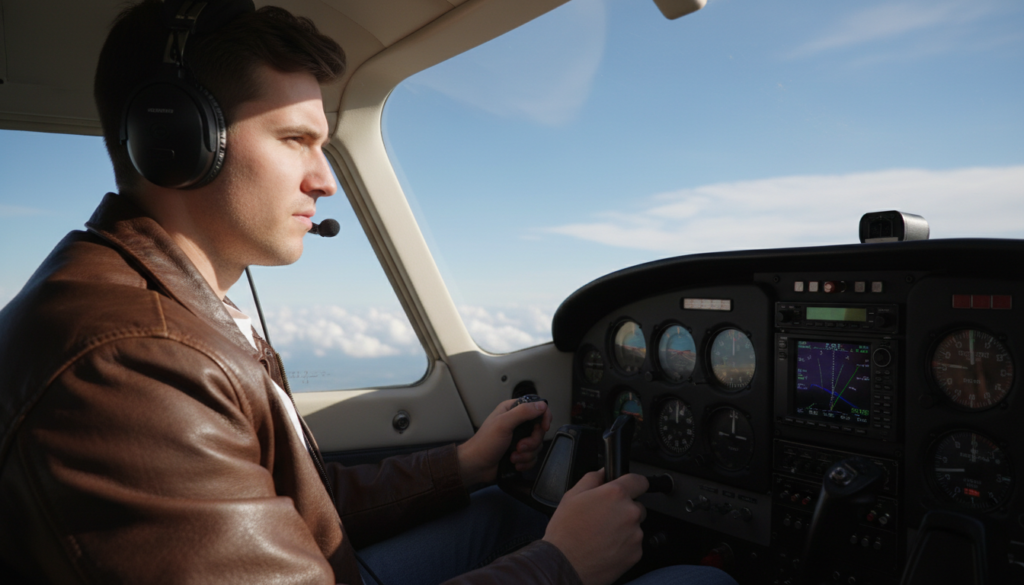
Being prepared is more important than trying to be a hero. You learn by doing it. However, the grown-up way is to plan, practice, and make safe choices. This makes your solo flight uneventful, which is good.
It’s also key to stay connected. When traveling alone, your phone is everything you need. In the air, staying connected means following your training. This helps you stay in control and safe. It turns solo skills into consistent performance.
| Maneuver focus | What the DPE tends to notice | Simple self-check | Why it supports first solo flight confidence |
|---|---|---|---|
| Steep turns | Smooth entry, consistent bank, altitude control, and a steady scan | Pick one visual reference on the horizon and confirm altimeter every few seconds | Proves you can manage workload without “locking on” to one instrument |
| Slow flight | Coordination, pitch discipline, and clear awareness of energy state | Call out airspeed trend and add small power changes before it gets ugly | Makes low-and-slow feel like math, not mystery |
| Stalls | Recognize, recover promptly, minimize altitude loss, and use correct rudder | Say “pitch, power, rudder” in your head as the break approaches | Turns a fear moment into a practiced sequence you can repeat on solo flight days |
| Ground reference maneuvers | Wind correction, consistent spacing, and looking outside | Identify wind direction early and adjust crab angle before the drift is obvious | Builds the same judgment you’ll need when it’s just you and the runway |
| Emergency procedures | Immediate control, smart field choice, checklist flow, and communication | Commit to a landing spot, then work the problem from “fly the airplane” outward | Reinforces that student pilot solo skills are about priorities, not panic |
If your maneuvers feel messy, focus on cleaning up your process. Make clear callouts, stick to standards, and be truthful in your scanning. This turns solo flight into something expected rather than a big leap. It boosts your confidence for your first solo flight.
Final Prep: Resources and Study Techniques
My top advice for checkride prep is to plan as you would for a trip. Confirm flights, hotel, and rides well in advance. This approach frees you up from last-minute stress. It’s like having a checklist you can trust, even when you’re not fully awake.
If you’re just going with the flow, you don’t really have a plan. Instead, you’re setting yourself up for a funny story later on.
Travelers get insurance to deal with the unexpected: delays, cancellations, and lost luggage. In flying, we have something similar called redundancy. Make sure you have extra time, fuel, and a backup plan for your first solo flight. And always have a clear rule for when to stop if things seem wrong.
This redundancy also helps you stay calm. Your mind relaxes when it knows there are alternatives. Stress doesn’t stand a chance against good planning.
Then, tailor your prep to suit your needs. Maybe you need to focus on weather patterns. Or maybe you need to practice radio communication until it feels easy. Make sure your solo flight checklist addresses your specific weaknesses.
Before checkride week, make sure you’ve organized your resources. Just like downloading travel apps before a trip, preload everything you need. Include your POH highlights, airport diagrams, and key maneuver cues. This way, you don’t rely on a poor connection to remember crucial steps.
Last, think of your mental health as you would a travel first-aid kit. Include basics like water, a simple snack, a reliable pen, spare paper, and a method to relax if you’re feeling nervous. This could be deep breathing, visualizing the flight, or a quick walk.
| Travel Prep Principle | Checkride Study Translation | How It Reduces Stress in the Moment |
|---|---|---|
| Sort arrangements in advance | Build a solo checklist with “non-negotiables” (docs, weather, NOTAMs, performance, plan B) | Less improvising; fewer last-second decisions under pressure |
| Travel insurance for surprises | Create redundancy in first solo flight prep (time buffer, alternates, personal minimums, clear abort gates) | One hiccup doesn’t derail the whole day |
| Add-on riders for specific risks | Customize study to your risk profile (weather gaps, radio phraseology, landings, airspace) | You stop guessing what to study and start targeting what breaks |
| Download essential apps before the trip | Preload key resources: POH bookmarks, ACS tabs, maneuver notes, airport diagram highlights | Lower workload when bandwidth is low and time is tight |
| Pack a first-aid kit | Pack “readiness supplies” and a reset routine for overcoming nerves (hydration, snack, pen, quick chair-fly) | Small comforts keep small problems from becoming big distractions |
What the DPE is Really Looking For
The DPE doesn’t look for risk-takers. They want pilots who are prepared and conservative, not reckless. Solo travel is a good comparison. The more you plan, the smoother the trip. This applies to flying too, with its own set of rules.
What does showing “good judgment” mean? It means picking the best day, runway, and pace that suits you. It’s not about feeling ready; it’s about proving it. The DPE checks if your decisions reflect your skills, not just your ambitions.
Good choices in flying reveal themselves in little moments. Do you review the taxi plan before starting? When things get busy, do you take your time? Making an early decision to abort a landing shows you’re wise, not weak.
How well you communicate matters too. Safe pilots keep in touch; they don’t disappear. During a checkride, this means being clear over the radio, confirming instructions, and sharing your plans early. And if plans change, you speak up before things go wrong.
Being safe personally is like being careful with procedures in flying. Don’t show off, stay under the radar, and don’t try to be flashy. The DPE doesn’t care how creative you are. They want to see if you can follow the rules, especially when under stress.
| What the DPE Observes | What It Signals | What It Looks Like in the Airplane |
|---|---|---|
| Risk posture under pressure | Student pilot solo readiness as a habit | Uses personal minimums, asks for delay or discontinuance, and avoids “maybe it’ll work” weather |
| Choices that match capability | Solo flight decision-making with restraint | Chooses a stable approach, corrects early, and goes around without negotiation |
| Clarity and coordination | Transparency with stakeholders | Briefs the plan, makes timely position reports, and keeps ATC and the DPE in the loop |
| Discipline over flair | Respect for first solo flight standards | Uses checklists, standard calls, and consistent procedures instead of “watch this” moments |
The secret to impressing? Keep calm, stay organized, and know yourself. That’s the essence of being ready to fly solo. And that’s why making smart, safe flying decisions might look dull. It’s about sticking to the rules, not showing off.
Test Anxiety and Mental Prep
If you get nervous the night before a big test, you’re not alone. Feeling anxious isn’t a flaw—it’s your brain’s way of trying to protect you, though it can be overly dramatic. You can beat nerves by seeing them as something manageable, like bad weather, not a fierce enemy.
Overcoming anxiety starts with making a clear plan. Uncertainty feeds anxiety like water to mold. So, I set specific steps for the exam day: arrival time, briefing points, meal plans, and backup plans for memory lapses. This clarity leaves less space for worry and fear to grow.
After doing anything solo, like flying, check in with yourself. The mix of freedom and doubt after flying solo is unique. Post-flight, I reflect on how I felt. I question myself: was I anxious speaking over the radio? Did I rush procedures? Noticing patterns is crucial.
Here’s where writing down your thoughts comes in handy. Being alone highlights your thoughts, similar to the quiet of a cockpit. I write down three things: successes, struggles, and next steps. This process turns my stress into something tangible, which is much easier to manage.
| Mindset Move | What I Notice in Real Time | What I Do Next | Why It Helps on Checkride Day |
|---|---|---|---|
| Pre-brief with clear “if/then” steps | Before starting the engine, my thoughts race | I run a short script: if I forget, then I slow down, fly, and ask for a break | This replaces uncertainty with a plan, helping overcome nervousness |
| Emotional debrief after each flight | Sometimes, I can’t pinpoint why I felt off | I score my stress, attention, and confidence from 1–5 and identify the cause | This self-awareness helps develop a solid solo flight mindset |
| Journal before bed | I often dwell on mistakes too much | I write a brief, factual summary and plan one improvement | Writing it down keeps worries from affecting sleep or memory |
| Channel “alone time” into discipline | Alone, my awareness heightens and I overdo checks | I focus on one task: breathe, check, then do the next step | It makes flying solo feel more controlled and focused |
It’s not about numbing your feelings. The aim is to face them and fly professionally anyway. This is how you should think during your first solo flight: stay curious, systematic, and don’t let fear control you.
And when you still feel nervous—because it happens—I see it as just an alert, not a doom. It’s a reminder to slow down, be thorough, and follow my plan. This approach makes handling nerves much less of an ordeal than it feels.
What Happens if You Don’t Pass?
Not passing isn’t the end of the world. It might bruise your ego, like dropping your phone. It’s just paperwork, not a mark against you as a person.
I view it as just data. Flying is empowering and tough, sometimes all at once. This challenge is normal, not a judgment.
First solo flight setbacks teach us valuable lessons. It’s okay to feel the sting. But the goal is to make a plan to move forward.
When doubts creep in, I don’t just try to feel confident. I improve my planning and research. Clearer strategies and higher standards help more than just positive thinking.
A good solo recovery plan is intentionally dull. And that’s a good thing. It helps avoid unwanted surprises.
| What Went Sideways | What I Look For | Next Practice Focus |
|---|---|---|
| Task overload during maneuvers | Where workload spikes: setup, trim, scan, radio | Slow it down; do structured reps with clear callouts |
| Knowledge gaps in oral topics | Missing links between regs, weather, and decisions | Short study blocks; teach-back briefings out loud |
| Decision-making under pressure | Risk triggers: fuel, ceilings, crosswind limits | Write personal minimums; run “what-if” scenarios |
| Confidence dip after a bad flight | Patterns, not moods; what repeats and when | Rebuild with small, planned sorties before scaling up |
I keep information under wraps, too. I don’t share my location online in real time. But I do tell close ones about my route, ETA, and backup plans.
After a setback, I stick to advice from one teacher or a mentor. I avoid spreading it all over social media. That’s the key to growing stronger, without too much noise.
I start with simple steps. Go to a nearby airport, plan a simple day, and focus on a thorough review. It’s about building confidence step by step, not just faking it.
That’s what you should do after a setback: start small, get precise, then slowly add more. A good recovery plan and resilience can change a failed test into success next time.
Celebrating Your Success
The checkride is over, and everything seems more intense. Sounds are louder, and the world looks like a movie scene. I avoid doing a victory walk as though I’ve won an Oscar. Aviation likes it when we’re quietly skilled, not loud. Yet, I embrace the moment with joy.
This feeling is like after your first solo flight. Everything is more vibrant, and you notice things you used to overlook.
Before the moment fades, I jot it down. I make a quick journal entry, reflecting on the experience. It’s straightforward: what went well, what surprised me, and what needs work. I mention tough questions and smooth maneuvers, alongside the tricky ones. It’s like writing about a vacation to remember who you were then, while it’s all fresh.
I then protect the culture of safety like it’s precious. It’s easy to show off, but here, that means flaunting confidence, not ego. I stick to safe practices, watch for planes, and respect the rules of flying. A smooth flight that doesn’t get noticed is often the best acknowledgment.
I love the freedom of flying alone, which is truly special. You make all the decisions, from the path you take to radio communications. But, this freedom only lasts if you stay focused and prepare well. It makes sure this significant step doesn’t end up as a cautionary tale.