


Flying on Instagram looks like pure freedom. But in real life, it’s freedom with homework, a logbook, and crosswind challenges. So, is becoming a private pilot worth the effort, or is it an expensive lesson in not liking to study on sunny days?
The dream of flying is real but it has its demands: responsibility, standards, and commitment. The pros and cons of being a private pilot affect your time, money, and how seriously you take weather briefings.
People get into flying for various reasons. Some aim for a career path—starting as a Private Pilot and moving up. Others seek the joy of flying for weekend adventures and breathtaking views.
In this article, we’re taking a serious look. We’ll explore what having a pilot’s license allows you to do, the cost in money and time, and what it requires of you. If you’re wondering if becoming a private pilot is worth it, you need the real pros and cons, in straightforward language.
What a Private Pilot License Really Lets You Do
I used to think a private pilot license meant freedom to fly anywhere, anytime. It’s actually about managing a complex machine with care. But the freedom you do get changes the game completely, in ways a car ride can’t match.
Wondering if becoming a private pilot is worth it? Let’s look at what you can really do with the license. You get a lot of privileges, but there are also clear rules to follow.
Flying for pleasure or personal business (not for compensation or hire)
With this license, flying with friends or family for fun is a go. Need to reach a meeting without the airline hassle? You can do that. But you can’t make money by flying people or stuff. So, no starting “UberAir.”
You can share costs under certain conditions, but it’s not a free-for-all. Being smart and organized pays off in aviation, not just winging it.
Typical privileges like day and night flying with proper training
Daytime flying helps you master important skills. If you train right, you can also fly at night. Night flights are quiet and have their own unique charm but remind you to stick to your checklists.
Then there’s the community aspect: events, festivals, and meet-ups where plane enthusiasts gather. It adds value to the experience beyond just flying.
Key limitations to understand before you start training
Understanding the limits is crucial. Weather, visibility, how well your aircraft performs, and airspace rules are always in play. These rules are serious and everyone must follow them.
The trade-off is simple: more freedom up high means more responsibility down low. Once you’re in the pilot’s world, decisions are based on facts and safety, not just desire to fly.
| What you can do | What it feels like | What keeps it honest |
|---|---|---|
| Fly yourself and passengers for pleasure | Spontaneous weekend trips and cinematic views | Preflight planning, weight and balance, passenger briefing |
| Fly for personal business (no compensation) | More control over your schedule than commercial travel | Weather decisions, alternates, and conservative go/no-go calls |
| Fly at night with proper training | Quiet air, sharper focus, and a different kind of calm | Night illusions, lighting limits, stricter discipline with procedures |
| Join fly-ins and aviation events | A subculture with its own language and rituals | Airspace compliance, NOTAM awareness, and traffic coordination |
| Share certain expenses in allowed scenarios | Less financial sting on longer outings | Clear legal boundaries; no “for hire” vibes, no gray-zone marketing |
is becoming a private pilot worth it
Often, the question isn’t just theoretical. You could try to map it out, but the truth hits you on a windy Tuesday. That’s when you have to choose between flying and everything else. So, asking if becoming a private pilot is worth it means seeing if it fits into your life. And making sure it doesn’t become a part-time job you never wanted.
Who tends to feel it’s “worth it” and why
Some people love the freedom and joy of flying. They crave those sunrise flights, quick day trips, and weekend escapades. They don’t miss the usual airport hassle one bit. For these folks, becoming a pilot is all about control. They enjoy planning their routes, deciding when to fly, and the peace above the clouds.
Then, there’s the group that loves structure. They like how aviation requires step-by-step progress and study. For them, the time and money spent feels like an investment. It’s a way to achieve bigger dreams, not just an expensive hobby.
When the time and cost investment may not make sense
But, mixing flying with real life can get tricky. If your life is all over the place, taking a break can confuse you fast. Because in aviation, if you get rusty, you’ll be relearning instead of moving forward.
Money acts the same way. Stretching out training means higher costs since flying is paid by the hour. If you’re dealing with big bills already, the decision to become a pilot depends. Can you keep training without breaks, or will you start strong and then stop?
How to decide based on goals, budget, and lifestyle fit
First, ask yourself why you want to fly. Are you looking for fun, business travel, or a career? Your reason will affect your training plan big time. If you’re unsure, the journey feels tougher, like you’re carrying a heavy flight bag everywhere.
Then, plan your budget for the real world, not the minimum. Most folks need more flying hours than they think. It’s not a failure; it’s normal. If you wonder whether becoming a private pilot is worth it, see if you and your budget can handle the ups and downs of learning.
| Decision factor | Good fit signs | Red flags |
|---|---|---|
| Primary goal | Clear use case: travel flexibility, skill-building, or a defined aviation path | Vague curiosity with no plan for how you’ll use the certificate |
| Schedule | Steady weekly blocks for lessons and study time | Frequent gaps that stretch training and weaken retention |
| Budget tolerance | Room for extra hours, weather delays, and checkride prep | Budget set to the minimum with no cushion for real-world pacing |
| Stress style | Comfortable with feedback, repetition, and performance standards | Low patience for critique or for doing the same maneuver again |
| Lifestyle fit | Enjoys planning, weather awareness, and deliberate decision-making | Wants spontaneity but dislikes preparation and strict procedures |
The Pilot Lifestyle: What Changes After You Learn to Fly
Learning to fly changes your view on life. One day, traffic annoys you on the ground. The next, you’re above it at 6,000 feet, seeing the world’s vastness.
When you’re a private pilot, theory turns into reality. Weather plays a key part in your plans, beyond just chit-chat.
A new perspective from the cockpit and why it feels meaningful
In the cockpit, your view shifts. Roads and towns form patterns beneath you. Your mind quiets down in a profound way.
Simple things gain deep meaning. Executing a clean run-up or a steady climb teaches mindfulness. You learn gravity’s non-negotiable nature, especially after a bumpy flight.
Confidence, focus, and decision-making skills that carry into daily life
Flying sharpens your focus. It’s a constant process of briefing, checking, and adjusting. It’s like a real-life puzzle with real stakes.
This discipline influences your everyday life. You’re clearer in thought, better at spotting risks, and less likely to make hasty decisions. Flying improves leadership skills, offering lessons in calm, decisive action.
Freedom, flexibility, and the “make your own schedule” appeal
Freedom is enticing: choose a destination, plan, and take off. The reality involves dealing with maintenance, fuel stops, and unpredictable weather.
Living as a pilot illustrates real-life pros and cons. It allows for a more flexible life, yet teaches you to adapt quickly to unforeseen changes in weather.
| What changes | How it feels in the moment | What it adds to daily life |
|---|---|---|
| Seeing weather as a decision, not a backdrop | Checking METARs like they’re plot twists | Better planning and fewer impulsive commitments |
| Time becomes “daylight, ceilings, and fuel” | More patience, less rushing | Sharper prioritizing and calmer scheduling |
| Responsibility moves from abstract to concrete | I’m the final filter before takeoff | Stronger judgment under pressure |
| Travel turns into routing and options | Freedom with a side of homework | More flexibility, plus smarter backup plans |
Real Pros: The Best Reasons People Become Private Pilots
Many argue about the benefits of being a private pilot. The truth? It’s more than just pretty pictures. It’s about making your own choices. You decide where to go, when, and how fast. This freedom is a sweet escape from a world ruled by schedules.

Unmatched views and experiences, from smooth mornings above clouds to sunrise at altitude
Imagine mornings with air so still, the world below looks softly muted from high above. Flying over clouds, everything feels bright and serene. It’s a special moment you can’t get from a screen, even in the highest quality.
As a pilot, your phone takes a backseat. Focus is everything, offering a unique, almost meditative state. It keeps you sharp yet deeply engaged.
Weekend getaways and day trips without relying on airline schedules
Commercial flights often mean long, slow lines. But with a private pilot’s license, planning a trip is straightforward. You just go, enjoy your time, and return on your schedule. This flexibility often becomes the deciding factor for many.
It’s not about flying cheaply but flying on your own terms. For many pilots, this independence is priceless.
Access to remote destinations and smaller airports
Small airports get you closer to your destination, whether it’s lakes, mountains, or hometowns. You’re free from the usual travel hassles. But remember, you’re still under the rule of weather and regulations.
| What you want | Why general aviation helps | What you still manage |
|---|---|---|
| Arrive closer to a small town or rural site | Many regions have local airports that airlines don’t serve | Weather shifts, runway length, and daylight planning |
| Turn a day trip into a clean schedule win | You control departure time and routing within limits | Preflight checks, fuel planning, and traffic pattern work |
| Make travel feel human again | Less crowding, fewer choke points, more control | Risk management and staying current in the pilot lifestyle |
These factors make the difference in the private flying debate. It’s not about looking cool. It’s about practical freedom. Plus, blending efficiency with fun is truly rewarding.
Real Cons: The Biggest Downsides to Expect
Talking about the downsides of being a private pilot, we hit a common point: planes don’t care about our plans. I quickly saw that it’s not fear or nerves, but the true challenge hits in terms of time and money. This becomes clear especially when life throws curveballs.
Training is demanding and requires steady dedication
Flight training prefers a steady effort rather than random bursts of effort. It’s a balance of handling weather, scheduling conflicts, ground school, and flight lessons. Missing sessions makes even the basics suddenly tough.
Then, the real cost and time investment starts to bite. Taking breaks leads to more revision flights, more instructor hours, and longer to reach your goals.
Flying is a responsibility-heavy skill with high standards
Flying seems dreamy until you hit the reality of tough decision-making. The FAA and physics don’t care about your good vibes or intentions. You juggle rules, communication, weather decisions, and plane performance all at once.
This is a crucial part of weighing the pros and cons of being a private pilot: freedom is thrilling, yet the high standards remain, even for fun flights. It’s all part of the deal.
Stopping and starting training can increase both difficulty and cost
Skills fade quicker than you’d think. Taking breaks means slower reactions, rough landings, and dented confidence. Bouncing back is doable but takes time.
If your training isn’t steady, here’s what tends to happen:
| Training Pattern | What Tends to Happen in the Cockpit | Likely Impact on Time and Cost Investment |
|---|---|---|
| 2–3 lessons per week | Skills grow smoothly; fewer redo flights needed | Less repetition and backtracking |
| 1 lesson per week | Progress is made, but errors creep in with complex moves | Some review time and maybe extra lessons |
| Long gaps (weeks or months) | Skill recall drops; tasks feel harder, mistakes creep back | Need for more catch-up flights, more teacher time, and more expenses |
In essence, staying consistent is less about being perfect and more about avoiding extra trouble and cost. When considering the pros and cons of being a private pilot, consistent training could mean a smoother journey or a path filled with financial surprises.
Time and Cost Investment: What You’ll Spend and What Drives the Price
Money comes first in adulthood. Turning dreams into plans often starts after your morning coffee.
You’re not just paying for flight hours. It’s about gaining consistency, coaching, and learning about risk.
Typical U.S. cost range
Students in the U.S. usually spend $13,000 to $16,000 for a plane pilot license. Remember, this is an average. Costs vary a lot in aviation.
Helicopter training might cost about $24,000 to $30,000. The time and cost quickly add up, much faster than a “quick lesson” might suggest.
Typical flight time to be checkride-ready
Students are often checkride-ready after 40 to 75 hours flying. People learn differently, and weather can change plans.
If you’re wondering whether becoming a pilot is worth it, consider your schedule. A regular practice can mean less repeating and more understanding.
Major cost factors
Main costs include aircraft rental, fuel, instructor time, ground school, materials, exams, and checkride fees. It’s like a subscription where the sky is your app.
Flying regularly helps you remember more. This can make the entire process more cost-effective.
| Cost driver | How it shows up in your budget | What tends to push it higher |
|---|---|---|
| Aircraft rental | Hourly wet or dry rate tied to the airplane type and local demand | High-demand schedules, newer aircraft, larger engines, limited fleet availability |
| Fuel | Either included in a wet rate or billed separately with a dry rate | Rising avgas prices, longer lessons, more pattern work, cross-country flights |
| Instructor time | Hourly CFI rate for flight and often ground briefing | Extra review sessions, skill plateaus, longer pre/post-flight debriefs |
| Ground school & materials | Course access plus books, apps, and test prep tools | Buying multiple resources, switching programs midstream, retaking practice exams |
| Knowledge test, checkride, and related fees | Written exam fee plus designated pilot examiner and paperwork costs | Retests, delays that require more prep flights, regional examiner pricing |
Extra expenses to budget for
There are also “small” things that add up: FAA medical exams, pilot supplies, and other costs. You’ll need things like a headset, a logbook, and a kneeboard.
Planning for these costs helps avoid unexpected bills. If you’re thinking about becoming a pilot, these extras get you from “almost ready” to actually ready.
Training Requirements in the United States: What the FAA Expects
The FAA acts tough for a reason: no room for unnecessary stuff, only the essential facts count. These rules ensure flying remains a dream, not a risk. They say if you want the pilot life, you must work for it, show you’re good at it, and keep proving it.
To start, you’ll need two things: a student pilot certificate and an aviation medical certificate. Once you’re signed up, a Certified Flight Instructor (CFI) will help with the student pilot certificate. It’s not the fun part, but it saves you from future headaches.
Your medical check is crucial because flying isn’t about pushing limits without care. Most flyers need a Third-Class Medical unless BasicMed fits better. The goal is simple: be healthy for flying, not just eager.
Now, training gets real with minimum flight hours, specific tasks, and recorded lessons. The FAA’s goal isn’t just to make you feel ready. It’s to ensure you’re skilled, can handle unexpected events, and stay safe thousands of feet up.
Studying is also key. You’ll dive into flight rules, understanding the sky, health in flying, finding your way, how planes work, and their limits. It might not look exciting, but it’s what keeps flying safe and makes your efforts valuable.
| FAA Expectation | What You Actually Have To Do | Why It Matters in Real Flying |
|---|---|---|
| Student pilot eligibility | Get a student pilot certificate early and keep your training records organized | Prevents last-minute paperwork drama and protects your time and cost investment |
| Medical fitness | Complete an FAA medical exam (often Third-Class) or qualify under BasicMed | Confirms you can handle workload, stress, and safety-critical decisions |
| Flight experience minimums | Log the required hours, including dual instruction and supervised solo time | Builds repeatable skill, not “one good day” luck |
| Aeronautical knowledge | Learn regulations, weather, navigation, performance, and limitations | Keeps the pilot lifestyle from turning into confident confusion |
| Written and practical tests | Pass the FAA knowledge test and the checkride with a designated examiner | Verifies you can apply judgment under pressure, not just recite facts |
Being consistent is key but often overlooked. Taking breaks can make flying harder and more costly to relearn. If you’re balancing flying with life, treat training like an important meeting you can’t skip.
What Flight Training Is Like: Ground School, Flight Lessons, and the Checkride
Learning how to fly isn’t just a hobby, it’s like adding new software to your brain. You quickly see the good and the bad of being a pilot. The freedom is great, but there’s a lot of study too. And it costs both time and money, even before you fly.
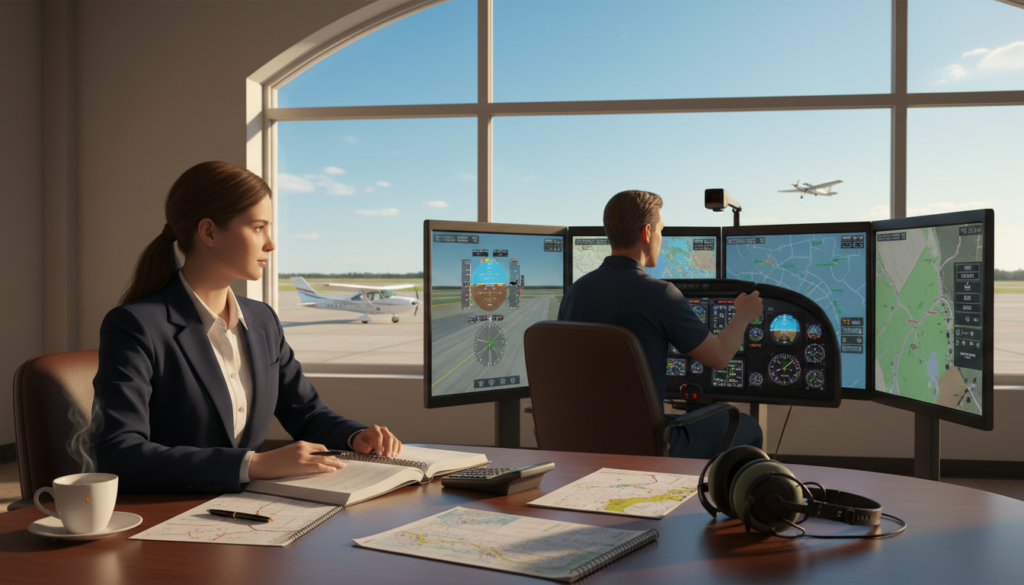
Ground school topics
In ground school, you learn all about how flying works. You study aviation law, navigation, weather, and flight theory. There’s a bunch of rules, plane performance, and how things work because the FAA won’t take “I didn’t know” as an excuse.
Choosing between Part 61 and Part 141 affects your training vibe. Part 141 has strict FAA rules and tests, but Part 61 gives you more freedom in how you learn. This detailed comparison on Part 61 vs. Part 141 helps you see the differences clearly.
Flight training focus
Flight lessons are where you bring theories to life. You practice flying activities till they feel natural. You also deal with real situations like planning longer trips, using the radio, and making quick decisions in tricky weather.
Here, the money and time you spend become very real. Although there are FAA minimums, most students need 60–80 hours of flying to be ready. This can change how the costs and benefits of flying look on your budget.
| Training piece | What you do | What it tests | Why it matters |
|---|---|---|---|
| Ground school | Regulations, charts, weather reports, weight and balance | Judgment before the engine starts | Keeps mistakes from becoming “learning moments” at 3,000 feet |
| Flight lessons | Maneuvers, landings, navigation, emergency checklists | Coordination under workload | Turns skills into habits you can repeat on a bad day |
| Test prep | Mock oral questions, scenario flights, logbook review | Consistency and gaps in knowledge | Protects your time and cost investment from last-minute surprises |
The written exam and practical test (checkride)
The written test checks your knowledge on flying. It covers rules, flying paths, weather, and plane use. It’s all about the studying that becomes important when you really need it.
Next is the checkride, a big test with both questions and flying. It tests your planning and flying skills, including emergencies. It’s where all your prep work really proves its worth. This is what being a pilot all comes down to.
Staying Sharp After You Get Your License: Currency and Proficiency
The day you earn your certificate is just the beginning. Flying is just like learning a second language or playing the guitar—if you don’t practice, you’ll lose your skills. As a pilot, you must treat flying skills as a daily habit, not just a one-time achievement.
The FAA agrees with this idea. Just saying “I used to fly a lot” doesn’t count in the aviation world. You have to keep up with your flying paperwork, practice often, and always stay humble to stay current.
Why consistency wins
Flying regularly keeps you legal and sharp. Patterns like landing visuals, checking instruments, and communicating clearly become second nature. But when you don’t fly for a while, basic tasks become much harder.
Experienced pilots know that flying a little bit often is better than trying to cram in a lot of flying all at once. Flying consistently helps keep your confidence at the right level. Too much confidence, though, can lead to risky decisions, like thinking it’s okay to microwave metal.
What you keep learning
Even after your checkride, you never stop learning. Rules change, weather patterns evolve, and the technology in cockpits keeps advancing. Staying curious helps keep you safe in the air.
| Skill area | What to revisit | What “rust” looks like | Low-drama way to stay ready |
|---|---|---|---|
| Procedures & emergencies | Checklists, engine-out flow, go-arounds, abnormal indications | Hesitation, missed steps, fixating on one problem | Chair-fly flows, brief every takeoff and approach |
| Airspace & rules | Class B/C/D habits, VFR cloud clearances, NOTAM review rhythm | Second-guessing boundaries, sloppy planning, surprise restrictions | Preflight with a kneeboard note of key airspace callouts |
| Weather decision-making | METARs, TAFs, winds aloft, icing cues, convective outlook thinking | Optimism bias, late diversions, confusing “legal” with “smart” | Build a go/no-go checklist and stick to it |
| Communications | Clear readbacks, frequency changes, towered pattern calls, CTAF discipline | Stepping on others, rushing, forgetting who you’re talking to | Listen before you talk; write the clearance before you repeat it |
| Aircraft systems & avionics | Electrical/fuel systems basics, autopilot modes, GPS setup, failures | Button hunting, mode confusion, late workload spikes | Practice one avionics task per flight, not five |
Practice that builds safety and confidence
Practicing regularly is key to making good decisions. Simple flights help manage surprises more easily. This is how you build a strong safety foundation.
Flying connects you with others, too. Through safety pilots, group activities, and hangar talks, you can learn a lot. It’s a way to stay proficient while being part of the community.
Career Pathways: How a Private Pilot License Can Lead to Professional Flying
I once thought getting a private pilot license was everything. But that’s just the start, the first step in a bigger journey.
Wondering if becoming a private pilot is worth it for a career? It boils down to liking progress over quick wins. The benefits and drawbacks are clear: you get real flying skills and forward movement. Yet, you must dedicate time, money, and frequently check the weather.
The step-by-step pathway: Private Pilot, Instrument Rating, Commercial, and ATP
In the U.S., the path to flying professionally is well-defined, like a strict curriculum. You begin with your Private Pilot license. Then, you add an Instrument Rating to navigate the skies more freely.
After that, you achieve your Commercial certificate, where flying becomes more than just fun. The Airline Transport Pilot (ATP) certification is the highest achievement, demanding intense training and flying experience.
| Milestone | Main focus | Why it matters to employers |
|---|---|---|
| Private Pilot | Basic flying skills, understanding of airspace, making smart decisions | Demonstrates your ability to grasp aviation basics and handle risks |
| Instrument Rating | Mastering instrument flight rules (IFR), weather evaluation, precise route navigation | Shows you can fly safely in less-than-ideal conditions |
| Commercial | Meeting higher flying standards, complex flight planning, being professional | Indicates you’re ready for the responsibilities of flying as a job |
| ATP | Advanced flying knowledge, teamwork, airline industry standards | Often a must for airline jobs, highly respected in aviation |
Common hour-building route: becoming a Certified Flight Instructor (CFI)
One practical step is to rack up flight hours by teaching others as a CFI. It means you get paid to teach the basics of flying in an engaging way.
This step really proves if becoming a private pilot is worth it. You’ll improve quickly by teaching others. Yet, you’ll also get used to doing the same things over and need to be patient with students.
Potential careers: airlines, corporate/charter, cargo, aerial survey, agriculture, and law enforcement
There are many career options with a pilot’s license. Outside of airlines, there are jobs with corporate and charter flights, and cargo flights that keep going regardless of passenger numbers.
Other fields include flying for aerial surveys, agriculture, and supporting law enforcement. All need precise flying and the ability to stay calm under pressure. Here, the value of a private pilot license truly shines, offering paths beyond the usual.
Pilot Community and Support: The People Side of General Aviation
From the outside, aviation may seem like a solo journey. But it’s actually a team effort filled with communication. Here, mistakes become valuable lessons instead of forgotten tales.
The pilot community also shapes your lifestyle in subtle ways. Suddenly, you’re organizing weekends around weather updates. And finding joy in early mornings becomes the norm, for reasons hard to explain.
Finding mentorship through instructors, local airports, and fellow student pilots
Your Certified Flight Instructor (CFI) often starts as your mentor. The right CFI teaches not just maneuvers, but also judgment, timing, and how to stay calm. This relationship can make training feel achievable, not overwhelming.
At local airports, this sense of mentorship quickly spreads. You’ll find student pilots sharing tips on everything from landings to staying calm under pressure. An honest account like this private pilot license experience can make the journey seem more relatable.
Some flying schools, like Leopard Aviation, include mentorship in their training. They use advanced equipment in their training, such as Cessna 172S Skyhawks with modern avionics. This high-tech gear helps provide clear feedback, although it’s not a substitute for human mentorship.
How the pilot community helps with motivation, safety habits, and accountability
Motivation can waver, especially against scheduling conflicts. The pilot community helps you keep going, even when you face setbacks. It’s about holding each other accountable, without the formalities.
This community also fosters safe flying habits. Discussions about safety checks and procedures are common. Embracing discipline becomes second nature, supporting you through moments of doubt.
| Support source | What you get in real life | Why it matters for training |
|---|---|---|
| CFI mentorship | Clear standards, honest debriefs, better decision-making under pressure | Turns “I’m stuck” into a plan you can fly next lesson |
| Fellow student pilots | Shared tactics for landings, studying, and radio confidence | Makes setbacks feel normal, not personal |
| Airport regulars and local pilots | Route ideas, weather tips, and real stories about consequences | Builds judgment and reinforces conservative choices |
Why community matters when training gets challenging
Training feels personal because it is. Your brain manages flight details while your body learns the finesse of flying. That’s when the support from the pilot community becomes invaluable.
Other pilots understand your frustrations; they’ve been there. This support system encourages constant learning and improving, without forgetting the importance of humility.
Conclusion
So, is becoming a private pilot worth it? It depends—a tricky answer, but it’s what the FAA seriously believes. If you love freedom, traveling on your own time, and the charm of small airports, getting a Private Pilot License opens up a new world. Seeing a sunrise from above the clouds changes how you see everyday life.
However, it’s not all about feeling like a movie pilot. The main challenge is the amount of time and money needed. It usually costs about $13,000 to $16,000 in the U.S. It also takes 40 to 75 hours of flying time for students to be ready for their checkride. Plus, you need to attend ground school, understand weather patterns, learn about aircraft systems, and stay committed.
If you see flying as a career path, a PPL is a great first step. It leads to more licenses and flying jobs, like being a CFI. If you just want to fly for fun and improve your thinking skills, it’s still worth it. You learn how to make decisions better than at most workshops. So, whether getting a private pilot license is worth it depends on if you see responsibility as a challenge or a chore.
Getting your license is just the beginning; it means keeping your skills sharp and knowing your limits. If this challenge excites you, the investment seems more like a fair exchange than just a cost. If this doesn’t appeal to you, you can always fly commercial, even with the extra fees they add for choosing a seat.




