


I began my journey in aviation, wondering if my passion was for flying or for the paycheck. This question is the core of choosing between private and commercial piloting. It’s more than just getting a license; it’s choosing a lifestyle that includes checking the weather.
A Private Pilot License (PPL) is mainly for flying yourself and maybe for some business trips, without being paid. Going commercial means adding more responsibilities and stricter standards. It’s basically choosing between flying for pleasure or as a career. Each has its own set of rules, even though the sky is the same for both.
Getting into ground school is important, even if you just want to fly for fun on weekends. When comparing commercial and private flying, it’s not just about the paperwork. It’s about your approach to flying. One path offers regular benefits and a set career ladder. The other offers varied experiences and some unpredictability. It’s like choosing between a government job and working for a startup, but with turbulence as a constant factor.
There are clear differences in the job. Private jets may carry a few people, whereas airliners transport hundreds. Your schedule could be flexible or fixed. You might fly solo or as part of a larger team. And of course, there’s the aspect of salary because money matters.
This section is your starting point. We will explore what’s taught in ground school, its relevance to the exams, and study tips. If you’re weighing private versus commercial piloting, ground school will help you start forming a realistic plan.
Why Ground School Matters
Ground school is where the real deal begins in aviation. It’s more than just fun—it’s learning to navigate a system with strict rules. Here, pilot licenses transform from cool badges to serious responsibilities.
Ground school makes us face tough decisions early. The FAA’s rules are set in stone, and the knowledge tests don’t wait for us to be ready. It helps bridge the gap between dreaming about flying and actually understanding what it takes in the cockpit.
Learning to fly privately is about earning your wings while judging risks wisely. Flying commercially takes it up a notch with complex weather, tight schedules, and a high-stakes safety culture.
The training hours hint at the journey ahead. Private pilots train for at least 40 hours. Commercial pilots aim for 250 hours. The lessons get more intense as the hours add up.
That’s why honest resources are valuable to me. When you understand the real demands of commercial vs private flying, making a choice gets easier.
- Airlines value pilots who follow procedures and keep learning.
- Private flying needs pilots who can stay calm and offer great service.
- Both careers require skill in reading weather and making sound decisions.
| Ground-School Focus | Private Track (PPL) | Commercial Track (CPL) |
|---|---|---|
| Core purpose | Build safe habits for personal flying and local trips | Prepare for paid flights and bigger challenges |
| How FAA requirements show up | Learn the rules, airspace, and planning for safe flights | Learn deeper systems and better performance planning |
| Time expectations | Minimum 40 hours total, including 20 dual and 10 solo | Target 250 hours total before taking the final test |
| What employers or passengers “feel” | Enjoy smooth flights and smart decisions | Experience professional handling of timing and weather |
| How it shapes types of pilot licenses | Lays the foundation for more skills | Prepares for advanced ratings and tougher flights |
In ground school, I learn to explain my decisions clearly—like fuel choices and dealing with weather issues. This ability is crucial, whether flying for fun or work. It’s about meeting FAA standards, getting the right license, and making smart flight choices.
What You’ll Learn (Subjects Breakdown)
Ground school might seem easy at first glance. But then, it gives you a list of topics that are crucial for flying. These topics help you make important decisions, whether you’re learning to fly for fun or as a career. The main idea is learning how to make the right call, no matter what type of pilot you are.
Weather in aviation is crucial because it can change everything. You’ll understand how different weather conditions affect your flight plans. You’ll stop seeing METARs and TAFs as confusing codes. Instead, they tell you when to fly, wait, reroute, or stay grounded.
Then, you’ll dive into flight operations, where you learn about planning and managing flights. You might learn about operating everything from small jets for a few people to big commercial planes. Each type of flying, private or commercial, has its own challenges and rules.
Cockpit teamwork is vital and starts early, even if you’re flying alone. Building good habits early can prevent small issues from turning into big problems. In big airlines, teamwork means well-defined roles in the cockpit. In private flights, you might handle many different tasks yourself.
The workload can be tough, and it’s important to remember pilots are people too. Ground school teaches you how to manage stress and stay focused. It emphasizes routines and self-checks to keep your mind sharp, even on tough days.
| Subject | What you’ll practice | How it plays out in private pilot vs commercial pilot flying |
|---|---|---|
| Aviation weather | Reading METARs/TAFs, spotting thunderstorm risk, setting personal minimums | Private flying often prizes flexibility and timing; airline flying protects schedule integrity with stricter dispatch layers and alternate planning |
| Flight operations | Performance math, fuel planning, weight and balance, alternates, risk tradeoffs | Cessna Citation-class to Gulfstream G700 and Bombardier 8000 trips may run lean on support; Boeing 787 and Airbus A350 routes run on standardized procedures and deep infrastructure |
| Cockpit resource management | Task management, communication, error-trapping, sterile habits when it matters | Private crews may be one pilot juggling extras; commercial crews split duties inside a sealed cockpit with defined roles and callouts |
This might seem like just schoolwork, but it’s far more. Ground school equips you to think like a pilot. It prepares you to make smart choices, before you’re even in the air.
Online vs. In-person Options
Choosing a ground school is like choosing how to get an MBA. Do you prefer sleek, online lessons or a traditional classroom setting? Online is more efficient, while in-person offers a deeper immersion. Nothing quite compares to the urgency felt when everyone else gets METARs and you don’t.
If considering flying as a career, I’d go for in-person training. It mimics real-world operations with its structured schedule. This approach reflects the discipline found in many pilot training programs.
Online ground school suits those who are disciplined and have another job. It lets you learn weather theory, regulations, and aeromedical basics in manageable chunks. This flexibility could mean the difference between starting your training now or putting it off indefinitely.
The training format affects how you experience private versus commercial training. Private flying allows for more personal choice, including aircraft and missions. Commercial training, however, follows a stricter regimen with less room for deviation.
The setting of your training is crucial. Take Blue River Aviation as an example. Your learning is shaped by your environment and mission, not just internet speed. The demanding conditions of Alaska, float ratings, and multi-engine training emphasize the importance of choosing the right format for your goals and learning style.
| What you’re comparing | Online ground school | In-person ground school |
|---|---|---|
| Pace and structure | Self-paced modules; great for steady daily reps | Fixed schedule; deadlines create momentum |
| Accountability | You are the attendance policy | Instructor and peers provide social-pressure “fuel” |
| Best fit for pilot training pathways | Flexible entry point alongside work and family | Closer to professional cadence and standardized routines |
| Practice for private vs commercial training experience | Matches private flying’s flexibility and independent planning | Feels like commercial environments: briefs, debriefs, and rhythm |
| Ideal learner profile | Independent, consistent, comfortable asking questions later | Social learner who benefits from live Q&A and real-time feedback |
| How it supports flying as a job | Builds study stamina while life keeps moving | Builds schedule discipline and operational mindset |
Preparing for the Written Test
I see the knowledge test as the first real step. It’s where my love for flying meets reality. I have to study hard for the pilot licenses I want.
Truth is, it’s a big commitment. The FAA’s flight hour requirements make that very clear. The written test shows me if I’m ready for what’s next.
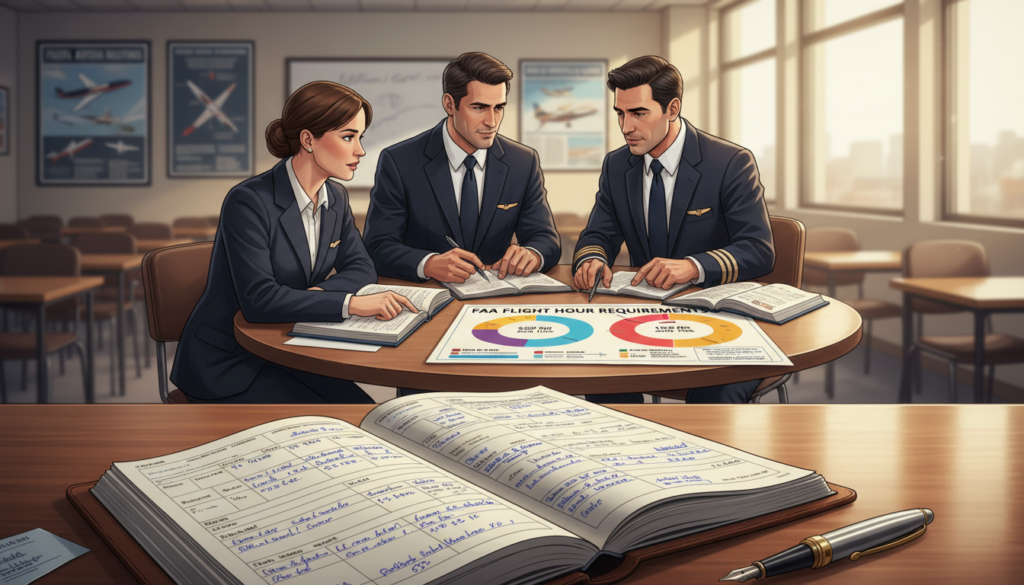
Comparing commercial and private licenses really sets things straight for me. To get a Private Pilot License (PPL), you need at least 40 flight hours. This includes 20 hours with an instructor and 10 hours flying alone.
Many people end up flying 35–45 hours because of different factors. For a commercial license, you must fly 250 hours. It shows it’s not just a small step up, but a whole new journey.
Even the minimum age is something to think about. You can start flying private at 17 and commercial at 18.
One year might not seem long, but everything changes quickly. Moving from flying for fun to flying as a job is a big leap.
| Checkpoint | Private Pilot (PPL) | Commercial Pilot | Why it changes how I prep |
|---|---|---|---|
| Minimum age | 17 | 18 | I study with the end role in mind, not just the nearest test date. |
| FAA flight hour requirements (minimum) | 40 total hours | 250 total hours | The commercial vs private benchmarks demand more stamina and tighter habits. |
| Training and solo breakdown | 20 hours training, 10 hours solo | Higher-hour experience building across varied operations | I focus on judgment and risk management, not just memorizing definitions. |
| What the written test signals | Can I meet the baseline and fly safely? | Can I scale into professional standards? | It’s the first proof point that my study system can hold up under pressure. |
I treat prep seriously, as more than just aiming for a good score. I work on knowing the rules, understanding airspace, weather, and performance inside out. Then I test myself under time pressure.
To me, the written test is just the start of a long journey, not just a small hurdle.
If I plan to fly bigger planes later, I need to be ready for more training. Pilots of private and commercial jets need an ATP certificate and specific type ratings.
Keeping different pilot licenses in mind helps me study. The stuff I learn now is what I’ll use in real flights later, just in another context.
Study Techniques and Resources
I like to study with the end goal in mind. Aviation doesn’t forget easily and doesn’t accept excuses. When you’re choosing between commercial and private flying, don’t just look for the right answers. Learn to remember facts quickly, even when you’re tired, in a hurry, or worried about the weather.
There’s a seldom-spoken truth about moving forward in a pilot’s career: the tests become tougher as the risks increase. That’s why I see ground school as serious preparation, not just a quiz game.
My main study method is straightforward: study a little every day and focus on active recall. I write down questions for myself, practice procedures out loud, and repeat key points about regulations, weather codes, and airspace.
Talking to myself in an empty room might seem odd, but it helps. Nobody cares if I’m shy when it’s time for an airline check ride.
In commercial flying, doing things the same way every time is crucial, and that’s what airline training programs focus on. Crews practice their routines until they can do them without thinking. Simulator training makes sure you can apply what you know under stress.
So, my study method imitates that approach. I practice the steps, say the commands, and answer questions that make me think on my feet, not just recite facts.
| Goal | Study Technique | Best Resources to Use | Why It Transfers to the Cockpit |
|---|---|---|---|
| Fast recall on rules and limits | Spaced repetition with short daily drills | FAA Airman Knowledge Testing Supplement, FAR/AIM excerpts, flashcards you write yourself | Reduces “blank page” moments when stress spikes and time is tight |
| Better weather decisions | Scenario practice: build a go/no-go story from METARs and TAFs | Aviation Weather (FAA), surface analysis charts, your own written brief template | Moves you from memorizing terms to making defensible choices |
| Procedural discipline | Chair-flying with scripted callouts and flows | Pilot’s Operating Handbook, checklists, kneeboard notes | Matches how airline training expects you to think in steps, not vibes |
| Real-world trip readiness | Day-of-flight checklist planning: fuel, alternates, maintenance notes | Flight planning worksheets, logbook habits, personal minimums card | Builds practical competence beyond the written test |
Private flying brings its own unique challenges. You might need to handle fueling, fixing things, and meeting passengers’ needs. Plus, flying private jets requires excellent customer service skills on top of everything else.
So, part of my preparation is about being ready for the day of the flight. I focus on paperwork, calculating performance, and the little things that ensure a smooth trip.
As for advancing in my pilot career, I take it very seriously. Many pilots go from being a co-pilot at a small airline to being a captain at a big one. And you can’t get there by cramming at the last minute.
When I think about commercial vs private flying, I prepare for both. I aim for precision in airline training. And I make sure I can make smart decisions for flights that don’t have a support team.
- Two-pass reading: skim first for structure, then reread and turn headings into questions.
- Teach-back: explain airspace, weather, and ADM like you’re briefing a skeptical friend.
- Error log: track missed questions by topic, not by mood, and drill the weak spots.
- Pressure reps: set a timer, then answer scenario questions like it’s a mini oral exam—because someday it will be.
Approached this way, simulator training becomes more than just a fancy term. It becomes a crucial step. The goal of studying isn’t just to pass tests. It’s to be ready to perform when unexpected things happen.
Scheduling and Duration
Scheduling is the quiet villain of flight training. It’s not about the weather or steep turns. It’s my calendar. To grasp the real training duration, ask who controls the schedule: you, your instructor, or the world.
Most people finish private training in 4–6 months. Commercial training can take 8–10 months. These averages help with planning. But, the clock counts more than study time. It includes reschedules, breaks, and the days you thought were free.

Private flying is known for having no set schedules. This means being on-call, often within 90 minutes of the airport. If you’re on standby a lot, your social life might suffer.
But airline jobs tend to have more predictable schedules. You’ll see your trips months ahead, making it easier to plan time off. Despite many flying hours, your calendar becomes more reliable.
| Path | Typical Training Duration | What Scheduling Really Feels Like | Common Lifestyle Trade-offs |
|---|---|---|---|
| Private training (PPL) | 4–6 months (general range) | No set schedules; lessons move with weather, instructor availability, and aircraft maintenance | More last-minute changes, more make-up lessons, and more “sorry, can’t” weekends |
| Commercial training (CPL) | 8–10 months (general range) | More structure, but still vulnerable to delays if training is part-time | Longer runway to finish, higher pressure to stay consistent, fewer gaps allowed |
| Private jet operations | Varies by employer and aircraft | Often unpredictable; longer duty days because trips can change fast | Harder to protect personal time, even when the flying looks glamorous |
| Airline operations | Varies by seniority and base | More predictable schedules; pairings bid and set ahead of time | Less spontaneity on workdays, but better planning for time off |
Pilot salary becomes more than just a number. Money feels different depending on your schedule. If two jobs pay the same, the one with a steady schedule usually offers better sleep and more time for loved ones.
When planning my training, I see the calendar as essential. I monitor it closely. The trade-offs start early and often last well after finishing your training.
Best Practices to Pass
Passing ground school involves knowledge, managing stress, and staying away from bad habits. It’s like a mission for me: short study sessions, strict review, and not relying on memory alone. Trusting your memory too much is risky.
For the exam, I start with the basics: understanding regulations, weather, performance, and how to plan flights. I then focus more on areas I find difficult. This helps me to really understand them. If something becomes boring, that’s a sign I know it well.
During the checkride, it’s important to explain decisions clearly. This isn’t about impressing with words but showing I can make good choices. The examiner wants to see good judgment, decision-making, and practical plans. Especially when unexpected problems occur.
- Study like a pilot: focus on real-world scenarios over simple memorization.
- Brief everything: cover weather, backup plans, risks, and potential failures.
- Log mistakes quickly: write down errors and correct them within the week.
- Train for the lifestyle: good sleep, staying hydrated, and staying calm are key.
Motivation is crucial, and financial rewards are a real motivator. The pay difference between private and commercial pilots isn’t just about prestige. Private pilots can make between $100K and $300K, depending on who they work for and their experience. Tips and bonuses can also add to their income.
Commercial pilots see their salaries increase steadily. At the beginning, they may earn about $50K. But this can rise to $300K for experienced captains at major airlines. The median wage for airline and commercial pilots in the U.S. in 2022 was over $130,000. This is good to remember when planning your training budget.
Job security is another factor. Commercial flying often offers benefits like retirement plans and health insurance. However, private pilots might have a less stable income. It can depend on how much they fly and their willingness to work.
There are different benefits in each path. For example, airline pilots often get travel benefits. This means cheaper flights for them and their families. Private pilots might not get these perks but can experience luxury travel and visit many places.
To succeed, adopting the right mindset early on helps. Commercial pilots focus on safety and timeliness for many passengers. Private pilots need to be flexible and ready for changes. They offer more personalized service on their flights.
| What I’m Passing | Best Practice That Actually Works | How It Shows Up Later (Private vs Commercial) |
|---|---|---|
| Written exam | Two short study blocks a day, then timed practice tests until scores stay steady | Builds habits that support career stability when training pace ramps up |
| Oral exam | Explain weather, regs, and performance in plain English, then back it with numbers | Private flying leans on discretion; commercial flying leans on standardization |
| Practical test (maneuvers) | Chase repeatability, not perfection; debrief one fix after every flight | Both tracks reward consistency, but commercial ops demand tighter SOP discipline |
| Lifestyle “sniff test” | Run a realistic schedule: early mornings, study after work, and no hero sleep debt | Commercial often brings benefits and predictable pay; private may trade that for flexibility and higher upside |
| Long-term motivation | Track the private pilot vs commercial pilot salary ranges and tie goals to a budget | Airlines may add travel perks; private roles may add bonuses, but income can swing |
Moving from Ground to Flight
Ground school covers the basics. Flying shows me what rules matter when it’s early and grey outside. In class, everything’s orderly. But in the cockpit, things get real, loud, and honest.
Thinking of flying for a living? Consider where you’ll fly. Airlines fly between big airports on a strict schedule. Private flights go to smaller places, offering a personal touch. But that charm fades when you’re working hard in tough conditions.
Life as a pilot differs in each field. Airline pilots have quick, back-to-back flights and limited passenger interaction. Private pilots might spend more time with clients, offering a personal service. The environment varies, too. Airline cockpits are strictly professional. Private flights might be more relaxed or solo.
Both paths require serious credentials. You’ll need specific licenses and ongoing training, no matter the choice. So, it’s not about who’s the better pilot. It’s about the lifestyle you prefer: routine and structure, or flexibility and custom service.




