The cost of a private pilot license isn’t just a simple number. It changes based on the plane you use, where you’re learning, and how often you fly.
The bulk of the PPL cost comes from two things: renting the plane and paying the instructor. You’re billed for both flight lessons and ground briefings. And sometimes, unexpected delays can add to your costs.
Next, you must face two major tests: the FAA knowledge test and the checkride. They act like checkpoints. The written test costs about $150–$160, while the checkride fees range from $400 to $500, sometimes even $650, depending on where you are.
The FAA says you need 40 flight hours minimum. But often, pilots need 50–70 hours to be ready. Delays, bad weather, or needing more practice can push that number even higher.
All in all, getting your pilot’s license can cost from $6,000 to over $20,000. Most folks end up spending around $10,000. Renting the plane usually eats up most of the budget, while instructor fees vary.
Don’t forget the extra costs, like study materials and gear. You can find some materials for free, or buy fancier ones. The same goes for gear: borrow it or treat yourself to the best.
So, it’s not just about the initial cost of getting a PPL. It’s also about what you can do once you have it and what it takes to keep flying.
Destinations and Adventures
I love dreaming about quick trips. A beach lunch. A mountain sunset. A fun detour that seems like a movie scene.
But, financial reality calls. The cost to fly is like a door guard, checking everyone.
Learning to fly mostly involves math with cool sunglasses. The FAA says you need 40 hours minimum. But many people need 50–70 hours. Every extra flight adds more cost.
The cost for a private pilot license varies a lot. For about $10,000, renting a plane usually takes $5,000–$7,000 of that. Depending on your flight hours, this could go up to $5,000–$15,000.
| Where you rent | Typical aircraft | Common posted rate range | What drives the flight hour cost |
|---|---|---|---|
| Urban market (Dallas) | Cessna 172 | $110–$175/hour | Higher demand, newer avionics, busier airspace, tighter scheduling |
| Rural market | Cessna 172 | $60–$80/hour | Older airframes, simpler panels, lower overhead, more flexible availability |
There’s a catch with “cheap” rates: wet vs. dry. Wet includes fuel; dry does not. A “dry” rate of $65/hour can jump to $105/hour if you use 10 gallons of fuel at $4 each. That’s $40 more every hour.
To save on your training cost, study smart. Some students practice on computer simulators to get better at flying without spending more.
Some flight schools have fancy simulators like the Redbird FMX, approved by the FAA. You can log up to 2.5 hours in it. This tool can help lower training costs by saving on real flight time.
Weekend trips and day adventures are possible. Just plan well. Remember, your credit card can’t help in the skies.
Taking Friends and Family Up
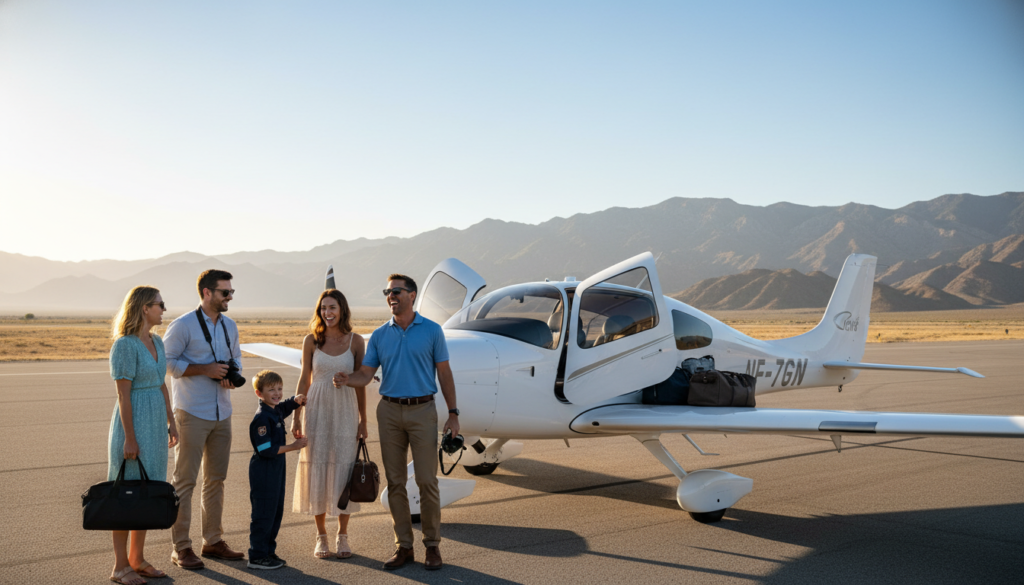
When someone asks, “Can you take us up this weekend?” it feels exciting, like the Top Gun theme song. But then you realize, it’s not just about flying. You now own responsibility, good habits, and a schedule full of early mornings.
Becoming a pilot feels less like just a cost and more like a new way of life. It’s not just about the plane price at flight school. It’s about the prep work needed to ensure your passengers have safe, fun stories to tell.
Instruction can cost you $1,000–$2,500, taking up 10–25% of your budget. Rates vary from $35–$75 an hour. But what many don’t talk about: costs can go up even when the plane’s not flying.
Instructors might spend around an hour on pre-flight briefings and another 30–60 minutes debriefing after. Some might charge just for the time in the air, while others include pre- and post-flight time. Always check if their fee is separate or included with the aircraft fee. After all, understanding a detailed invoice is part of being grown-up.
| Cost Item You’ll Feel Before Passenger Selfies | Typical Price Range (USD) | What Drives the Cost | Why It Matters When You Carry People |
|---|---|---|---|
| Instructor time | $1,000–$2,500 | Hourly rate ($35–$75), plus pre-brief/debrief policies | Sharper decision-making; fewer “let’s just try it” moments |
| Written exam | $150–$160 | Testing center pricing | Forces real study instead of vibes and YouTube confidence |
| Checkride examiner fee (oral + practical) | $400–$500 (can be $650) | Local examiner rates and availability | Proves you can explain, plan, and fly under pressure |
| Aircraft rental for checkride | $250–$400 | Hourly aircraft rate and length (often a couple hours) | You’re evaluated in the same environment you’ll fly loved ones in |
| FAA medical (Third Class) | $75–$200 | AME pricing and region | Baseline fitness to solo and earn the certificate |
| Exam-related total (all-in) | $800–$1,000 | Written + checkride + aircraft time + odds and ends | It’s the gate between “student pilot” and “bring your family” |
The process to get your pilot’s license seems simple: pass a written, oral, and practical exam. But in reality, it’s a journey full of paperwork and a serious talk with yourself about standards. FAA fees start to feel like the entrance fee to a club where you’re trusted with lives.
There’s a big reason to improve and be consistent: taking your friends and family flying. You come prepared and no longer take shortcuts. The cost of a private pilot license is not just about money. It’s about earning the right to safely say, “Buckle up—I’ve got you.”
Flying for Business Trips
Business flying is like a spreadsheet that flies. It’s not about being cool, though it is. It’s about saving time and staying on schedule, even when things get busy.
Understanding the cost of a Private Pilot License (PPL) becomes a strategy, not just trivia. Training properly means better predictions, less redoing work, and maintaining progress. A good look at how long training takes and what it costs is key. This breakdown of PPL costs explains things in simple terms.
Flying schools typically say the best plan is to fly 2–3 times a week. Trying to fly just once a week is like joining a book club and hoping for the best. Then, as skills start to fade, costs go up because of repeated lessons.
Flying more can cost more each month but can reduce the overall cost by needing fewer refresher sessions. Skipping sessions seems cheaper at first, but it’s not. Many schools say about 30–50% of their students don’t finish, mostly because they don’t come in consistently.
| Training choice | What it optimizes | What usually happens to flight hour cost | Business-traveler trade-off |
|---|---|---|---|
| 2–3 flights per week | Skill retention and fewer repeat lessons | Often steadier because fewer “relearn” hours stack up | Harder scheduling, but the timeline behaves |
| Once per week (or less) | Short-term cash flow comfort | Tends to rise due to rust, extra patterns, and rechecks | Looks manageable, then quietly sabotages completion |
| Part 141 program | Structure, published syllabus, tighter estimates | Can be easier to project because benchmarks are tracked | Less flexible, more like corporate training (for better or worse) |
| Part 61 training | Flexibility and custom pacing | Can vary more based on instructor, weather, and pace | Great for odd schedules, riskier for cost predictability |
Choosing between Part 61 and Part 141 is about systems, not just feeling. Neither is always cheaper. Part 141 is like a well-organized manual; Part 61 is more like agile development. But watch out, as costs can increase unexpectedly with Part 61.
For managing costs, I prefer clear tactics: buying hours in bulk and having a strict schedule. Financing can shorten the timeline, potentially lowering total costs. But, be wary of high interest rates in flight-training loans.
FlyCarolina has teamed up with Pilot Finance, Inc. for finance options. Their goal is simple: train faster to keep skills sharp and lower costs by not needing to catch up.
Renting and Owning an Aircraft
Many start by renting from a flight school, swiping a card, and hoping for good weather. Renting seems simple at first. But in reality, it comes with rules such as arriving early and following the schedule strictly.
Choosing the right aircraft can affect how much you pay per flight hour. This choice also quickly impacts the cost of getting your private pilot license. For many, the Cessna 172 is the top choice because it’s reliable and common. However, more affordable options like the Cessna 152, Diamond DA20, or Piper Sport exist and can save money if they’re available.
Sometimes, going for the cheaper options can end up costing more. An older plane needing sudden repairs can delay your training. This delay can increase your pilot school cost due to needing extra practice flights and more time reviewing.
Advanced avionics like glass cockpits can make each flight hour pricier. Although they’re modern, they’re not always necessary for learning basic maneuvers. On the other hand, older steam gauges might be less expensive and help with learning fundamentals, depending on your future flying goals.
For renters, understanding “wet vs. dry” rates is vital. “Wet” means the cost of fuel is included, whereas “dry” means you’ll pay for fuel separately. If the plane uses 10 gallons of fuel per hour at $4 each, that’s an extra $40 per hour you’re spending on fuel alone.
| Cost driver | What it changes | How it can raise private pilot license cost | How it can lower pilot school cost |
|---|---|---|---|
| Trainer type (Cessna 172 vs. Cessna 152/DA20/Piper Sport) | Baseline flight hour cost and scheduling odds | Higher hourly rate or fewer available aircraft can slow progress | Lower-hourly models can cut the total bill if consistently available |
| Maintenance reliability | Training continuity and skill retention | Downtime leads to more “warm-up” flights and extra review time | Reliable dispatch keeps lessons tight and fewer hours get wasted |
| Avionics (glass vs. steam gauges) | Hourly rate and learning focus | Glass can cost more per hour even for basic maneuvers | Steam gauges are often cheaper and reinforce fundamentals |
| Wet vs. dry pricing | Whether fuel is included | Dry rates add variable fuel costs (e.g., 10 gph × $4 = $40/hr) | Wet rates make budgeting predictable and reduce surprises |
FlyCarolina gives an idea of minimum cost at $9,418. This includes 30 flight hours in a Cessna 172, 10 solo hours, and more. It shows how flight hour cost quickly becomes a big deal.
Their system lets you pay per flight, which helps keep the cost clear. Be cautious about third-party financing due to interest rates. Renting might seem straightforward, but owning means dealing with fixed costs and unexpected maintenance.
I see renting as a starting point, not a second choice. But remember, renting requires keeping track of rates, fuel policies, and which aircraft are available. In doing so, you’re basically running a small business for a while.
FAA Restrictions and Responsibilities
The FAA acts like the careful person in charge, not the bad guy. Think of them as a detail-focused accountant with a headset, checking if your flight plan is correct. These rules impact when you can fly, plus what getting a private pilot license costs.
Anyone can start learning to fly at any age. But remember, you need to understand algebra too. To fly solo, you must be 16. To get your private certificate, you must be 17. You also need at least 40 flight hours before you can take your test. However, most people need 60–75 hours due to weather, schedules, and how we learn.
Here’s something important about flight school: you must pass the FAA written test before your flying test with an examiner. The test includes an oral interview and a flying portion. It’s graded against specific standards that the FAA shares publicly, so everyone knows what to expect.
Now, let’s talk costs. You need a Third Class Medical to fly solo or get your certificate. This usually costs between $75 and $200. The full test includes written, oral, and flying parts. Failing any section means you might pay more for retakes or extra study time.
| Requirement or Cost Item | What the FAA (or process) Requires | Typical Range in the U.S. | Why It Affects Timeline and Budget |
|---|---|---|---|
| Minimum flight time | At least 40 hours before the private pilot practical test | 40 hours minimum; many finish at 60–75 hours | More hours usually means more aircraft and instructor time, which drives private pilot license cost |
| Solo age | Must be at least 16 years old to solo | Fixed requirement | Sets the earliest point you can log solo time toward the PPL cost plan |
| Certificate age | Must be at least 17 years old to become a private pilot | Fixed requirement | Defines when training can convert into the actual certificate |
| Medical (Third Class) | Required to solo and to obtain the private certificate | $75–$200 (example: $100) | One of the early FAA fees that can pause training if delayed |
| Knowledge test (written) | Must be passed before the practical test with an FAA examiner | $150–$160 | Failing adds delay and retest costs, increasing PPL cost |
| Checkride examiner | Oral + practical conducted by an examiner | $400–$500 average; can be $650 | A major cost spike near the finish line; common FAA fees-adjacent reality |
| Testing standards | Oral and practical must follow the ACS | ACS is publicly available at no cost | Clear standards help you study smarter, not longer, which protects private pilot license cost |
Here’s a tip that’s not in the ads: being prepared saves money. If I study what my instructor tells me, we use less time on review flights. This can make learning to fly a lot more affordable.
Simulators are helpful as well. They’re not a substitute for actual flying but can lessen the need for repeated lessons. The FAA’s goal isn’t to spoil your fun. They want to make sure your fun doesn’t lead to an accident, while you manage the costs.
Adding Endorsements
I see endorsements like gamers view DLC: optional, costly, yet a must-have once discovered. Unlike DLC, this upgrade boosts your safety and skill, not just your gaming prestige. Adding endorsements means more training, exams, and yes, paying more FAA fees.
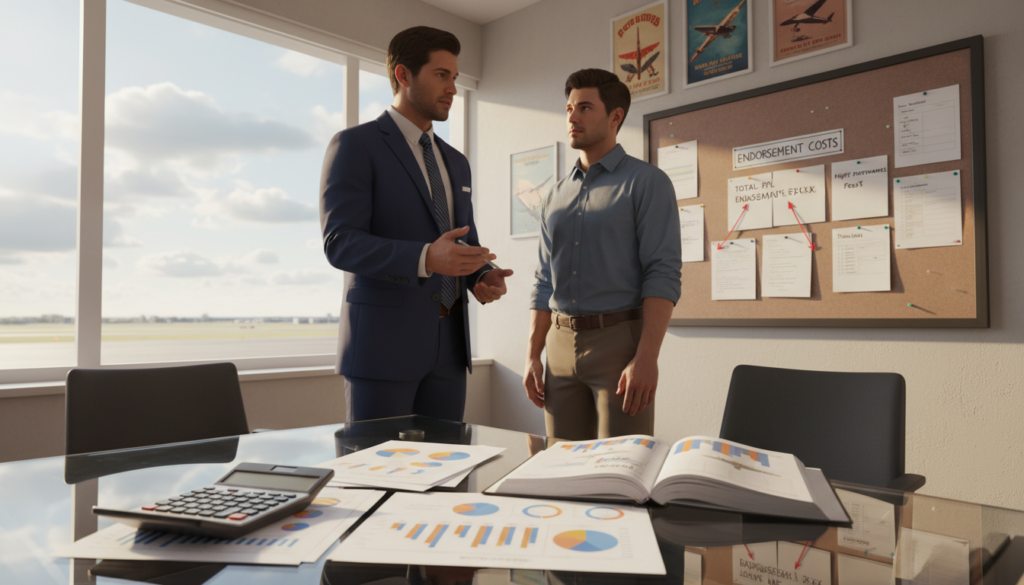
The biggest step is getting an instrument rating. Expect 40 extra hours flying and lots of ground learning. Your schedule will get as full as a loan statement. Pilots often set aside about $10,000 for this, but costs vary with weather, plane availability, and instructor’s time.
Why go through all this? For IFR privileges – flying in clouds or low visibility by trusting your instruments over your eyes. It’s tough like chess: needs patience, planning, and humility. Yet, mastering it feels incredibly rewarding as your flying precision improves.
After that, there’s the commercial certificate for earning from flying. Costs range from $2,000 to $5,000, based on previous achievements and how streamlined your training is. This step, too, reflects earlier decisions that can either ease or complicate future training, but won’t make it cheaper.
Then you must decide between Part 61 and Part 141. Part 61 suits busy adults with its flexibility, while Part 141 offers a structured, faster pace. Your choice affects accessing new ratings, completing stage checks, and managing FAA fees, with neither being the outright economical choice.
FlyCarolina suggests looking beyond the private certificate. The path includes Advanced ratings and teaching certifications. Rather than an endpoint, your PPL becomes a base for further growth, albeit with a cost for each new step.
- Time: more hours in the air and more study time on the ground
- People: more instructor time, plus an examiner when it’s checkride time
- Paperwork: more testing milestones and the related FAA fees
- Budget: pilot school cost that expands with each added privilege
| Upgrade path | What it unlocks | Training effort (typical) | Cost and fee pressure |
|---|---|---|---|
| Instrument Rating | IFR flying in clouds and low visibility; tighter precision and workload management | About 40 additional flight training hours plus substantial ground study and procedures practice | Around $10,000 is a common budget target; added examiner scheduling and FAA fees can stack |
| Commercial Pilot Certificate | Ability to be paid for flying under the right rules; a key step toward aviation jobs | Depends on prerequisites already completed; focus shifts to standards, maneuvers, and professionalism | Typically $2,000–$5,000; pilot school cost rises with aircraft time, instructor prep, and FAA fees |
| Multi-engine training | Complex aircraft systems, engine-out handling, and broader career flexibility | Higher workload and systems knowledge; training pace depends on aircraft access and proficiency | Often higher hourly aircraft costs; PPL cost can feel distant as the hourly burn rate climbs, plus FAA fees |
| Instructor ratings (CFI, CFII, MEI) | Teaching privileges; a common way to build hours and sharpen skills | Heavy on lesson plans, precision flying, and explaining “why,” not just “what” | More prep time and evaluation costs; pilot school cost becomes part training, part performance, plus FAA fees |
| ATP | Airline-eligible certification level and advanced professional standards | Structured, high-standard training and testing expectations | Typically the most intensive and expensive stretch; PPL cost is just the opening act, and FAA fees continue |
Joining Aviation Communities
I used to think aviation groups were just for hangar talk. Then I realized they’re much more. Community is the best way to control flying costs. It turns the scary cost of pilot school into a problem we can solve together.
Looking at the cost for a private pilot license can be daunting. AOPA helps a lot by showing scholarships and resources. They offer a Student Pilot Trial Membership, making things less confusing. And yes, this support helps people finish their training faster.
Scholarships are great, but there’s more to it. It’s about meeting deadlines and getting feedback. Meagan Huerta got a $3,000 scholarship from AOPA during a conference in March 2021. She kept raising money by washing planes and selling art. It shows you can tackle flight costs with hard work, not just hope.
Madison Seymour got her pilot certificate at 17 using AOPA scholarship funds. She later got a scholarship from professors at Embry-Riddle. Her advice? Be yourself, apply a lot, and treat applications seriously. Also, be honest and do your research.
- Apply frequently so a rejection doesn’t stop you.
- Personalize each application—generic answers won’t work.
- Be professional because the aviation field loves standards.
Not sure about committing? Communities offer easy ways to start. FlyCarolina offers a 1-hour flight for $250. You can fly the plane and ask questions. It’s a good way to check things out before diving into the costs of getting a private pilot license.
Flight schools can be like communities too. Aviator Zone Academy in Miami started small in 2018. By 2021, it was awarded for being the best flight school in the Southern region. It grew to have more instructors and planes. This shows how good support can save you from costly mistakes.
| Community path | What it gives you | How it helps manage money | Real example |
|---|---|---|---|
| Aviation associations | Mentors, study habits, safety culture, scholarship info | Reduces restarts and aids in budgeting for flight training | AOPA scholarships and Student Pilot Trial Membership |
| Scholarship networks | Funding, deadlines, application tips, confidence boost | Lowers the cost of getting a private pilot license | $3,000 AOPA Student Pilot Scholarship from Women in Aviation International (Meagan Huerta) |
| Flight-school ecosystems | Help with dispatch, maintenance, and consistent teaching | Saves time and prevents unexpected fees | Aviator Zone Academy’s success and 2021 AOPA award |
| Intro flights and local airports | Easier starts and straight talks with instructors | Avoids early mistakes and extra costs | FlyCarolina’s 1-hour intro flight for $250 |
Community might seem like a light word, maybe just fun coffee talks. But it’s actually very practical. By pooling knowledge, you avoid big mistakes. This way, the costs of pilot school and flying become manageable, not frightening.
Inspiring Private Pilot Stories
The cost of a private pilot license isn’t just one big number. It’s made up of many choices, like each lesson or weather delay. Plus, there are always FAA fees to consider. This makes the cost more like a habit you build over time.
Felipe Santiago started young because money was tight. At 12, he worked at a flight school, doing things like washing planes. In return, he got flying time in a Cessna 150. This work-for-flight time idea grew into Aviator Zone Academy in Miami by 2018. By 2021, the academy won an award for being the best flight school in the Southern region.
Ben Templeton found a unique way to earn his flight funds. He worked on landscaping at Triple Tree Aerodrome in South Carolina. It’s a place that makes aviation feel special. Later, he flew a tour of 48 states to promote general aviation. He also gave over 40 kids a ride in a Boeing Stearman biplane. He shows us that paying for a PPL can be about effort, not just money.
Madison Seymour and Meagan Huerta took another approach: scholarships and hard work. Seymour got her license at 17 using AOPA scholarships. Then she got more support from her professors at Embry-Riddle. Her advice? Apply early and be yourself. Huerta sold her motorcycle and art to pay for training. She also got a scholarship from Women in Aviation International. Later, she washed planes for more flying opportunities. These stories show the private pilot license cost isn’t just about money. It’s about finding smart, small ways to meet your goals.