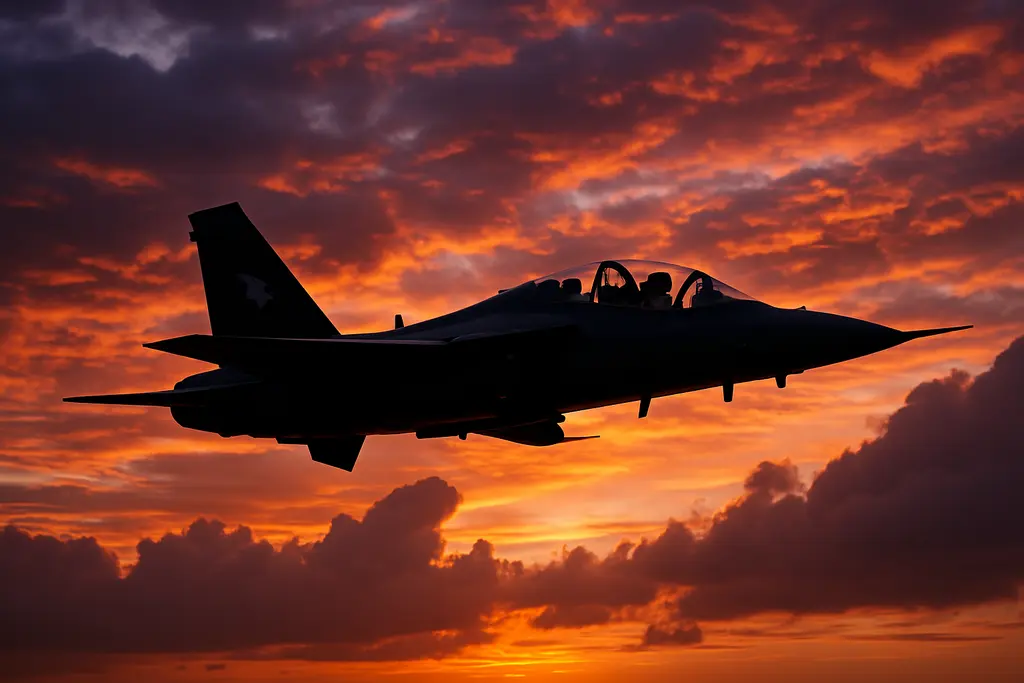
Confirmed: The T-7A Red Hawk took a practical step forward for Air Education and Training Command on September 16, 2026, when AETC executed its inaugural live-virtual-constructive capability flight between one live APT-4 aircraft and two ground-based simulators. For flight training professionals, the important point is not simply that a new jet flew with simulators. The training value sits in how live aircraft, virtual cockpits, and computer-generated threats were tied into a single instructional event that instructors could shape, observe, and repeat.
As an instructor, I judge new training systems by one question: does the tool help a student build judgment before risk increases in the aircraft? Live-virtual-constructive integration, often shortened to LVC, is promising because it can place students in tactical situations that are hard, expensive, or unsafe to build with live assets alone. Confirmed reporting from AETC said the September 16 event used secure high-bandwidth tactical data links to exchange flight parameters, weapon employment, and sensor sweeps between the airborne jet and simulator cockpits, while students on the ground could act as virtual wingmen or adversaries against the live aircraft AETC LVC report.
What T-7A Red Hawk LVC Changed
What T-7A Red Hawk LVC Proved
Confirmed: the September 16, 2026 flight demonstrated more than simulator connectivity. AETC reported that constructive threats could be injected into both the live and simulator environments in real time. Those threats included surface-to-air missile rings, electronic warfare jamming, and simulated adversary aircraft. In training terms, that matters because the same event can put one student in the air, place another in a ground-based cockpit, and expose both to the same tactical picture without launching a full adversary package.
That is why the T-7A Red Hawk event should be viewed as a training architecture milestone rather than a stand-alone demonstration. A live sortie has always carried high instructional value because the aircraft, weather, communications, workload, and physical sensations are real. A simulator has always offered repeatability and controlled failure injection. LVC connects those strengths. The instructor can create a contested environment, see how the student reacts, and reset parts of the event without depending entirely on airborne support aircraft or range availability.
Why Constructive Threats Matter To Learning
Confirmed: AETC described the event as validating the technical foundation required to modernize the undergraduate pilot training syllabus. The phrase “technical foundation” is worth unpacking from a training standpoint. It means the system can support a learning model where students face representative threats earlier, with instructor control and replay potential. The value is not entertainment-style immersion; it is better timing, better cueing, and better correction.
In a traditional progression, many threat reactions are first introduced through classroom discussion, static diagrams, part-task trainers, then simulator events, and eventually live flying. LVC shortens the distance between those steps. A student can brief a tactical problem, fly it in a simulator as a supporting player, watch how the live aircraft responds, and then rotate into another position later. For training teams building competency-based lessons, that provides richer evidence than a single checkride-style snapshot. Readers tracking how digital tools support competency-based aviation instruction may find the related discussion on pilot training technology for CBTA useful here.
Training Devices And Fleet Scale
The Planned Aircraft And Simulator Mix
Confirmed: published Department of the Air Force acquisition documentation lists the T-7A Advanced Pilot Training System planned inventory as 351 aircraft and 46 training devices to replace the T-38C Talon trainer fleet Air Force acquisition report. Those numbers matter because LVC training only becomes an everyday instructional method if the aircraft and ground-based devices are fielded as a connected system, not as separate purchases that happen to share a name.
Market-analysis: the scale of the planned system suggests AETC has treated the ground-based training environment as part of the aircraft program rather than an accessory. That is the correct approach for modern military pilot production. If a syllabus expects students to learn sensor management, threat reactions, formation contracts, and tactical communication before they reach an operational conversion course, the simulator cannot remain a low-fidelity rehearsal room. It must be a networked classroom, mission trainer, and assessment station.
Instructor Preparation And Simulator Fidelity
Confirmed by the research record: in September 2026, the first instructor class completed a 31-day simulator course on the ground-based training system at JBSA-Randolph. The same research notes state that the ground-based simulators feature 8K high-fidelity imagery, including displays and projected visuals, and support Integrated-Live, Virtual, Constructive training. Those details are relevant because instructor confidence often decides whether a new training tool is used well or treated as a novelty.
A high-fidelity image system helps, but visual quality alone does not create training value. The stronger benefit comes from synchronizing cues across the live jet and simulated aircraft. If a student in a ground-based cockpit sees the same tactical situation as the pilot in the air, then the instructor can evaluate communication, timing, task sharing, and tactical discipline. Those are core fighter and bomber preparation skills. For readers interested in the broader training-media side of synthetic visuals and video delivery, Internet Video Magazine provides insights related to digital media topics across the same network.
How LVC Changes Instructor Workload
Better Scenario Control, Higher Debrief Value
Analysis: LVC raises the instructor’s responsibility as much as it raises the student’s training opportunity. A poorly designed scenario can overload a student without producing useful learning. A well-built scenario gives the student a clear objective, a manageable threat picture, and measurable decision points. The instructor must decide which variables are live, which are virtual, and which are constructive. That design choice affects everything from radio discipline to fuel planning and task prioritization.
For example, constructive surface-to-air missile rings can train threat respect without placing a student near an actual live-fire environment. Simulated adversary aircraft can force a formation to communicate and maneuver against a thinking problem without the cost of launching every player. Electronic warfare jamming can teach students to recognize degraded information and keep flying the mission instead of freezing at the first sign of system uncertainty. These are not shortcuts around airmanship. They are structured ways to build judgment before the student meets the same pressure in a higher-stakes live environment.
- Confirmed: the September 16, 2026 event linked a live aircraft with two ground-based simulators.
- Confirmed: simulator students could operate as virtual wingmen or adversaries.
- Confirmed: constructive threats were injected into the live and simulated environments in real time.
- Analysis: the strongest training gain is earlier exposure to tactical decision-making under instructor control.
Assessment Moves Beyond Aircraft Handling
Opinion based on training practice: the most useful LVC events will not be judged only by whether the student flew the aircraft smoothly. Aircraft control remains non-negotiable, but tactical aviation demands more. Instructors need to see whether a student cross-checks sensors, listens to the formation, responds to changing threats, and communicates before small errors become mission-level problems.
LVC gives instructors a better record of those behaviors. If the system captures the live aircraft state, simulator actions, weapon employment, sensor sweeps, and constructive threat timing, the debrief can move from “what did you see?” to “here is what happened at this exact moment.” That style of evidence-based debriefing is where modern pilot training gains depth. It also protects students from vague feedback. Clear event reconstruction helps them connect choices with consequences.
Risks And Limits In LVC Pilot Training
Connectivity Is Not The Same As Proficiency
Analysis: a connected training system does not automatically produce better pilots. The syllabus, instructor standardization, event design, and debrief discipline still decide the outcome. If the training team adds too many threats too early, students may learn to chase symbols instead of thinking tactically. If the system is used only to create impressive scenarios, it will miss its best purpose: building repeatable decision-making skills.
The transition from simulator to aircraft also requires care. Research notes state that synchronized synthetic environments can improve immersion, realism, and ease of moving from simulator work to flight. That is useful, but instructors should still verify that students are not overfitting to the training device. A student who performs well in the simulator must still manage aircraft feel, weather, physiological stress, and live communications in the aircraft. LVC should support that transition, not replace the instructor’s judgment about readiness.
Open Architecture Needs Training Discipline
Confirmed by the research record: the aircraft has been described as digitally native and open architecture, with fly-by-wire controls, high-fidelity crew stations, and scalable mission systems. Those design choices support growth as threats and mission demands change. Training leaders still need disciplined configuration control. If scenarios change too often without clear objectives, data comparison between student cohorts becomes harder.
In practical terms, squadrons should protect standard scenarios for baseline assessment while allowing advanced events for development. The baseline events show whether students meet the required standard. The advanced events stretch their thinking after the basics are reliable. That balance is familiar to any good instructor: train the standard first, then increase pressure with purpose.
T-7A Red Hawk Training Takeaways
Confirmed: the September 16, 2026 AETC flight showed that live aircraft, ground-based simulators, and constructive threats could operate together in a shared training event. Analysis: the training significance is strongest for tactical judgment, not merely technical display. Students can be placed in richer mission settings earlier, instructors can observe more decision points, and debriefs can be tied to synchronized evidence.
For flight schools and military training organizations watching the T-7A Red Hawk program, the lesson is clear: technology matters only when it is tied to instructional design. LVC integration can give instructors better tools, but the hard work remains familiar—define the objective, control the workload, observe the behavior, and debrief with evidence. The September 2026 event was a meaningful step because it connected those principles to a real aircraft and real training devices, giving AETC a practical foundation for the next phase of pilot education.