Many call being a CFI “hour-building purgatory.” That’s not the whole story. Sure, you need 1,500 hours for your ATP certificate. And teaching is a common way to rack them up without going broke.
The story on flight instructor pay is interesting. By 2026, they might earn $35–$55 an hour. This means they could make $45,000–$65,000 a year. That’s not just pocket change.
The salary growth for CFIs is also promising. Beginners might start around $46,066. Those with 8+ years experience can make up to $78,906. You won’t get rich overnight, but you will see progress.
Where you teach affects how much you make. For example, in South Carolina, CFIs earn about $64,049 a year. But salaries vary greatly depending on the location. It’s a different game in different places.
Looking at the bigger picture is important. The median pay for airline pilots is about $226,600 a year. For commercial pilots, it’s around $122,670. These are goals to work toward, not immediate rewards.
The demand for pilots is increasing, too. Boeing thinks we’ll need 649,000 new pilots in the next 20 years. That means skilled instructors are crucial. They’re not just logging hours, they’re shaping the future.
Improving Your Skills as You Teach
Teaching is a tough test in aviation. If I can make a steep turn easy to understand, I’ve got it. If not, the plane and student will immediately show it.
Being a flight school instructor is unique. You can’t just know a move; you need to tell it as a story. If you’re not clear, mistakes happen, like losing altitude or speed.
At a big place like ATP, things are more organized than improv. It focuses on standardized airline-oriented procedures. This leads to better briefings and safer flying.
Good teaching also means better pay. At ATP, instructors earn more by teaching flights, classes, and simulators. Do well, and you’ll see it in your paycheck.
Instructors’ pay can be complex, but it’s all about what you bring to the table:
| Pay Piece | What It Rewards | Why Teaching Skill Moves It |
|---|---|---|
| Annual Income = (Hourly Rate × Monthly Credit Hours) × 12 | Consistency and volume | Clear lessons lead to more stable hours. |
| Per diem | Time on duty | Planning well reduces problems and helps keep schedules. |
| Bonuses (ex: checkride pass) | Preparing students well | Better debriefs and tracking can increase pass rates. |
| Extra streams (ground and AATD) | Teaching off the plane | Effective teaching works in the classroom and simulator too. |
The place you teach affects your skills. Part 141 schools have more rules and paperwork but offer stability. Instructor pay there might range from $30–$45, often with benefits.
Teaching independently under Part 61 can bring in $45–$75. But you deal with weather, cancellations, and self-promotion.
Regardless, cleaner processes mean it’s easier to show you’re reliable. And in flying, being reliable pays off.
Gaining Confidence & Air Sense
Teaching has an odd benefit: getting paid to practice making good choices until it’s nearly dull. Every flight pattern becomes a repeat episode, but with new surprises like wind changes and radio chatter. Your brain quickly learns to catch issues before they arise thanks to this repetition.
And yes, being a flight instructor won’t make you rich. But the real reward is making decisions nonstop. You plan, observe, step in when needed, then review and start over. It’s through this routine that confidence builds, not during flashy moments.
Having confidence is crucial, especially with the current demand for pilots. Boeing says we’ll need 649,000 new pilots in the next 20 years, with a shortage of 24,000 by 2026. With such high demand, being a calm and sharp instructor gets noticed by schools and airlines.
As the pressure mounts, regional airlines have upped pay by 15–25% to attract pilots. This raises the stakes in every planning session. When instructor salaries fall short, turnover increases, leading to tighter schedules and frustrated students.
There’s also an unspoken hierarchy. The 1,500-hour rule means ATP-certified instructors can earn way more. Having the authority to sign off on pilots is rare. So “building hours” becomes about enhancing skills, gaining trust, and developing resilient confidence.
| What teaching repeats daily | How air sense shows up | Why it ties to job demand |
|---|---|---|
| Pattern work, landings, go-arounds, and crosswind corrections | Earlier recognition of drift, sink, and unstable approaches | More consistent performance under time pressure makes hiring easier to justify |
| Brief–fly–debrief loops with tight feedback | Faster pattern recognition and cleaner decision trees | Stronger training outcomes matter when schools race to meet demand |
| Sign-offs, endorsements, and risk calls in real time | Confidence rooted in standards, not bravado | Higher responsibility can align with higher CFI earnings in a tight market |
| Managing student workload, radios, and airspace | More mental bandwidth for “what’s next?” thinking | Airlines paying more want fewer surprises, which raises the bar beyond flight instructor salary alone |
Building Hours and Networks
Working as a flight school instructor is not all about exciting stories in the sky, but rather like managing a detailed budget. Each flying lesson adds up in your logbook, helping you reach the 1,500-hour requirement for ATP. In a field where jobs are waiting, the right school turns every minute into a step towards your career.
The goal with ATP is clear: get to 1,500 hours within 18–24 months. This is because time is of the essence in aviation. The faster you accrue hours, the quicker you can get interviews, job offers, and move up the ranks at airlines, where seniority is key.
What really matters is flying consistently. ATP’s report of over 600,000 hours flown last year indicates a bustling student body and minimal downtime. This regular flying schedule is not only good for logging hours but also for meeting individuals who could recommend you during hiring surges.
| What You Track | Typical Monthly Snapshot (ATP example) | Why It Matters |
|---|---|---|
| Flight instruction time | About 70 hours | Directly builds up your experience and aids in reaching 1,500 hours steadily |
| AATD simulator time | About 20 hours | Enhances training with structured practice and helps make your training schedule predictable |
| Checkride passes supported | About 2–3 per month | Indicates the quality of your instruction and helps you get referred within the network |
| CFI pay (monthly) | About $3,200–$4,000, depending on the training center | Makes building hours financially viable and allows for financial planning |
Networking is the secret advantage that’s not often talked about. ATP showcases partnerships with airlines like Spirit, Frontier, Avelo, and Sun Country, as well as the Delta Propel Pilot Program for a quicker path. Simply put, as you fly more, you meet more people, and job opportunities become real chances instead of just news.
Career Benefits in Aviation
People always ask about flight instructor salaries early, like unexpected bumps during a smooth flight. But being an instructor is the first step toward the salaries that airlines compete to offer. The Bureau of Labor Statistics shows why: commercial pilots earn about $122,670, and airline pilots, including copilots and flight engineers, around $226,600.
If you’re curious about what instructors make, check this flight instructor pay guide. It gives a good starting point. Then, consider the climb up the airline career ladder, where the pay improves significantly.
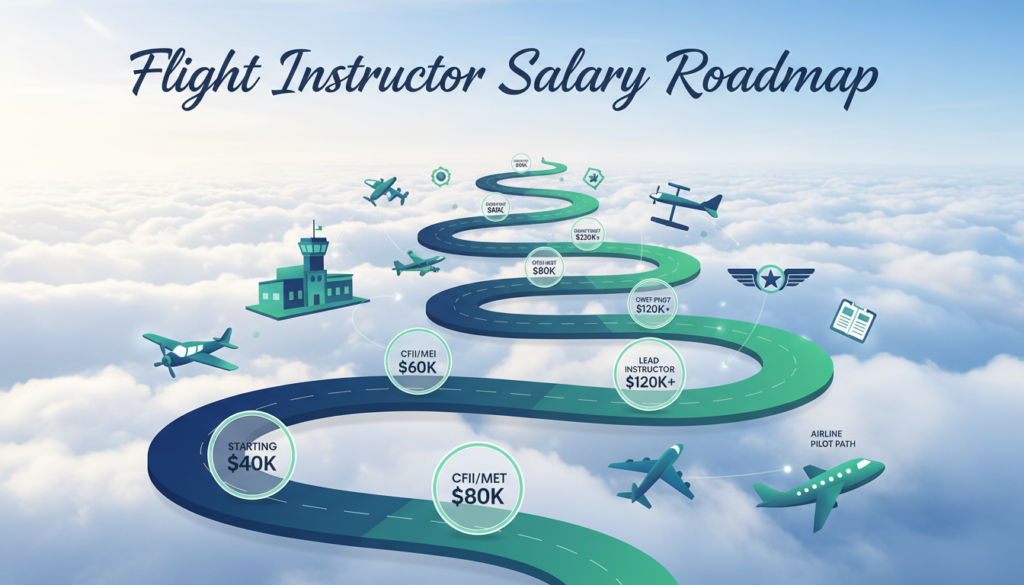
There’s talk of a 2026 career path that intrigues many in aviation. It starts with modest earnings as a Certified Flight Instructor (CFI). Then, your income jumps when you switch from instructing to piloting a jet.
| Stage | Typical role | Hourly rate | Monthly credit | Projected annual range |
|---|---|---|---|---|
| Stage 1 | CFI (time-building, multi add-ons, checkride prep) | $35–$55/hr | 80–100 | $45,000–$65,000 |
| Stage 2 | Regional First Officer (example: SkyWest package) | $95–$115/hr | 75 | $95,000–$130,000 (SkyWest cited ~$90,000–$100,000 first year) |
| Stage 3 | Major airline First Officer (example: United new-hire) | $160–$240/hr | 75 | $180,000–$260,000 (United cited ~$120–$120.69/hr; first year often $110,000+) |
| Stage 4 | Major airline Captain | $350–$480/hr | 75 | $380,000–$700,000+/year |
But there’s more to the story than just the pay. Major airlines also contribute up to 16% to a 401(k) without you having to do a thing. For example, if you made $400,000, that’s $72,000 for retirement before any other perks.
And the initial instructor wages? They’re crucial. They give you the time, ratings, and choices for later. Instructing can also lead to leadership roles without the need to constantly travel. Opportunities like Training Center Flight Standards Instructor and Regional Flight Standards Instructor show how teaching skills can open doors.
So, starting as a CFI might seem small, but it’s only the beginning. Your salary as an instructor is just the start. What matters more is learning how airlines operate, building standards, and setting yourself up for bigger moves later.
The Reward of Student Success
As a flight school instructor, I don’t just count the hours. I see success in students mastering difficult maneuvers, making clear radio calls, and being confident. To me, seeing students excel is the real measure of achievement. It proves I am helping them improve, not just logging hours.
Real victories are those you can measure. Like high pass rates, students being fully prepared for checkrides, and consistent teaching. Seeing a student handle a checkride without panicking is proof our teaching works. Plus, being dependable can boost your career, almost like being talented.
Schools keep track of these achievements because it helps their business, and they reward instructors for it. At ATP, rewards include checkride pass bonuses and extra pay for being professional and reliable. This makes the pay for instructors feel more like a reward for good performance.
ATP also rewards instructors for tasks like knowledge test proctoring, giving training center tours, and even for student no-shows. It’s like getting paid for being organized and keeping students on track. If you manage your program well, the pay structure reflects that.
| Measurable outcome | What the student shows | Why it helps a flight school instructor | How it can affect CFI pay |
|---|---|---|---|
| Checkride readiness | Stable maneuvers, solid ADM, composed DPE day flow | Signals consistent training and good risk management | Supports eligibility for checkride pass bonuses at ATP |
| Standardized performance | Repeatable profiles, tighter tolerances, fewer re-teaches | Builds trust with chief pilots and scheduling teams | Can boost incentive-friendly metrics tied to reliability |
| Student engagement | Prepared briefs, fewer no-shows, faster knowledge gains | Shows you can coach habits, not just maneuvers | Connects to fees for knowledge test proctoring and student no-shows at ATP |
Doing well can lead to better opportunities within the school. ATP, for instance, has roles like Flight Standards Instructor for those who excel. This position offers an extra up to an additional $575 per month. It basically means better results can lead to better pay.
And with high job demand, your good track record can follow you. Schools know instructors move on to airlines, so they pay more to keep the best. Skyborne, for example, increased CFI salaries and added benefits to keep their instructors. High pay and benefits are their way of keeping talented instructors.
Flexible Schedules for Instructors
Flight instructing is marketed as “flexible,” almost like a drop-in yoga session. Yet factors such as weather, student availability, aircraft access, and economic considerations come into play. This can make a flight instructor’s salary feel more like a hard-won agreement than a regular paycheck.
Where you teach impacts your schedule and earnings significantly. The location can affect yearly income by 20–30%. In places where the weather allows year-round flying, pay tends to be higher. More flying days means more lessons, more hours billed, and better pay for instructors.

Let’s talk about the harsh realities of the math involved. In places with consistent weather, teaching more students can boost a CFI’s yearly earnings. Having fewer classes canceled means less lost income. After all, “nearly got paid today” isn’t something anyone wants to say.
How you schedule classes is crucial, too. Programs under Part 141 provide a more predictable flow of students and benefits. On the other hand, Part 61 independent work might offer higher earnings that fluctuate more. This difference becomes apparent when trying to plan your life based on the weather forecast.
| Path | Typical Hourly Rate | Schedule Reality | What It Often Means for Pay |
|---|---|---|---|
| Part 141 school | $30–$45/hr | More structured blocks, steadier student pipeline, clearer dispatch rhythm | More predictable instructor wages; flight instructor salary depends on volume and fewer weather gaps |
| Part 61 independent | $45–$75/hr | Client-driven calendar, more reschedules, demand swings with seasons and budgets | Higher peaks for CFI earnings; annual totals can vary with cancellations and student churn |
Flexibility is also influenced by the network’s size. For example, ATP’s nationwide presence in 87 places lets them adjust as demand changes. This means your training location and “ideal schedule” could shift with job assignments and student numbers.
While it’s true you might adjust your days and manage lesson loads, the real schedule is defined by your location, dispatch logistics, and student consistency. This reality is often overlooked in advertising, hidden beneath promises of “flexibility” and the allure of steady earnings.
The Joy (and Challenge) of Teaching
By lunch, I’ve tackled four roles: teacher, pilot, risk manager, and customer service rep. The highlight is when a student finally gets it. But aviation doesn’t care if I’m tired or overbooked.
CFI pay is tricky, with weather causing delays. Starting pay ranges from $25–$45/hr. But, there’s a catch. Schools billing only for Hobbs time means preflight briefs might not get paid. The CFI-to-CFI breakdown highlights how billing practices affect pay.
Gaining more certifications helps you climb out of low pay. Adding ratings means more money. Becoming CFII/MEI often boosts pay to $50–$85/hr. That’s because the training is tougher and standards are higher.
| Teaching lane | Typical hourly range | Why the market pays more |
|---|---|---|
| New CFI (core private/commercial) | $25–$45/hour | High competition, lots of similar résumés, weather-driven cancellations |
| CFII/MEI (instrument and multi) | $50–$85/hour | More complex risk decisions, tighter checkride standards, fewer qualified instructors |
| Multi-engine and advanced instruction | $75–$100/hour | Higher insurance expectations, higher aircraft operating costs, higher student urgency |
| Specialized premium-market instruction | $100/hour and up | Clients pay for efficiency, polish, and results under pressure |
Multi-engine training is top-tier because it costs more. It commands $75–$100/hr in many areas. High stakes and complexity mean fewer teachers. When demand surges, the need grows.
There are other ways to earn besides teaching by the hour. Corporate gigs can offer $75–$200/hr. Some clients even pay $200–$400/hr for urgent, liability-heavy training. This isn’t selling out. It’s market demand.
Still, pay can be uncertain with bad weather or cancellations. To counter this, I recommend digital courses. They can make $10,000–$100,000+ annually. A successful online course might earn $50,000–$200,000 each year. It’s stable, though less hands-on.
The work isn’t easy, but it can be fun. The best days? They end with a safer pilot. And there’s always more work to keep teaching.
Stories from Lifelong CFIs
I’ve met many pilots who see flying as a quick stop. They wait, log their hours, then move on. But others choose to stay. They realize that being a flight instructor is more than a step. On paper, the pay might look small. Yet, by gaining more qualifications and a good name, the job becomes a lasting career.
Leadership plays a big role in this. Total Aviation Staffing shows Chief Flight Instructors earn a lot more, with salaries between $100,000 and $120,000 a year. It’s a decent amount of money. For instructors who love both flying and managing, this can quickly change the game.
Being a Chief isn’t just about flying more. It involves managing courses, keeping records, planning, and following rules. Airlines really value this kind of work. It’s vital for their training teams where following guidelines is key. So, a higher salary can come from playing a bigger role in keeping everything running smoothly.
ATP’s career path is an example of growth without leaving. Their Flight Standards Instructor path offers mentoring and better skills. This leads to an extra $575 a month. Plus, ATP’s deal with SkyWest Airlines adds benefits like tuition help and more pay. Ultimately, you might aim for a major airline captain’s salary. Still, the journey offers many choices. An instructor can grow their career early on and decide whether to stay or move on later.